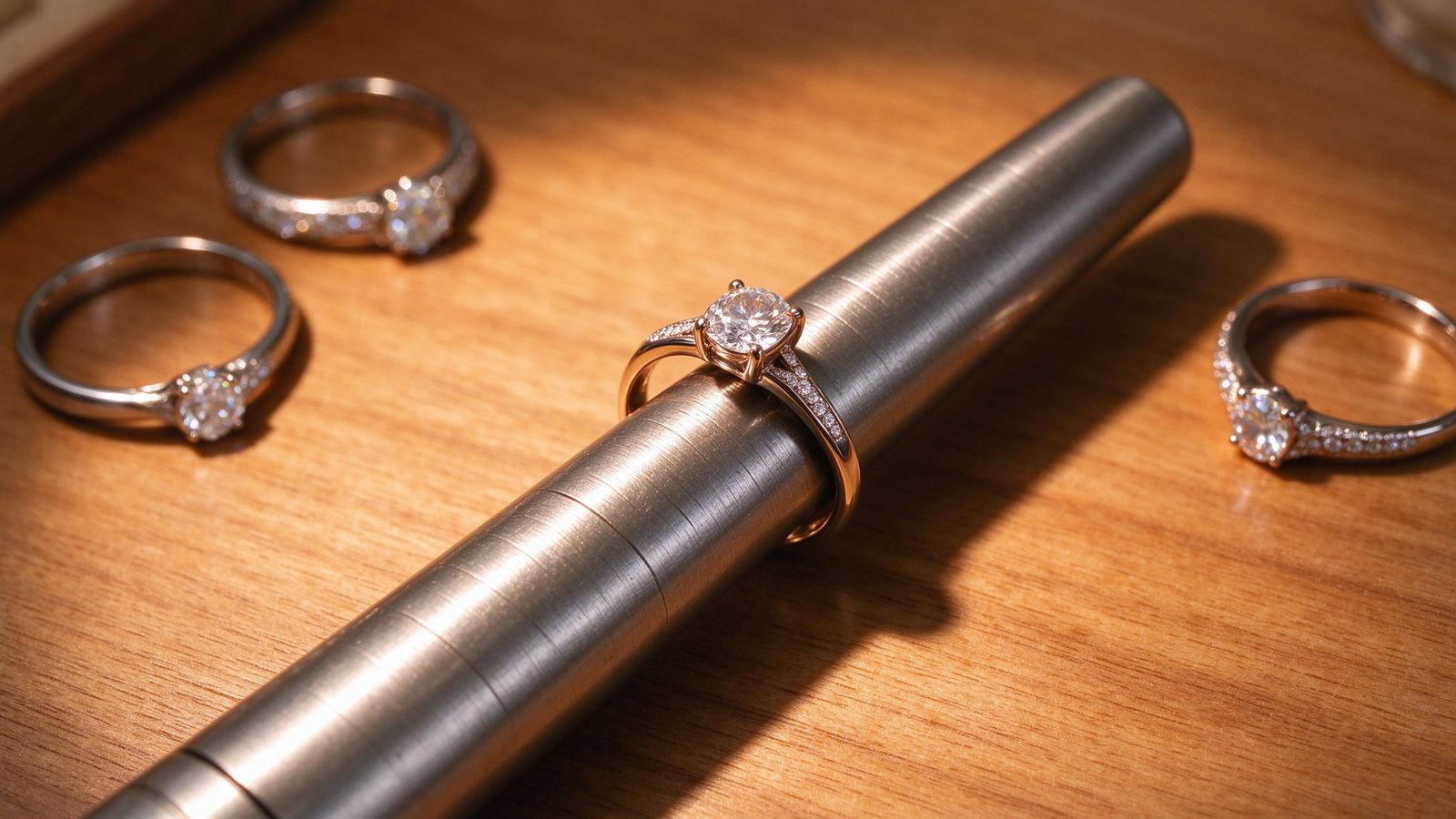
How to Choose a Wedding Band That Matches Your Engagement Ring
The engagement ring is the headline. The wedding band is the frame. Choose the band well and the two rings sit together like a single piece on your finger. Choose it badly and you spend fifty years looking at a gap, a mismatch, or two rings that fight each other. Most people treat the wedding band as an afterthought bought a month before the wedding. That is a mistake. The band should be chosen at the same time as the engagement ring, because its shape, metal, and width interact with the setting you already love.
This guide walks through how the two rings should fit together: flush versus curved bands, matching metals, width balance, and the popular options for halo, solitaire, and vintage-inspired settings. By the end, you will know exactly what to look for when you go to buy.
The First Question: Do the Rings Sit Flush?
When two rings sit next to each other on the same finger, they should touch along their whole side, with no visible gap. A plain straight band sits flush against a plain solitaire shank perfectly. But once the engagement ring has stones that curve down the shank, a halo, a cathedral setting, or raised prongs, a straight band will not sit flush; it will leave a wedge-shaped gap. That gap is the single most common complaint couples have about their ring set.
The solution is a contoured, notched, or curved band. A contoured band is shaped to wrap around the base of the engagement ring, so it touches along the curve. A notched band has a small cutout that clears a specific protrusion. A tapered band narrows at one end to slip alongside the setting. These bands are slightly more expensive than a straight band, but they are the difference between a set that looks intentional and one that looks like two random rings.
If you are buying the engagement ring and band together, ask the jeweler to design them as a matched set. A matched set is engineered so the band fits that exact setting, which eliminates guesswork. If you already have the engagement ring, bring it with you when you try on bands, so the fit can be checked on your actual hand.
Matching Metal and Color
The wedding band should be the same metal and color as the engagement ring. This is not a strict rule, but breaking it requires intention. A white gold engagement ring with a yellow gold wedding band is a deliberate mixed-metal look that works for some, but it can also look like a mistake if the two yellows and whites are not balanced. For a classic set, keep the metal the same: both platinum, both 18k yellow gold, or both rose gold.
There is a practical reason to match, beyond looks. Platinum and gold wear at different rates, and putting a platinum band next to a white gold band can wear the softer metal faster. Matching metals avoids that asymmetric wear. If you do choose mixed metals, expect the higher-maintenance metal to need attention sooner. Our metal guide explains the wear differences.
Rhodium plating is another subtlety. White gold engagement rings are rhodium-plated bright white. A matching white gold band should be plated at the same time, so both rings age together. If you re-plate one but not the other, the two rings will look subtly different for a few months. Plan to re-plate both together.
Width and Profile Balance
The band's width should relate to the engagement ring. A dainty 1.5mm solitaire looks odd next to a heavy 8mm man's band. A 1mm band next to a 2mm engagement shank looks whisper-thin. As a rule, the wedding band is slightly thinner than or equal to the engagement shank. Many brides choose a 2 to 2.5mm band to sit alongside a 2mm engagement ring. If the engagement ring is bold, a 3 to 4mm band balances it.
Profile matters too. A high-polish band next to a matte engagement ring can look mismatched. Choose the same finish: polished with polished, brushed with brushed, matte with matte. The details that feel tiny when you look at one ring become obvious when the two rings sit side by side. Our wedding band guide covers the full range of widths and finishes.
Band Styles by Engagement Setting
A solitaire pairs with almost anything. A plain straight band is classic. A pavé band adds glitter. A contoured band hugs the base. Because the solitaire shank is plain, most bands sit flush, which gives you the most flexibility.
A halo engagement ring needs a curved or notched band, because the halo protrudes. A straight band will leave a gap. Many brides choose a matching pavé band that echoes the halo, so the two rings form one continuous glittering surface. A plain band next to a halo can look too restrained by comparison.
A three-stone or vintage setting, with stones down the shank, often needs a custom contoured band designed around it. These sets are usually best bought together, because the shank already has stones that dictate the band's shape. If you buy a vintage-style engagement ring, budget for a matching band at the same time.
An eternity band, set with stones all the way around, is a bold choice that reads as a statement. It is beautiful but cannot be resized, so confirm the size carefully with our sizing guide. It also pairs best with a simple solitaire, because an eternity band plus a detailed engagement ring can look busy.
When to Buy the Band
The ideal time to buy the band is when you order the engagement ring, especially if you want a matched, contoured set. Buying both at once means the jeweler designs them together, and you avoid the gap problem. If the engagement ring is already a surprise, you can buy a temporary band for the wedding day and upgrade later, but most couples prefer to choose the real band together after the proposal.
Do not leave the band for the last week. Contoured and custom bands take as long to make as the engagement ring itself. Order the band at least two months before the wedding. If you want engraving or special stones, add more time. Rushing the band is how people end up with a plain band they do not love, because nothing else was ready.
What to Do If You Already Have the Engagement Ring
If the engagement ring is already on your finger, bring it to every band appointment. Try bands on the same hand, on the same finger, with the engagement ring in place. Look at the pair in a mirror from the top, not just from the side. Check whether the two rings rub, whether they rotate together, and whether the gap is acceptable. A small gap of a millimeter is normal; a gap that lets a fingernail slide through is not.
If the engagement ring cannot pair with a straight band and you do not want a contoured band, an alternative is to wear the wedding band on a different finger or as a stacking set on the right hand. But most brides want the two rings on the left ring finger together, which is why the contoured band exists. It is a small investment that saves decades of irritation.
Care for the Set Over Time
Once you have the matched set, treat the two rings as one. Clean them together, check the prongs together, and re-plate them together. When you resize one, resize the other. If the engagement ring's prongs wear thin, the band's edges may also need polishing. Taking the set in as a pair means it ages as a pair. Our care guides cover cleaning diamond rings and storing jewelry to prevent scratches.
Alternatives to a Matching Band
Not every bride wants a band that exactly matches. There are legitimate alternatives that still look intentional. A plain platinum band next to a yellow gold engagement ring is a modern mixed-metal choice that many stylists favor. A thin diamond eternity band worn on the right hand, rather than stacked, gives the sparkle without the fit problem. A vintage band inherited from a family member can sit alongside a modern engagement ring, and the contrast becomes part of the story. None of these are mistakes; they are choices.
The mistake to avoid is buying a band on price alone without trying it next to the engagement ring. A cheap band that leaves a gap will annoy you every day, and over years that annoyance adds up far more than the extra cost of a properly contoured band. If budget is tight, choose a simple contoured band in the right metal rather than a fancy straight band that does not fit. Fit beats sparkle.
Stacking More Than Two Rings
As marriages go on, many women add anniversary bands and eternity rings to the stack. Planning for that from the start makes later additions easier. If you imagine adding a third ring in ten years, choose an engagement ring and band pair that leaves room, or buy a set designed to stack. Thin bands stack more gracefully than wide ones. A 2mm band next to a 2mm engagement ring leaves a comfortable surface for a third 2mm ring. Wide bands stack poorly and can look heavy.
When you add a ring later, bring the existing pair to the jeweler so the new band is contoured to fit. The third ring should sit flush against the second, not float in a gap. Stacked rings that touch along their edges age as a unit, with even wear on all three. Rings that rattle against each other wear unevenly and loosen prongs faster. Our guide to building a jewelry collection includes how to plan for these later pieces.
Engraving and Personal Touches
The wedding band is the natural place for engraving: a date, coordinates, initials, or a short phrase. Engraving is done on the inside of the band, so it does not affect the outside fit, but it does remove a tiny amount of metal from the inner wall. Very thin bands under 1.5mm may not have room for clean engraving. If engraving matters to you, choose a band at least 2mm wide. Laser engraving is precise and fits longer messages; hand engraving has character but fits fewer letters.
If both partners are engraving their bands, keep the messages short and legible. Inside engravings are hard to read later if the letters are tiny. A date and initials age well; a long paragraph fades and becomes illegible. Plan the engraving before the band is made, because adding it later requires breaking the band's finish. Our bespoke process covers how engravings are added during production.
What to Check When You Try the Set On
When you finally try the engagement ring and band together, do not just glance and say yes. Look carefully. With your hand relaxed and flat, the two rings should sit side by side without rocking or tilting. Rotate your hand; the rings should turn together rather than grinding against each other. Check the gap at the top and at the bottom; on a contoured band, the fit should be even, not tight at the top and loose at the bottom. Run your finger along the shared edge; you should not feel a rough catch.
Look at the pair from across the room, not just at arm's length. The eye reads the set as one shape from a distance. If the engagement ring and band balance, the silhouette looks composed. If one ring dominates and the other disappears, the proportions are off. If the two rings look like they belong together, you have found the band. If they look like two separate ideas, keep trying. The right band often feels obvious once you slip it on.
Finally, move your hand the way you really move it. Type on a keyboard, grip a cup, wave your hand. The set should not catch, pinch, or rotate unexpectedly. A ring that looks perfect in a showroom and jabs you while typing is the wrong band. Wear the pair for at least ten minutes before you decide, and ask yourself whether you would forget you are wearing it. That is the test.
Designing a Matched Set With HOLYCOME
HOLYCOME, based in Henggang, Longgang, Shenzhen, designs engagement rings and wedding bands as engineered matched sets, so the two rings sit flush on your finger. Email us at service@holycome.com with a photo of your engagement ring or your chosen design, and we will model the matching band. If you are still choosing the engagement ring, our halo versus solitaire guide and our wedding band styles guide are the natural next reads.
The wedding band is not a backup singer. It is the half of the set that touches the engagement ring every day for the rest of your life. Choose it deliberately, in the same metal, in the right shape, at the right width. A matched set looks like one piece, and that quiet cohesion is what makes a ring set feel truly yours.