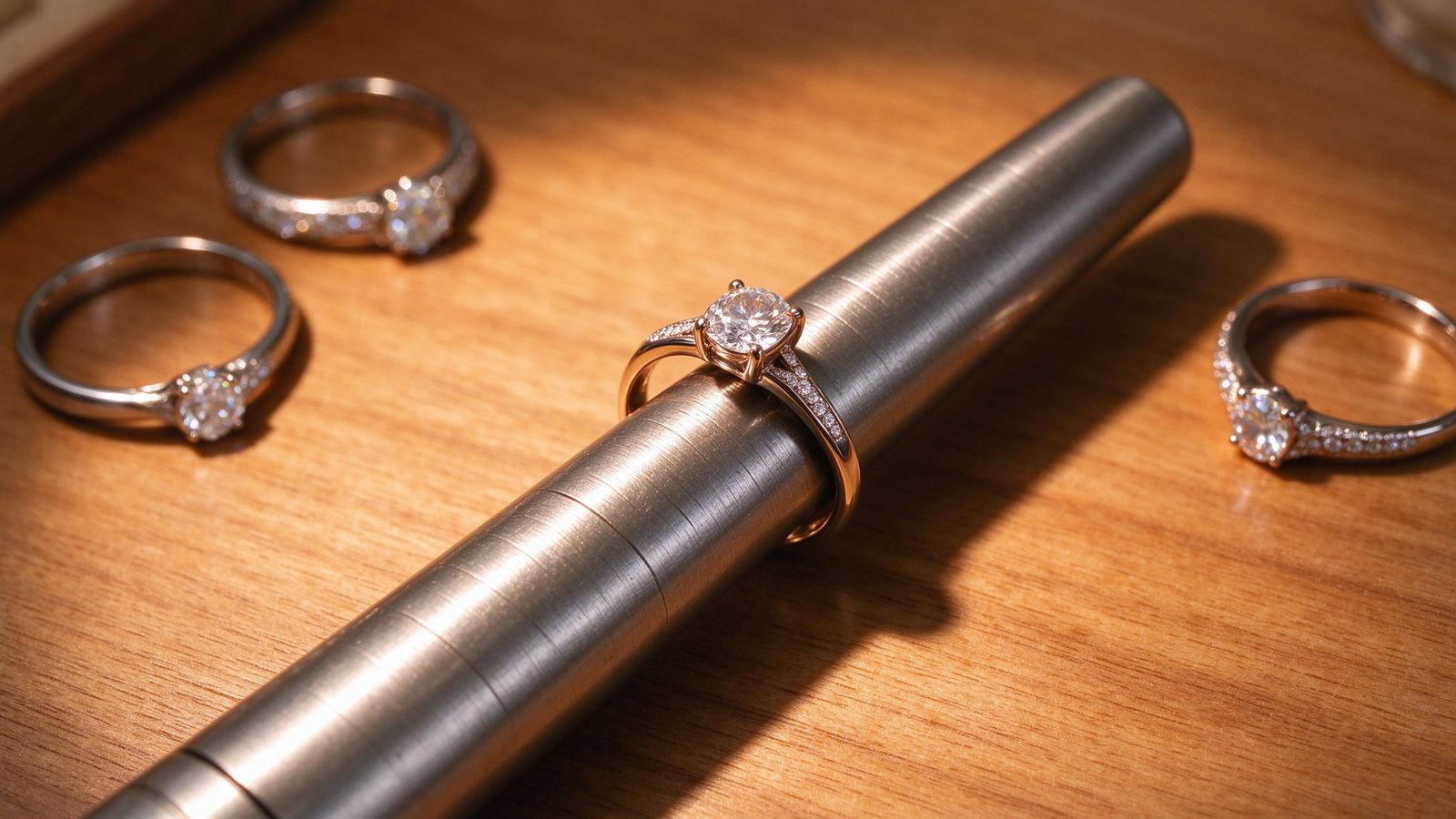
Ring Size Guide: How to Measure Your Ring Size at Home
Few moments in jewelry feel as deflating as sliding a beautiful new ring onto your finger only to watch it spin, twist, or refuse to pass over the knuckle. A ring that does not fit is not a minor annoyance. A loose ring catches on fabrics, slips off during a handshake, and eventually risks being lost forever. A tight ring pinches, leaves a mark, and can become genuinely painful by the end of the day. Yet most people guess their size, order online, and hope for the best. The good news is that you do not need a jeweler to get a close reading. You can learn how to measure your ring size at home with common household items, understand why the number shifts through the day, and order with confidence.
This guide walks through every reliable at-home method, explains why knuckles and temperature matter, lists average ring sizes by demographic, and tells you when an at-home measurement is close enough and when you should visit a jeweler. By the end, you will know exactly which size to order, how to handle a surprise proposal without spoiling the secret, and what to do when your fingers change size over time.
Why Ring Size Is Harder Than It Looks
A ring size is not a fixed number tied to your identity the way shoe size is roughly fixed. It is a measurement of the circumference of your finger at a moment in time, and that circumference moves. It expands when you are warm, hydrated, and have just eaten a large meal. It shrinks when you are cold, dehydrated, or exercising. A finger that measures perfectly at 10 a.m. in an air-conditioned room can feel loose by afternoon if you go for a walk and your hands swell, or tight if you fly across time zones and retain water.
Knuckles complicate things further. Many people have a knuckle wider than the base of the finger where the ring rests. For them, the ring has to be large enough to slide over the knuckle, which means it will feel slightly loose at the base. The solution is not simply to size up, because a band that clears a wide knuckle can spin uncomfortably. Instead, you balance the two measurements and, when needed, ask the jeweler about comfort-fit interiors or sizing beads that hold the ring in place without changing the overall size.
This is why professionals recommend measuring several times across different days and at different times of day, rather than trusting a single reading. The number you order should represent a comfortable middle, not the largest or the smallest your finger ever gets.
The String or Floss Method
The most accessible way to measure your ring size at home uses a strip of paper or a piece of non-stretching string. Wrap it around the base of the finger where the ring will sit, not the knuckle unless your knuckle is the deciding factor. Mark the point where the ends overlap with a pen, then lay the string flat and measure the length in millimeters with a ruler.
The result is the circumference of your finger in millimeters. Convert that to a ring size using a standard international ring-size chart. In the United States, a circumference of about 49.3 millimeters corresponds to a size 5, 52.2 millimeters to a size 6, 55.1 millimeters to a size 7, 57.3 millimeters to a size 7.5, and 60 millimeters to a size 9. In the United Kingdom and much of Europe, the same circumferences map to letter and numerical systems respectively, so always confirm which chart your jeweler uses before ordering.
Avoid elastic string, yarn, or ribbon, all of which stretch and give you a falsely large reading. Dental floss works well because it is thin and non-stretching, but it can cut into the skin if pulled tight. Paper strips roughly as wide as a ring band are ideal because they sit on the finger the way the band itself will.
The Paper Strip Trick for a Secret Measurement
One of the most common reasons people want to measure at home is that they are buying a surprise engagement ring and cannot simply ask their partner for a ring size. The paper strip method is perfect for this, but you need a ring that already fits. Borrow one of your partner's rings that they wear on the correct finger. Most people do not realize that ring size differs dramatically from finger to finger, and a ring worn on the index finger will not fit the ring finger.
Trace the inner circle of the borrowed ring onto a piece of paper, or press it into a bit of soft soap or clay to leave an impression. Take that trace or impression to a jeweler and they can match the inner diameter to a size. If you are measuring at home, measure the inner diameter of the existing ring in millimeters, then double it for a circumference and compare to a chart. A ring with an inner diameter of roughly 16.5 millimeters is about a US size 6, while 17.3 millimeters is a size 7.
Be careful with borrowed rings. If the ring is precious, keep it safe while you trace it, and return it exactly where you found it. A quick way to get caught is to leave a ring sitting on a kitchen counter where it never belonged.
How Temperature, Time of Day, and Body State Change the Reading
If you measure your finger first thing in the morning after a cold night, you will get a smaller number than if you measure it after a hot walk at lunchtime. Professionals recommend measuring in the late morning or early afternoon, when your body is warm but not overheated, and after you have been moving normally for a couple of hours. Avoid measuring immediately after waking, when fingers are often puffy, and immediately after exercise, a salty meal, or a long flight, all of which cause temporary swelling.
Weather matters more than people expect. In winter, fingers can shrink a half size or more. In summer heat, they expand. If you are ordering a ring to be worn year-round, measure in mild, neutral conditions and order the middle value. If the ring is a winter piece or a summer piece, you can bias slightly in either direction.
Hormones matter too. Many women notice their fingers swell in the second half of the menstrual cycle, during pregnancy, or while taking certain medications. If you are measuring during a known swelling phase, wait for a more representative week before committing to a size.
Average Ring Sizes by Gender, Age, and Region
Knowing averages is useful as a sanity check, but it is only a starting point. In the United States, the average women's ring size is roughly a US 6 to 7, with a size 6.5 or 7 being the most common single size. The average men's ring size is roughly a US 9 to 10, with a size 9.5 being common. These averages shift with population height and weight, and they vary by country. In parts of Asia, average sizes tend to run smaller; in parts of Northern Europe, they tend to run larger.
Height and hand size correlate loosely with ring size. A woman who is 5'4" with slender hands may wear a 5.5 or 6, while a woman who is 5'9" with larger hands may wear a 7.5 or 8. A man who is 5'6" may wear an 8.5, while a man who is 6'3" may wear a 10.5 or 11. But these are loose correlations. The only reliable number is the measurement.
For children's rings, sizes run from roughly US 1 to 5, and these change fast as a child grows. If you are buying a child a keepsake ring, consider choosing a slightly larger size or planning for resizing within a year.
Comfort Fit vs Standard Fit
When you order, the fit profile of the band changes what size feels right. A standard-fit band has flat inner walls and feels snug against the finger, so many people prefer a slightly looser measurement. A comfort-fit band has a rounded, domed interior that slides over the knuckle more easily, so it often feels a half size looser than a standard band of the same labeled size. Many jewelers will size a comfort-fit band slightly down to compensate.
Wide bands, especially those 6 millimeters or wider, also fit differently than thin 2-millimeter bands. A wide band covers more surface area and grips the finger more, so it often needs to be a quarter or half size larger to feel the same. If you are switching from a thin band to a wide wedding band, do not assume your old size will work. Test a wide ring on first, or ask the jeweler how they size wide bands.
When At-Home Measurement Is Not Enough
At-home methods get you into the right ballpark, usually within a half size, which is often good enough for a plain band that can be resized later. But for certain pieces, precision matters more. A wide eternity band set all the way around with stones cannot be resized, because cutting the band would damage the stones. A custom engagement ring with a channel set or a tension setting also resizes poorly. For these, an at-home measurement should be treated as a starting point, and you should strongly consider visiting a jeweler for a professional sizing before the piece is made.
If you are between sizes, the general rule is to size up for rings that will wear below the knuckle and spin, and to size down for rings that will sit tightly. When in doubt, sizing up is usually safer because a loose ring can be adjusted with sizing beads, while a ring that is too small may not go on at all. Talk to your jeweler about sizing beads or a temporary plastic ring guard if you are ordering a surprise and cannot get a professional measurement first.
What to Do When Your Size Changes After the Ring Arrives
If the ring you ordered is slightly off, do not panic. Most plain bands in gold, platinum, or silver can be resized up or down by roughly one to two sizes. The jeweler cuts out or adds a small section of metal, solders it closed, and re-polishes the joint. Eternity bands, rings with stones all the way around, and many titanium or tungsten rings cannot be resized at all, which is another reason to measure carefully for those designs.
For a ring that is only a little loose, a clear plastic ring guard or a small set of internal sizing beads can solve the problem without a jeweler. For a ring that is only a little tight and catches on the knuckle, a jeweler may be able to adjust the comfort fit or polish the inside to help it slide more easily. If the ring is more than two sizes off, professional resizing is the correct path.
Remember that your finger size is not permanent. Women especially notice size changes across pregnancy, weight shifts, and aging. A ring that fit perfectly in your twenties may feel loose or tight a decade later. Periodic re-measuring and occasional resizing are normal parts of owning fine jewelry, not signs that something went wrong with the original purchase.
Common At-Home Sizing Mistakes to Avoid
The most frequent mistake is measuring the wrong finger. The ring finger on the left hand is not the same size as the ring finger on the right hand, and your dominant hand is often a half size larger because it is more muscular. If you wear a ring on your right hand, measure that hand. If you are measuring a borrowed ring, confirm which finger it was worn on before you treat its size as universal.
The second mistake is pulling the string too tight. A string cinched into the skin gives a smaller circumference than the relaxed finger, which leads to a ring that feels tight once the string is released. The paper or string should sit snugly without indenting the skin. You should be able to slip a tiny bit of movement underneath it.
The third mistake is measuring only once. A single reading is a snapshot, and snapshots are unreliable. Measure on at least three different days, at roughly the same time of day, and average the numbers. If the readings vary by more than a half size, note that variation and talk to your jeweler about which average to use. The fourth mistake is ignoring the knuckle. If your knuckle is the widest point, measure both the base of the finger and the knuckle, and report both numbers. A skilled jeweler can design the band to clear the knuckle while sitting comfortably at the base.
Finally, do not measure yourself while wearing gloves, after applying hand cream, or with cold fingers straight out of a winter coat. Wash and dry your hands, warm them by rubbing them together for a minute, and then measure. Small details like this are the difference between a ring that fits the first time and one that needs a resizing trip.
Ordering From HOLYCOME: Sizing With Confidence
When you order a custom or made-to-measure piece from HOLYCOME, based in Henggang, Longgang, Shenzhen, our team works from your measured circumference and your notes about knuckle width, so the finished band sits where it should. We size both standard and comfort-fit interiors, and we are happy to walk you through the measurement by email at service@holycome.com before you commit. If you are building a matching set, read our guide to wedding band styles and sizing, and if you are still deciding on budget first, our engagement ring budget guide covers how size and design trade off.
The best ring is one you forget you are wearing, and that starts with a measurement that reflects your real finger on an ordinary day. Measure a few times, in comfortable conditions, average the results, and order the middle. Done right, your at-home ring size will be close enough that the only thing left to worry about is choosing the design you love.