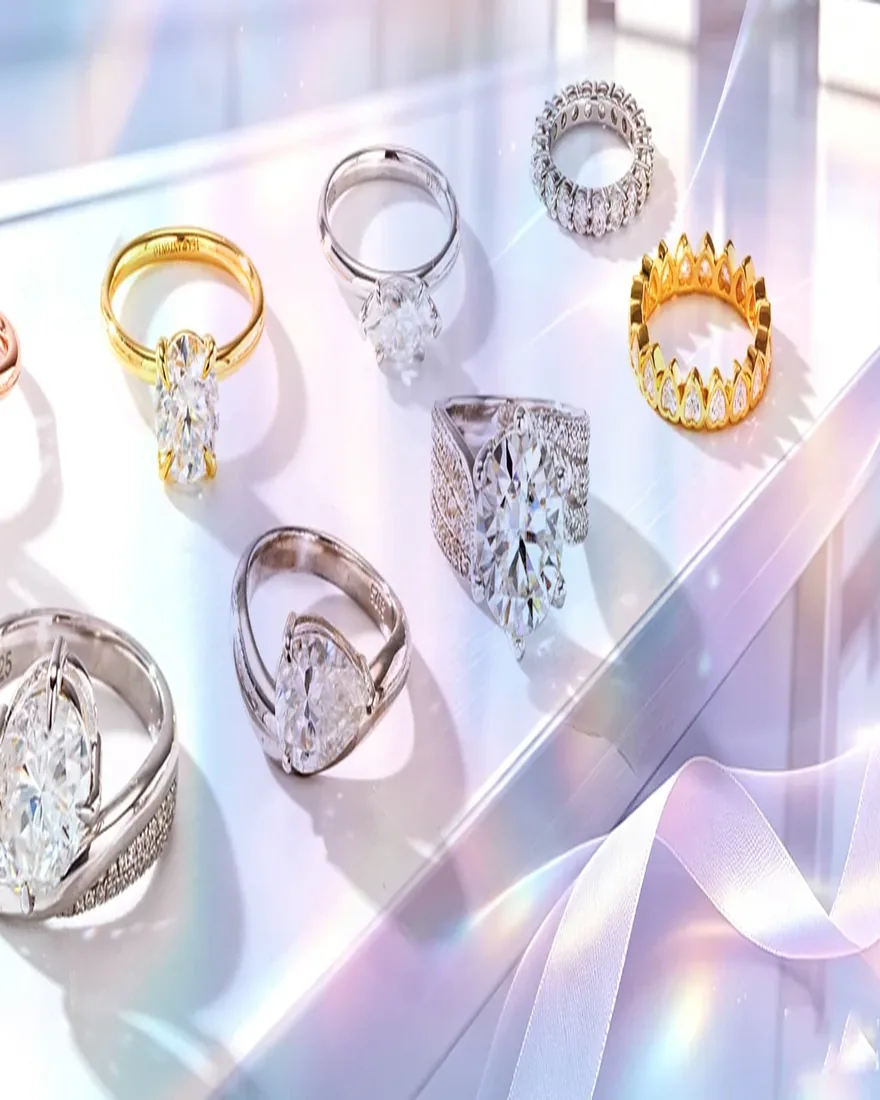
If you are reading this, you are probably deciding between a retail ring window and a bespoke commission. This guide walks you through every decision we help clients make, from the first email to the ring on your partner's finger.
Step 1: Decide what actually matters
Sit down and write three things: budget, timeline, and the one thing your partner loves. Is it size? Color? A specific era? A retail ring forces you to choose from what is in stock; bespoke lets you optimize for what you actually want.
Step 2: Choose the stone first
The stone is 50–65% of the cost. Compare moissanite, lab-grown and natural diamond honestly. We will not upsell you to a natural diamond if a lab-grown fits your life. We will also tell you if a 1ct D/VS1 is overkill for your partner's style.
Step 3: Choose the metal
Read our metal guide before you fall in love with a render. Platinum feels heavier and patinas; 18K yellow gold stays warm and light. The metal changes how the ring looks on skin tone.
Step 4: The render round
You get two render revisions. Use them. Change the shoulder width, the shank thickness, the head height. After casting, changes cost real money. We have seen clients change their mind at render — every time it was the right call.
Step 5: Wait six weeks
Here is the honest week-by-week timeline. Most clients check WhatsApp twice a day. That is normal.
Step 6: The proposal
We ship insured to your door. One free resize in the first year. If it does not fit, we fix it — no awkward resizing trips to a local jeweler who did not make the piece.
Ready to start? Tell us your idea and budget. We reply within 2 hours on weekdays.
Setting a realistic budget
Before picking a design, split your budget the way a bench quotes a ring: stone, metal, setting labor and finishing. The stone usually takes the largest share, but a detailed setting with shoulder stones or a heavier band can move a meaningful portion of the cost into workmanship. Writing these four lines down first keeps the commission focused, because a render that looks affordable on screen can hide metal weight and stone count that appear only at the CAD stage.
| Cost part | Typical share | What affects it |
|---|---|---|
| Center stone | Largest share | Stone type, carat, color and clarity |
| Metal and weight | Moderate | Metal type, band width, thickness |
| Setting labor | Moderate | Detail, side stones, engraving, finish |
| Finishing and report | Smaller | Plating, polishing, certification |
If a target number feels tight, the earliest place to adjust is usually the center stone rather than the setting. Keep the silhouette you like and move to a slightly smaller or more consistent stone; the finished ring still looks balanced, and the setting does most of the face-up impression once the piece is worn.
How to read your CAD and render
Your first render is a proportion check, not a final photo. Look at the shoulder width, the head height, how the band meets the setting, and whether the stones sit level rather than tilted. These are the details that survive in the finished ring; the stone size alone will not tell you whether the piece will be comfortable to wear. We include two render revisions so you can change the proportions before casting starts, and those two rounds are the cheapest point to make a design change.
When you review the render, compare it against your daily ring or a piece you already wear. Note how the band feels on the finger, whether the setting sits low enough for a computer keyboard, and whether the side profile suits the wearer's hand. A render that matches your reference image but misses these fit details will not read as comfortable on the finished piece.
Sizing, fit and after-sale resize
Ring size is easiest to confirm before casting, because resizing after the fact can change the band thickness and, on some designs, disturb the stones. If you do not know the size, measure a ring the wearer already wears on the same finger, or ask us for a printable sizer. After delivery, we cover one free resize in the first year for eligible designs; stones that wrap around the band or fit snugly against the hand may have resize limits worth checking before you commit.
Comfort fit matters more than a tight band. A band that presses the finger or catches on clothing will be taken off during the day, which works against the purpose of a daily ring. Our bench can adjust the inner profile and shoulder taper so the piece slides on smoothly while still sitting securely.
What wholesale and private-label clients prepare
For a repeat collection rather than a single commission, the brief we need is slightly different. Send the reference designs or your own sketches, the stone types and metal finishes you want to stock, the target price tier, and the quantity per style. With that in hand we can quote MOQ, sampling lead time, bulk production window and the photography or product record format your listings require.
- Reference photos, sketches or a short note on the look you are aiming for.
- Stone type, metal type and any plating or finish you want consistent across the line.
- Target retail or wholesale tier, so we can balance stone and setting to the margin.
- Quantity per style and the expected reorder cycle after the pilot run.
- Any labeling, certification or disclosure wording your market requires.
Bringing these together before the first render saves rounds of back and forth. Our design team replies within two hours on weekdays with a quotation, timeline and alternatives to anything that is difficult to reproduce as described.
Why custom takes longer than a ready ring
A ready ring ships from stock; a commission moves through design, render review, stone selection, casting, setting, finishing and inspection before packing. Each step has a reason, but the timeline is predictable once the design is locked. Most of our clients check messages twice a day during production, and that anticipation is normal. Building a realistic week-by-week plan up front avoids waiting on a piece that was never going to be ready for the date you had in mind.
If your occasion is fixed, tell us the deadline early. We can sometimes prioritize sampling or suggest a ready design that meets the brief, rather than pushing a custom commission past the date. We would rather adjust the scope than promise a finish date the bench cannot hold.
Planning around the occasion
If the ring is for a proposal, anniversary or retail launch, work backward from that date rather than from the production average. Reserve the bench early, lock the design and stone choice, and keep a buffer between the finish date and the event. A commission that slips by a week is usually still recoverable before the occasion, but one that slips through the final inspection and packing can leave no time for a resize or a last-second correction.
For wholesale launches, align the production window with your marketing calendar. A collection that arrives after the planned campaign has to wait for the next season, which is why we confirm sampling date, bulk dispatch date and shipping transit before the order is locked. If you need photography, product descriptions or stone reports ready for the listing, share that requirement when you send the brief so it is included in the production plan rather than added after delivery.
Common commission delays and how to avoid them
The most frequent delay is a late design change. Once casting and setting begin, changing the head, stone size or band width means reworking steps that have already run, which adds more time than moving the change into the render round. Keep reference photos, dimensions and metal choice settled before casting, and use the two render revisions to catch proportion issues while they are still cheap to fix.
The second delay is an unclear brief. A generic reference without stone type, metal or setting detail leaves the bench guessing, and a round of clarification can replace a finished sample. Sending a sketch, a budget and the look you are aiming for up front keeps the first render close to the target. The third is shipping and customs timing; insured international transit and any import clearance should be counted into the plan, especially for a fixed-date proposal or a store opening.
Frequently Asked Questions
Q: How many render revisions are included in a custom ring? Two render revisions are included in the design round, so you can adjust proportions, shoulder width or head height before casting begins. Changes after casting are handled as a separate modification.
Q: What is the minimum order for a wholesale custom collection? Sampling starts at 1 piece per design; bulk reorders carry a style-specific MOQ that we quote once we know the stone, metal and quantity you plan to stock.
Q: How long does production take after the design is approved? Sampling usually runs 7-14 working days, and bulk production runs 15-25 days after design approval, depending on stones, side-stone count and finish. Express shipping is arranged after dispatch.
Ready to begin? Send your idea, reference and budget; we reply within two hours on weekdays with the next steps and a written quotation.
Related Articles
- The Complete Guide to Custom Engagement Rings
- Traveling with Jewelry: Packing, Security, and Insurance Tips
For third-party reference, the Wikipedia article on moissanite details moissanite’s discovery, optical properties and use in jewellery.
Frequently Asked Questions
What ring sizes can you supply in bulk?
US 5 to 12 including half sizes. Send a size curve with the order and we cast to it.
Can I order a mixed size run?
Yes. Mixed runs are standard; specify quantity per size and we pack and label by size.
What is the MOQ for custom ring designs?
50 pieces per design on existing molds; 100 to 300 pieces when a new mold or CAD model is needed.
How should I price rings for retail margin?
Most partners use a 3 to 4x markup on FOB cost for sterling and 2.5 to 3x for moissanite solos.


