Wedding Band Buying Guide: Styles, Metals, and Sizing
The wedding band is the piece of jewelry you will wear every single day for the rest of your life, which makes choosing it far more consequential than its modest price tag might suggest. Unlike an engagement ring, which may be worn and occasionally admired, a wedding ring faces constant friction from keyboards, door handles, gym sessions, and handwashing. The right band balances comfort, durability, and visual harmony with the engagement ring, and it should feel so natural that you forget you are wearing it.
This guide walks through the major band styles, the metals that build them, the geometry of width and profile, the science of sizing, and the tricky business of matching a band to an existing engagement ring. Whether you are buying one band or a matched bridal set, these are the decisions that matter.
The Core Wedding Band Styles
Plain or comfort-fit bands are the most traditional and the most enduring. A simple unadorned circle of polished metal has been the wedding standard for centuries precisely because it never goes out of fashion and never catches on clothing. Plain bands come in flat, rounded, and court profiles, and they can be brushed, polished, or hammered for texture. They are also the most affordable and the easiest to resize or restore over decades of wear.
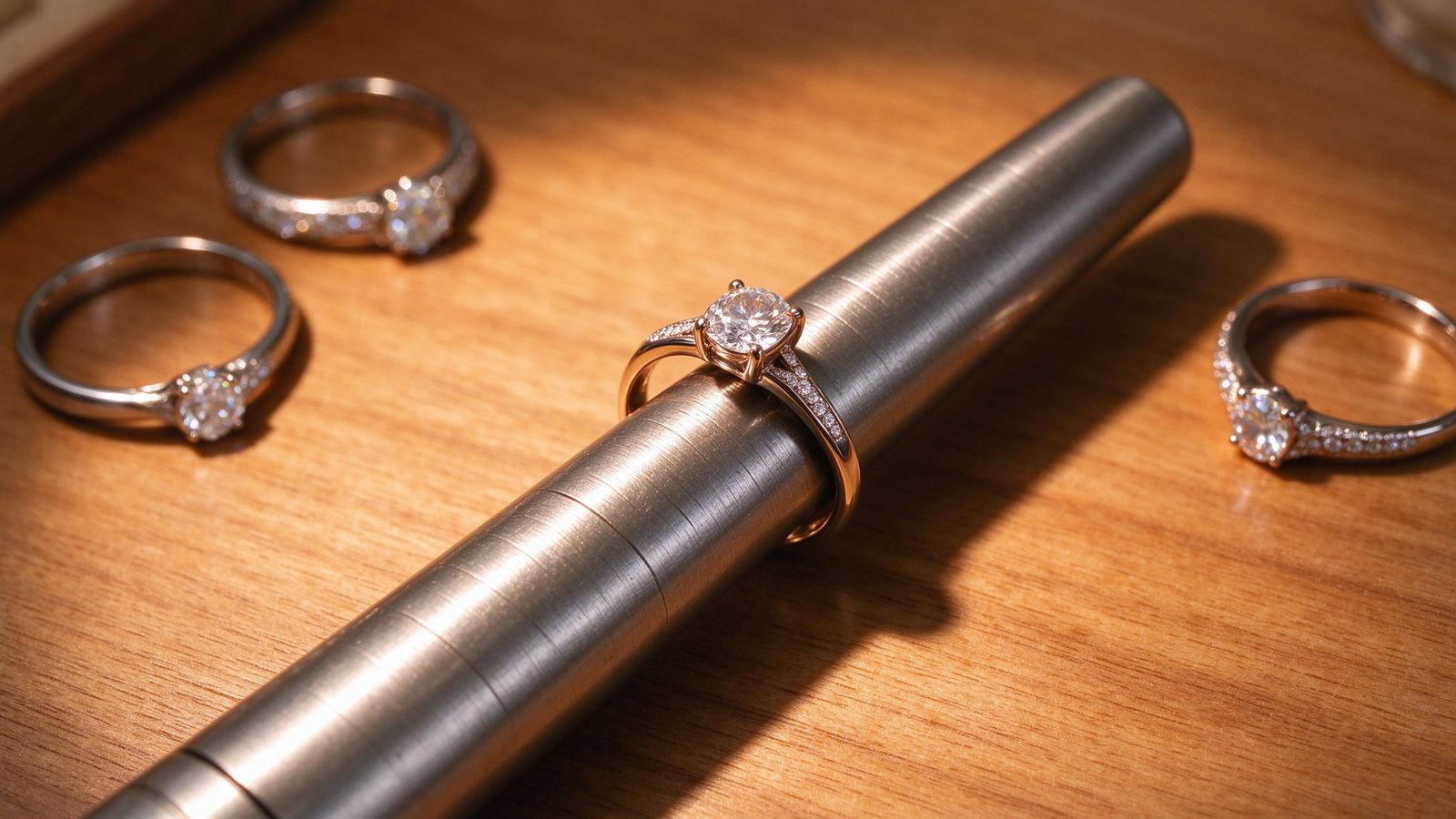
Pavé and diamond bands add a line of small stones for sparkle, creating a stacked look when worn beside an engagement ring. These are popular as anniversary bands or as the bride's coordinating band, but the small pavé stones collect soap and lotion and require more frequent cleaning. Sculpted or contoured bands are shaped to curve around the raised setting of an engagement ring, eliminating the gap that otherwise appears between two straight bands. Eternity bands, set with stones all the way around, are dramatic but cannot be resized, so get sizing exactly right before ordering.
| Style | Best For | Maintenance |
|---|---|---|
| Plain comfort fit | Daily wear, grooms | Very low |
| Pavé / diamond band | Bridal stacks | Moderate cleaning |
| Contoured band | Uneven engagement settings | Low |
| Eternity band | Anniversary, statement | High, no resizing |
Choosing the Right Metal
The metal determines how the band ages. Platinum is the premium choice for wedding bands because it is dense, naturally white, hypoallergenic, and develops a satin patina that many wearers find more attractive than a mirror polish. It is also the most expensive option. 18K gold is rich in color and a classic choice, available in yellow, rose, and white, while 14K gold is harder and more scratch-resistant because of its higher alloy content, making it the practical favorite for active hands.
White gold is rhodium plated to appear bright white; over time the plating wears and the slightly yellow underlying alloy shows through, requiring a re-plating service every one to two years. Rose gold's copper alloy gives it warmth and durability, though it can irritate highly sensitive skin. Sterling silver is the budget option but is soft and will tarnish, so it is better suited to fashion bands than to a lifetime commitment ring. As a rule, spend a little more on a solid precious metal rather than a plated or hollow band, because the band you choose now is the one you will repair and resize for fifty years.
Width, Profile, and Comfort Fit
Band width changes both the look and the feel of a ring dramatically. Men's bands commonly run 6 to 8 millimeters wide, while women's bands are typically 2 to 4 millimeters. A wider band covers more finger and reads as bold and masculine, but it also fits more snugly, so a wide band may need to be sized up by half a size compared with a narrow one. Thin bands are delicate and elegant but can bend if struck hard.
The profile refers to the shape of the band's cross-section. A flat band sits crisp against the skin and suits a modern, angular look. A court or rounded band curves gently on both the inside and outside and is the most comfortable all-day option. A comfort-fit band has a rounded interior that slides on and off easily, which is why most wedding bands are sold this way. When trying widths, wear a sample for several hours if possible, because a band that feels perfect in the showroom can feel heavy after a workday.
Getting the Size Right
Sizing is where most mistakes happen. Finger size changes with temperature, humidity, and time of day: fingers swell in the heat of the afternoon and shrink in a cold morning. Always measure at the end of the day, at normal room temperature, and never size a ring after exercising or in a frigid air-conditioned shop. If you are between sizes, size up slightly for a wide band and size true for a thin one.
The best method is to be sized by a professional jeweler with a wide set of metal mandrels, because a plastic sizing chart is not accurate enough for a lifetime ring. Leave a tiny amount of room: the band should slide over the knuckle with mild resistance and then sit snugly without spinning. Remember that pavé and eternity bands cannot be resized, and that a band worn beside an engagement ring may need a hair more room to avoid pinching. When ordering wholesale, request a printable sizing gauge or a reusable plastic ring sizer shipped to you before placing the final order.
Matching Your Band to the Engagement Ring
Coordinating the two rings is an art. The metal should match or deliberately contrast: mixing rose gold with a white-gold engagement ring is a current fashion choice, but mismatched metals can look accidental rather than intentional, so commit to a deliberate pairing. The width of the band should visually balance the engagement ring; a heavy 2mm diamond band next to a dainty solitaire can overwhelm it, while a thin band beside a thick halo looks lost.
Pay attention to the height of the engagement ring setting. If the solitaire sits high off the finger, a straight band will leave a visible gap, and a contoured or notched band is the clean solution. Some brides choose a wedding band that curves around the engagement ring to form a seamless unit, while others prefer to wear the engagement ring on one hand and the band on another. Whatever you choose, try the rings together before the wedding day, because the way they sit is the detail you will notice every morning for the next fifty years.
Care, Resizing, and Longevity Planning
A wedding band that never comes off should be built to last. Solid, not hollow, construction resists denting, and a comfort-fit interior reduces the chance of the band catching and twisting. Plan ahead: keep the receipt and grading paperwork, and have the ring inspected annually to check prongs and pavé stones. Clean gold and platinum bands with warm soapy water and a soft brush, and remove the band before heavy lifting, gardening, or applying hand sanitizer, which can dull plating and dry out skin around the ring.
Over decades, the inside of a band may develop grooves from friction and the finish may wear; this is normal patina, not damage. Most bands can be re-polished and re-plated by any jeweler, and a plain band can be easily resized unless it is fully eternity-set. Choosing a simple, well-made band from the start means the repairs over a lifetime will be inexpensive, predictable, and quick, so the ring stays on your finger for good rather than living in a repair drawer.
Wedding Band Traditions and Matching Sets
Wedding bands carry centuries of tradition, but modern couples are freer than ever to make them personal. The classic bridal set pairs an engagement ring with a matching contoured band, often in the same metal and finish, so the two sit as one unit. His-and-hers bands can share a metal or design thread without being identical. Many couples choose simple, durable bands that will survive decades of wear, because the band, not the engagement ring, is the piece that never comes off.
Matching does not mean identical. A bride may choose a pavé band while the groom wears a plain comfort fit in the same metal. Some couples engrave matching dates or coordinates inside the bands. The point is that the bands feel like a pair, even if they look different. When choosing, think about how the bands will look together on the same finger, and whether the bride's band curves around her engagement setting.
For same-day wedding bands, ordering early matters, because sizing and engraving take time. Plan to order both bands at least a few weeks before the wedding. If you are mixing metals or customizing, allow even more time. A well-coordinated set, chosen together, becomes a quiet symbol of the partnership, worn daily for life.
When buying wholesale, offering bridal sets as matched pairs simplifies the customer's decision and raises the sale. A solitaire engagement ring with a coordinating contoured band, sold as a set, is a perennial bestseller because it solves the matching problem. Stocking both men's plain bands and women's diamond bands covers the full bridal pair.
Resizing and Repairing Wedding Bands
A wedding band is meant to be worn for decades, and over that life it may need resizing, reshaping, or re-plating. Weight changes, temperature, and knocks mean even a well-sized band occasionally needs adjustment. Solid gold and platinum bands can be resized by a jeweler, though eternity and channel-set bands cannot, because cutting the band damages the stones. Plan ahead by sizing non-resizable bands carefully the first time.
Thin bands bend out of round over years of wear, and a jeweler can true them on a mandrel to restore the circular shape. White gold bands need periodic re-plating as rhodium wears. These routine services are inexpensive, and they keep the band looking new. The mistake is waiting until the band splits or a stone falls out, which turns a cheap repair into an expensive replacement.
Build a relationship with a jeweler who can service the band over the years. Keep the receipt and any sizing paperwork. An annual check catches worn shanks and loose pavé before they become emergencies. Because the wedding band is rarely removed, it accumulates more wear than almost any other piece, so it deserves that periodic attention.
For grooms especially, a durable plain band in 14K gold or platinum is the low-maintenance choice. It can be re-polished and trued over decades without fuss. The wedding band you choose should be one you can service easily for a lifetime, which is why simple, solid construction beats delicate, trend-led detail for the piece that never comes off.
Choosing His and Hers Bands Together
Choosing wedding bands together is a meaningful ritual, and it is wise to shop as a couple. Even if the styles differ, coordinating the metal gives the pair a subtle connection. Many couples pick matching 14K gold or platinum, while others intentionally mix metals for a modern look. Try bands on together to compare widths and finishes, and agree on a shared metal so the rings feel like a set even when they are not identical.
Men's bands often need a different approach than women's. A wider 6 to 8 millimeter comfort fit in a durable metal suits daily wear, and it may need sizing up half a size. Textured finishes like brushed or hammered hide scratches better than a mirror polish, which is practical for hands that work. A simple, well-made men's band is built to last decades with minimal fuss.
Engraving the inside of both bands with a shared date or phrase adds intimacy. Keep the engraving short and legible. Order both bands well before the wedding, because sizing and engraving take time. Shopping together turns a practical purchase into a small celebration, and the bands you choose become the quiet daily symbols of the partnership you are starting.
Lifestyle and Your Band Choice
The band you choose should match how you live. If you work with your hands, garden, or exercise often, a simple, durable comfort-fit band in 14K gold or platinum is the practical choice. Delicate pavé and thin bands catch on gloves and equipment and need more care. A smooth, plain band survives a lifetime of active wear with minimal fuss. Let your daily routine drive the band style, not just the aesthetic.
Think too about how the band stacks with other rings. If you plan to wear an engagement ring, choose a band that either matches cleanly or is contoured to sit beside it. If you like stacking multiple bands, slimmer widths layer more easily. A band that sits flush and comfortable will be worn every day, while one that catches or pinches gets taken off. Comfort is the quiet luxury of a good wedding band.
Whatever you choose, select a solid, well-made piece. Hollow or thin bands dent and wear through, while solid 14K gold or platinum lasts for decades and can be repaired. The wedding band is the ring you never take off, so build it for daily life. A band that feels invisible on your finger is the one that becomes a natural part of you.
Frequently Asked Questions
How wide should a wedding band be?
Women's bands typically run 2 to 4 millimeters and men's 6 to 8 millimeters. Wider bands fit more snugly, so size up half a size when choosing a band wider than 6mm.
Is platinum or gold better for a wedding band?
Platinum is the most durable, hypoallergenic, and long-lasting, but costs more. 14K gold is the practical daily-wear favorite because its alloy makes it harder and more scratch-resistant than 18K.
Should the wedding band match the engagement ring?
It should either match deliberately or contrast intentionally. Same-metal matching is the safest, but a planned metal mix is a legitimate modern choice. Use a contoured band if the engagement setting leaves a gap.
Can an eternity band be resized?
No. Eternity bands set with stones all around the circumference cannot be resized, so get an exact professional sizing before ordering.
How tight should a wedding band feel?
It should slide over the knuckle with mild resistance and sit snugly without spinning. Leave a little room, since fingers swell through the day, and measure at the end of a normal-temperature afternoon.
The wedding band is a quiet object that earns its meaning through daily wear. Choose a solid comfort-fit band in a metal that suits your lifestyle, size it carefully after hours of real-world wear, and coordinate its width and profile with the engagement ring so the two pieces move as one. A well-chosen band needs almost no thought over the decades, which is exactly the point. When you source a plain, well-finished band at wholesale, you invest in a durable object that will outlast trends and sit comfortably on your finger from the first day to the fiftieth.