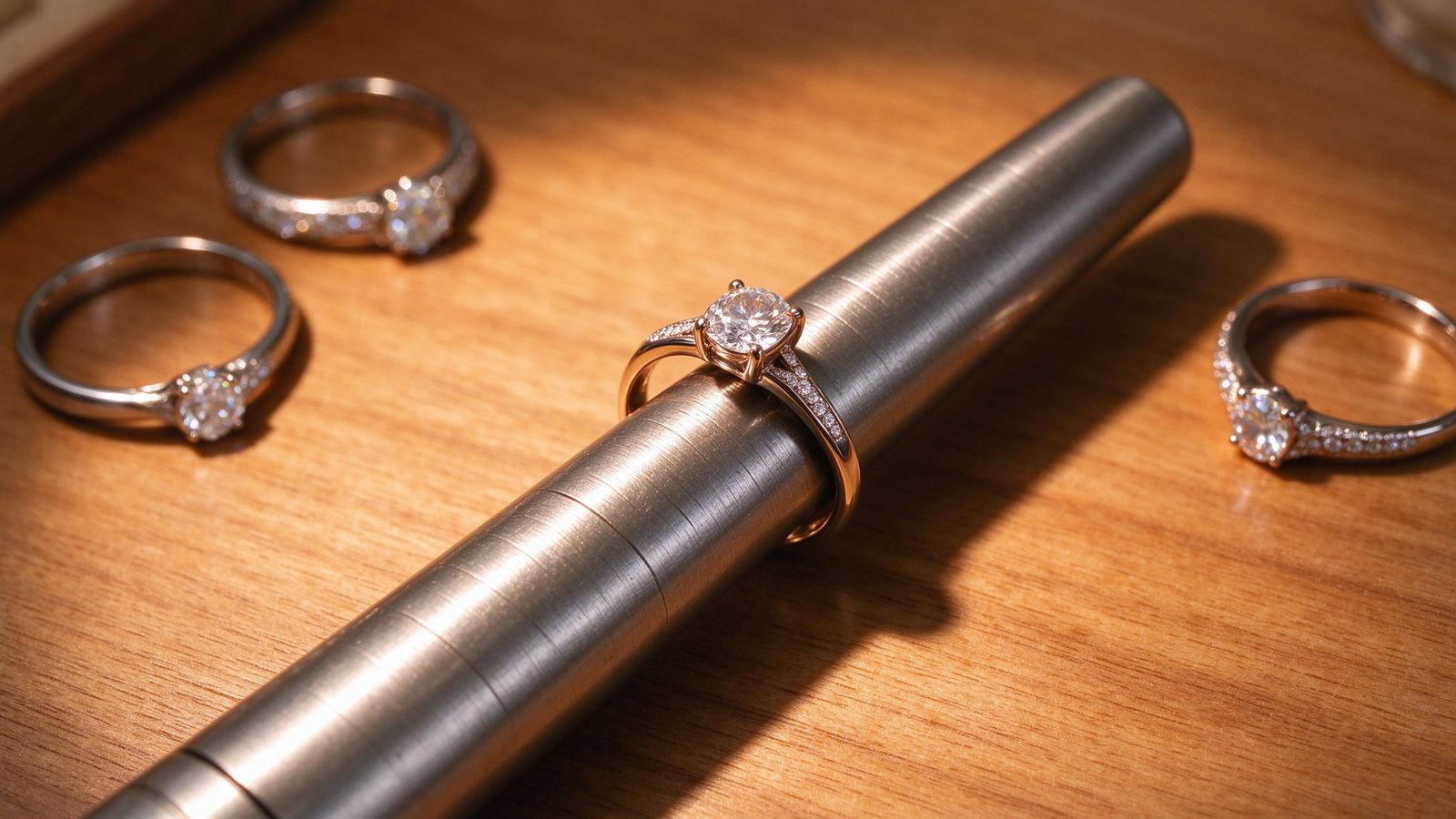
Halo vs Solitaire Engagement Rings: Which Should You Choose?
Among the first big decisions in engagement ring shopping, after the center stone and the budget, is the setting style. Two archetypes dominate: the solitaire, a single stone held by a handful of prongs, and the halo, a center stone circled by a ring of smaller diamonds. Both have been around for decades. Both can be breathtaking. But they read as completely different pieces, and they suit different hands, lifestyles, and personalities. Choosing between them is not about which is "better." It is about which one you will actually want to wear every morning for the next fifty years.
This guide compares the two honestly: how they look, how they perform, what they cost, what they hide, and how to decide. We also look at the middle options, because the real answer for many couples is neither pure extreme.
What a Solitaire Actually Is
A solitaire is the simplest possible setting: one center stone, held by three, four, or six prongs, on a plain band. There is nothing to distract from the stone itself. The brilliance, the cut, the color, the proportions of the center diamond or moissanite are all on display. Because there are no side stones, the center stone can sit lower or higher depending on the prong design, and the ring stacks easily with a wedding band.
The solitaire has survived for over a century because it is honest. What you see is the stone. It photographs beautifully because there is no competing sparkle. It is also the easiest setting to clean, the easiest to repair, and the most flexible if you later want to upgrade the center stone without changing the whole ring. Our guide to brilliance and fire explains why that unobstructed view matters.
The trade-off is scale. A one-carat solitaire looks like a one-carat stone. If you want visual size, the solitaire delivers only what the center stone actually weighs. On a limited budget, that can feel small.
What a Halo Actually Does
A halo setting circles the center stone with a paved border of small diamonds, usually one or two rings deep. The effect is optical enlargement: a one-carat center stone in a halo can visually read as a 1.5- to 2-carat stone because the surrounding ring of light blends into the center at a glance. Halos also add extra sparkle, because every small diamond is another point of reflection. A halo ring reads as more ornate, more glamorous, and more obviously "an engagement ring."
The halo's benefit is also its cost. You get a much larger-looking ring for the money, because the surrounding diamonds are small and cheap. A modest center stone can look like a substantial ring. This is why halos became so popular in the last twenty years: they deliver visual drama at accessible budgets. If your budget is the deciding factor, the halo is the efficient choice.
The trade-offs are real, though. The extra diamonds are held by tiny prongs that can catch on fabric. The setting sits higher and wider, so it can catch on sweaters and hair. Halos are harder to clean because grime collects around the pavé. And they are harder to resize, because the setting is more complex. Our guide to setting types explains these trade-offs in depth.
How They Look on the Hand
A solitaire elongates the finger, especially in an oval, marquise, or pear shape. It reads clean, modern, and slightly architectural. It is the setting people associate with classic engagement rings. A halo broadens the finger and reads wider. On long, slender fingers, a halo can look balanced and lush. On shorter fingers, a wide double halo can visually cut the finger off, making the hand look stubbier. If you have short fingers, a slim solitaire or a thin single halo is more flattering than a wide double halo.
Scale also matters. A halo on a size 7 finger with a 6mm center stone looks rich. The same halo on a size 5 finger with a 6mm center stone can look overwhelming. Try similar settings on your own hand before deciding, because photos lie. Our shape guide pairs naturally with this discussion, because the shape of the center stone changes how a halo reads.
Durability and Daily Wear
For active people, the solitaire usually wins. With four or six solid prongs and no pavé to catch, a solitaire tolerates typing, cooking, gardening, and gym work far better than a halo. Prongs can be re-tightened cheaply. A halo's tiny pavé stones, by contrast, can work loose over years, and re-tipping a halo is more delicate and more expensive. If you never take your ring off and you work with your hands, the solitaire is the safer daily companion.
That said, a well-made halo in a bezel-set outer ring is far more durable than a prong-set pavé halo. Ask your jeweler how the outer stones are held. A flush bezel halo is almost as tough as a solitaire; a fine pavé halo is not. If you love the look of a halo but need durability, choose a halo with a protective bezel or a low profile.
Cost and Value
At a fixed budget, a halo buys you visual drama; a solitaire buys you center stone quality. If you have set aside a fixed amount, you have a choice: spend it all on a larger, higher-grade center stone in a solitaire, or spend part on a smaller center and part on a halo of side stones. Which is smarter depends on what you value. If you want the stone itself to be impressive to experts, the solitaire with a better center is the move. If you want the ring to look large and luminous to everyone at a party, the halo is the move.
Resale and upgrade potential favor the solitaire. A solitaire with a certificated center stone is easy to value and easy to upgrade later by swapping the center. A halo is a more integrated piece; upgrading means reworking the whole setting. If you imagine trading up the center stone in ten years, the solitaire is more flexible. Our budget guide helps you think through that allocation.
The Middle Ground
You do not have to choose extremes. A semi-halo, where the center stone is circled by a partial ring of small stones, gives some enlargement without the full width. A hidden halo, where the diamonds sit underneath the center stone and peek out from the side, adds sparkle without widening the top of the ring. A solitaire with slim pavé down the shank adds subtle glitter while keeping the center uncluttered. These hybrids are increasingly popular precisely because they split the difference.
There is also the three-stone ring, which uses two smaller side stones rather than a circular halo. It reads classic and symbolic, and it elongates the finger. If the pure solitaire feels too plain and the full halo feels too much, a three-stone or a solitaire with a slim accent band often lands just right.
How to Decide for Your Partner
If this is a surprise proposal, look at what your partner already wears. Someone who loves clean, minimalist jewelry, who wears a single watch and no other rings, is likely to prefer a solitaire. Someone who wears layered necklaces, stacked rings, and earrings is likely to love the richness of a halo. Check their existing jewelry drawer for clues about metal color and finish. If they wear cool silver tones, a platinum or white gold setting suits them; if they wear warm gold, yellow or rose gold fits better.
When in doubt, choose the solitaire. It is the setting least likely to be regretted, because it is the most adaptable. A solitaire can be upgraded, re-set, and restyled. A halo is more of a committed look. And remember that the right setting is the one that makes your partner smile when they first see it on their hand, not the one that scored highest on a spreadsheet.
How Shape and Cut Change the Decision
The shape of the center stone changes which setting flatters it. Round brilliant stones work beautifully in both solitaire and halo settings, because their symmetry suits either frame. Cushion and oval stones take especially well to a halo, because the soft outline of the stone echoes the rounded border of the pavé. Emerald and asscher cuts, with their long parallel step facets, look most architectural as solitaires; a halo can soften their geometry in a way that some love and others find fussy.
Elongated shapes like marquise and pear benefit less from a halo, because they already read long and large. Adding a halo to a marquise can make the ring feel crowded. A solitaire lets the dramatic silhouette of the stone speak. The same logic applies to very large center stones: a two-carat solitaire does not need a halo to look substantial, and the halo only adds maintenance. A half-carat stone, by contrast, is where the halo earns its keep.
Color also interacts with setting. A white metal halo around a near-colorless stone adds bright white light that can make the center read slightly cooler. A yellow gold halo around a warmer stone blends the tones. If color grading matters to you, choose the halo metal deliberately, and ask the jeweler to show the same center stone in both white and yellow settings before you commit.
Maintenance and Longevity
Over decades, the two settings age differently. A solitaire needs prongs checked every year or two, because prongs wear thin with contact. That is a cheap, routine service. A halo needs the same prong checks plus occasional re-tipping of the tiny pavé stones, and a professional ultrasonic cleaning that flushes grime from under the borders. Neither setting is high maintenance, but the halo is slightly higher.
When it comes time to resize, the solitaire is easy. The halo is not, especially if it is set all the way around. If you are unsure of your size, order the solitaire, or choose a halo that resizes cleanly. This is another reason surprise proposers lean solitaire: if the size is off, fixing it is straightforward.
Both settings can be redesigned later. A solitaire can be re-set into a halo, and a halo can be stripped back to a solitaire. The center stone survives either transformation. So if you are genuinely torn, remember that the choice is not permanent; it is a starting point. Our setting techniques guide shows how flexible re-setting can be.
What Most Couples Actually Choose
In practice, the pendulum has swung back toward the solitaire after a decade of halo dominance. Brides today often cite the timelessness of a single stone, the ease of stacking a wedding band, and the confidence that a solitaire will not look dated in twenty years. That said, the halo has not disappeared; it has evolved. Modern halos are slimmer, lower-profile, and use smaller stones, so they add presence without looking heavy. The double-halo, which once defined the look, has largely given way to a single delicate halo or a hidden halo. This is good news for undecided couples: the setting you choose now can be a modern, restrained version of either style rather than a maximalist stereotype.
If you are comparing rings side by side, try them on with the wedding band you imagine. A solitaire usually sits flush against a plain band. A halo often leaves a gap, which may require a contoured or curved band. That gap is not a flaw, but it is a design decision, and it affects the cost and look of the final set. Our wedding band guide covers those contours. Seeing the two together removes most of the remaining doubt.
Designing Your Ring With HOLYCOME
At HOLYCOME, based in Henggang, Longgang, Shenzhen, we build both solitaire and halo engagement rings to order, and we will show you 3D renders of the chosen setting on a finger-sized model before production. Email service@holycome.com with your center stone size and your partner's hand size, and we will recommend whether a solitaire, halo, or hybrid suits. If you are still choosing the stone, our lab-grown versus natural diamond guide pairs with this, and once the ring is decided, our wedding band guide covers how to pair it.
The halo and the solitaire are not rivals. They are two honest answers to the same question: what should this ring say? The solitaire says the stone is enough. The halo says more light, more presence, more glamour. Pick the sentence that sounds like your partner, and you will not go wrong.