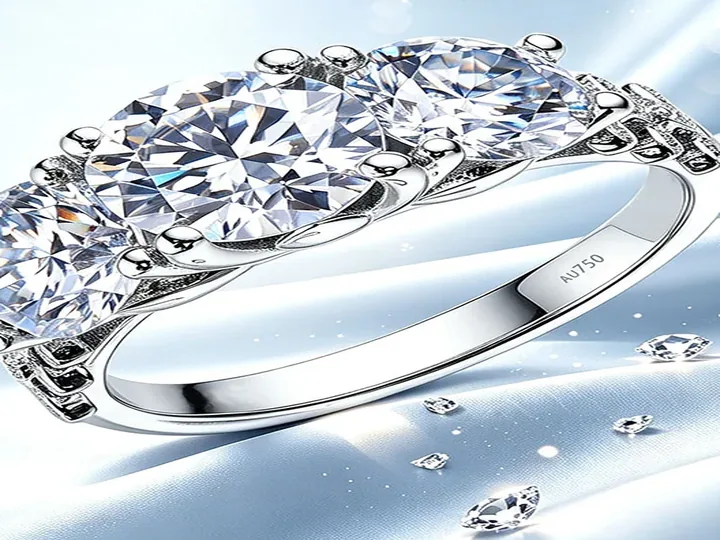
We get this question on almost every consultation. The short answer: they are different stones, and the right one depends on what you actually want the ring to feel like in ten years.
Hardness and wear
Diamond is 10 on Mohs; moissanite is 9.25. In practice, both will survive daily wear. The difference shows up in facet edges — after five years, a moissanite on a hand-active job may show slightly soft edges, while a diamond will not.
Fire and look
Moissanite has more fire (colored flashes) than diamond. Some clients love it; others find it "too rainbow". A well-cut lab diamond reads quieter, whiter, more "classic". If you have seen moissanite and thought it looked plastic, you probably saw a poorly cut stone under fluorescent light — good lighting matters.
Price
A 1ct equivalent moissanite finished ring typically lands $600–$1,200. A comparable lab-grown diamond ring starts around $1,800–$2,500. Natural is another 3–10x.
Our recommendation
Pick lab-grown diamond if you want the classic look, long-term hold value, and a certificate that will be recognized anywhere. Pick moissanite if you want maximum size per dollar and you love a bit of sparkle and fire.
Where the two stones part ways at the bench
Most comparisons stop at hardness and price. The bench tells a different story. A setter working a 6.5 mm moissanite and a 6.5 mm lab-grown diamond will notice the moissanite sits slightly lighter in the hand, which changes how a thin band balances under a heavy head.
Moissanite carries more dispersion, roughly 2.4 times that of diamond. In store lighting that reads as brilliance. In daylight it can read as color, and that is the most common return reason we hear from retailers who switched stones without briefing their counter staff.
Lab-grown behaves like mined diamond at the bench: same tools, same setting pressure, same polishing wheels. Training time is close to zero. That matters if your bench turns over or if you outsource setting to a local jeweler two doors down.
All-in cost per piece, run three ways
The quotation is rarely the cost you carry. Setting labor, metal weight and certificate handling all move with the stone choice. Below is the comparison we run with retail buyers before they commit to a stock plan.
| Cost line | Moissanite, 1 ct equivalent | Lab-grown, 1 ct | Where the money moves |
|---|---|---|---|
| Stone | USD 18 to 45 | USD 180 to 420 | Moissanite saves 80 to 90 percent |
| Setting labor, four-prong | USD 6 to 9 | USD 6 to 9 | No difference |
| Certificate | GRA card, included | IGI paper, USD 25 to 40 | Lab-grown adds a line |
| Return allowance | 3 to 6 percent of units | 1 to 2 percent of units | Moissanite needs a briefing |
Read the last row carefully. A cheaper stone with a higher return rate can erase its own advantage. In the retail partner data we track, moissanite returns cluster in the first sixty days and fall sharply once staff explain the stone before the sale closes.
What this year of wholesale orders tells us
Buyers pricing under USD 500 a piece almost always choose moissanite. Buyers pricing above USD 1,200 almost always choose lab-grown. The split sits near USD 800 this year and moved up roughly 12 percent against last year as lab-grown prices softened.
Mixed carts are now normal. About four in ten of our repeat buyers stock both stones in the same shape and size so a customer can compare across the counter. That pairing converts better than either stone alone and it protects the buyer from a single-supplier price swing.
How to brief counter staff in ten minutes
Give the team three sentences and one visual. First: this stone is moissanite, grown in a lab, not a diamond. Second: it measures 9.25 on the Mohs scale against diamond at 10, so it wears well but is not scratch-proof. Third: the color you see in daylight is dispersion, not a flaw.
Then hand them the comparison card. In our experience the briefing, not the price, is what keeps returns under four percent. Stores that skip it and let the tester do the talking see returns two to three times higher.
Minimums, sampling and the calendar
Our floor for stock designs is 10 pieces per style, and a single sample can ship from one piece. Custom CAD work starts once the style is confirmed in writing, alongside the metal and the finish.
Samples leave in three to seven days. Bulk production runs on a calendar quoted after sample approval, and we put that date on the order confirmation instead of leaving it verbal.
Frequently asked questions
Can I mix moissanite and lab-grown on one order?
Yes. Both quote on one invoice and ship in one carton, which keeps freight and customs paperwork to a single entry.
Does moissanite read as diamond on a tester?
It reads as diamond on a basic thermal tester, which is exactly why every parcel carries a GRA card and a printed stone card. The tester is not a substitute for disclosure.
Which stone protects margin better at the counter?
Moissanite protects margin on the buy and costs you on education. Lab-grown protects margin on the sale and costs you on working capital. Pick the one that matches how your staff sells.
Next step
Send the shape, size and mounting you sell most and we will quote both stones on the same spec sheet, side by side. Further reading: our production timeline, the custom engagement ring guide, and ring care basics.
Two buying patterns that repeat every season
The first is the trial buyer who orders twelve pieces across three styles, sells nine, and reorders the winner at forty. That pattern needs a fast reorder lane and a spec that does not drift.
The second is the seasonal buyer who locks one style deep before a holiday and wants it in hand six weeks ahead of the shelf date. That pattern needs a production slot booked early, because the bottleneck is the calendar, not the stone.
Related Articles- 18K Gold vs. Platinum: Which Metal for Your Ring?
- Clarity Grading in Moissanite: What You Need to Know
The Gemological Institute of America’s gem encyclopedia is an authoritative, widely cited reference on moissanite and diamond quality factors.
Frequently Asked Questions
Is moissanite a good diamond alternative for retail buyers?
Yes for price-sensitive customers who want brilliance and hardness. Moissanite ranks 9.25 on the Mohs scale, holds up to daily wear and costs a fraction of a natural diamond of the same size, so it resells fast in bridal and fashion lines.
What is the minimum order for wholesale moissanite?
MOQ starts at 50 pieces per design for stock items. Custom cuts and private-label settings usually start at 100–300 pieces depending on the mold.
Do you provide certificates with moissanite stones?
Yes. Every parcel ships with GRA or IGI documentation listing carat weight, color grade and cut. We recommend passing the certificate to your end customer for trust.
How long does sample and bulk production take?
Samples ship in 3–5 days. Bulk runs take 15–20 days under 500 pieces, and 25–30 days for custom work.
Related reading: Moissanite vs Lab-Grown vs Natural Diamond: A 2025 Buyer's Guide, Moissanite vs Lab-Grown Diamond: A 2025 Bespoke Buyer's Guide, Lab Grown Diamond vs Moissanite.


