Hand Wax Carving in Jewelry Making: The Sculpting Stage
Before a ring exists in metal, it exists in wax. Hand wax carving is the stage where a design becomes a physical, three-dimensional object in the jeweler's hand. It is the most tactile part of jewelry making: a bench jeweler holds a block of warm carving wax and cuts, files, and shapes it until the ring you imagined takes form. From that wax model, a rubber mold is made and metal is cast. Without the wax carving step, there is no ring. This guide explains what hand wax carving is, how it differs from CAD design, and why it produces a warmth that digital design cannot. It is one of the most human steps in the whole process.
What Is Carving Wax
Carving wax is a specially formulated hard wax that cuts cleanly. It comes in blocks, tubes, and rings pre-sized. Jewelers use wax files, carving tools, and heat to shape it. Wax is forgiving: you can add, remove, and reshape until it is right. When the wax model is perfect, it is attached to a wax sprue and invested in a plaster-like flask. In the casting process, the wax melts out and metal takes its place. This is lost-wax casting, described in our casting guide. The wax is the pattern; the metal is the permanent result.
Hand Carving Versus CAD
Most modern jewelry starts as a CAD design on a screen, then is 3D-printed in wax. Hand carving is the older, slower method where the jeweler shapes the wax by hand. CAD is precise and repeatable; hand carving has subtle organic character. A hand-carved ring has slight variations that make it feel sculpted. CAD rings are perfectly uniform. Many makers use both: CAD for precision parts, hand carving for artistic elements. Our bespoke process guide explains. Neither is wrong; they suit different designs.
The Hand Carving Process
The jeweler starts with a wax ring blank in your size. They cut away excess wax with a wax saw and files. They build up details by melting small wax bits onto the model. A design that looks simple, like a leaf motif, is carved millimeter by millimeter. The jeweler checks proportions against your finger size as they go. When the wax looks right, they cast it. Because wax is cheap, mistakes are easy to redo. This is why hand carving allows experimentation. Our consultation guide sets the design that gets carved.
Why Hand Carving Matters
Hand carving gives a piece a human signature. The slight irregularities, the way a curve flows, the feel of the surface, all come from a hand rather than a printer. People who value artisan jewelry often specifically request hand-carved pieces. It is also the best method for one-of-a-kind sculptural rings that cannot be easily modeled in CAD. Our hand-forged guide covers another hand method. A hand-carved ring carries the bench jeweler's touch, and that is part of its value.
What You See at the Prototype Step
If a piece is hand-carved, you may see the wax prototype before casting. This is your chance to approve shape and size. You hold a wax model of your ring, feel its weight, and check proportions. Then it goes to cast. Our prototype approval guide covers this. Approving in wax is much better than approving in metal, because wax changes are free. Once cast in gold or platinum, changes are expensive. This is why the prototype step exists.
The Tools of Wax Carving
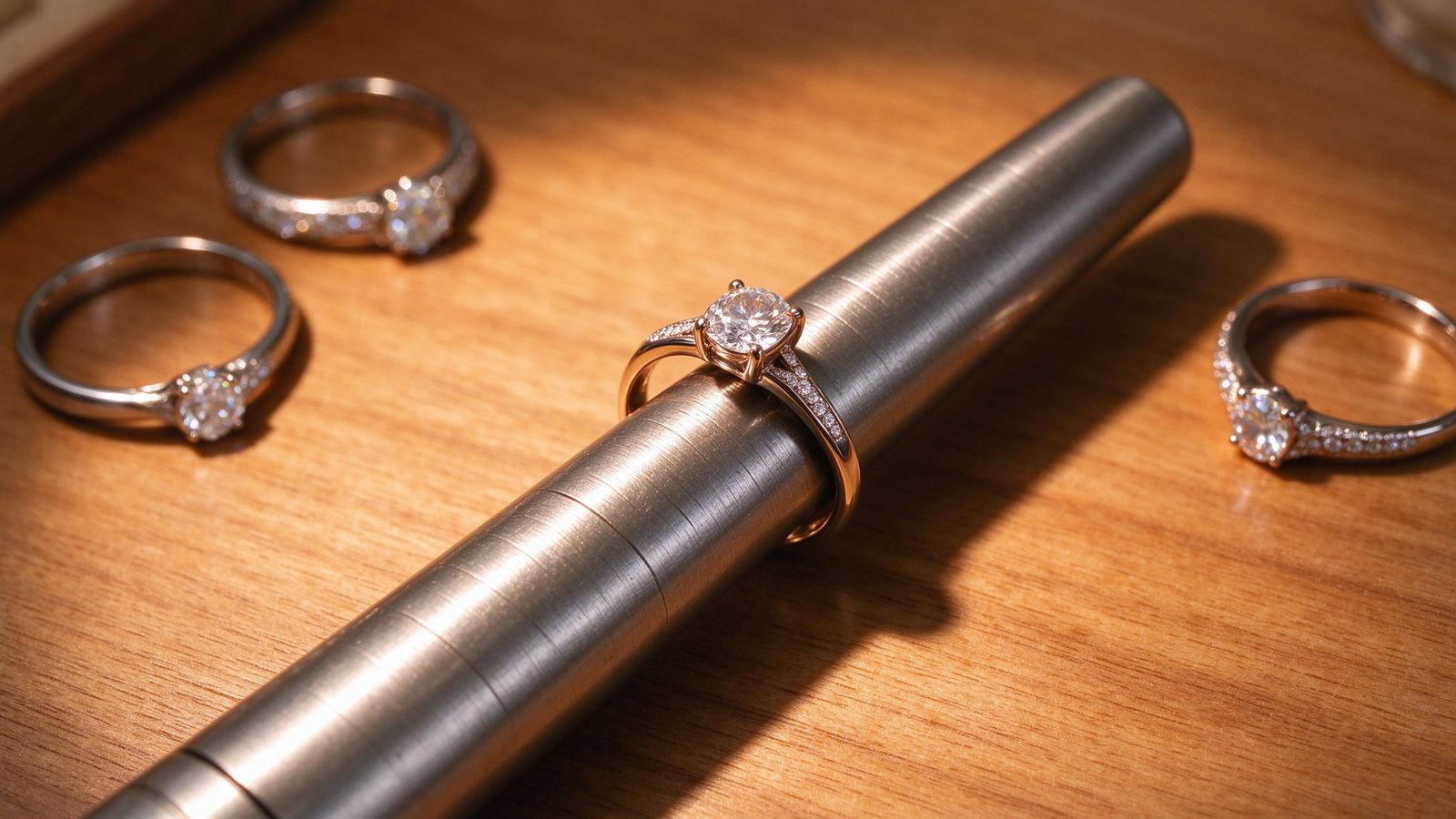
A wax carver's bench holds a set of tools that look like miniature sculpting instruments. Wax files of different grits shape the bulk. Wax knives and chisels cut fine details. A wax pen, which is a small heated tip, melts and joins wax pieces. Burnishers smooth surfaces. The jeweler also uses wax tubes of various diameters to form bands. A mandrel, which is a tapered metal rod, holds the wax ring while it is shaped. These tools are simple, but the skill to use them takes years. Our bench tools guide lists more. Wax carving is not magic; it is patience with small files.
The wax itself comes in hardness grades. Hard wax holds fine details for casting. Soft wax is easier to shape but less precise. A carver chooses the wax grade based on the design. Delicate filigree needs hard wax; a rough organic form can use softer. The color of wax varies, but it is only a working material. None of the wax survives casting; it all melts away. The wax model is a temporary shell that the metal permanently replaces.
How Long Hand Carving Takes
A simple band may be carved in an hour. An intricate sculptural ring, like one with birds or leaves, takes days. The carver works slowly, checking proportions against the design. Because wax is cheap, they can start over if a detail goes wrong. This freedom to experiment is why hand carving suits artistic pieces. A CAD design, by contrast, is built on screen and 3D printed in hours. Hand carving trades speed for character. Our bespoke process guide sets timelines. If you want a hand-carved piece, plan extra weeks.
Finishing the Wax Model
Once carved, the wax model is sprued: a thin wax rod attaches it to a base, creating a channel for metal to flow during casting. The whole assembly is invested in a flask of plaster. In the kiln, the wax melts out, leaving a cavity. Molten metal is poured into that cavity. This is lost-wax casting. Our casting guide details it. The wax carving is the master; everything downstream is reproduction of that master. A flaw in the wax becomes a flaw in the metal, so the carver inspects carefully before casting.
Hand Carving and CAD Together
Modern makers often combine the two. The structural parts, like a band, are CAD designed for precision. The artistic details, like a hand-shaped leaf, are carved in wax. The two are joined, then cast together. This gives the accuracy of CAD with the soul of hand work. Our consultation guide discusses which parts suit which method. The result is a piece that fits perfectly and looks handcrafted. This hybrid is common in fine custom jewelry today.
What Hand Carving Feels Like to Wear
A hand-carved ring wears slightly differently from a CAD ring. The surface has subtle undulations that catch light organically. The edges feel hand-finished rather than razor-perfect. Over years, those edges soften in a way that looks natural. Many owners prefer this. A hand-carved nature-inspired ring, with leaves or petals, looks alive because it was shaped by hand. Our hand-forged guide describes a similar tactile quality. If you want a ring that feels like a sculpture rather than a machine part, hand carving delivers it.
Hand carving also allows details that are hard to model. A tiny twisted vine, a bark texture, a claw shape that wraps the finger, these come more easily from a hand with a wax file than from a screen. The carver sees the form and adjusts as they go. This is why sculptural jewelry is still hand-carved even in the age of CAD. The medium suits the idea. Our bespoke process guide explains.
Cost and Value of Hand Carving
Hand carving costs more than CAD because it takes labor hours. A CAD design is built once and printed cheaply; a hand carving is shaped by an artisan each time. For one-of-a-kind pieces, this cost is worth it. For mass-produced bands, CAD is more efficient. When you commission a hand-carved piece, you are paying for the artisan's hours and skill. That labor is part of the value. Our pricing guide breaks it down. If budget is tight, choose a design where hand carving is limited to a focal detail.
The Prototype in Your Hand
The most exciting moment of hand carving is when you see the wax prototype. It is a light, white, slightly waxy version of your ring. You hold it, try it on a plastic mandrel, and feel the proportions. This is the moment to request changes. A thinner band? A smaller motif? The carver adjusts the wax in minutes. Once you approve, the wax goes to casting. Our prototype approval guide covers this. Seeing the wax makes the design real in a way a rendering cannot. Many customers are surprised by how different the wax feels from the screen image. This is exactly why the step exists.
After approval, the wax vanishes. The metal ring that returns is the permanent version. The hand-carved details are preserved exactly, because the casting is a mold of the wax. Every file mark, every curve, reproduces in gold or platinum. The warmth you felt in the wax becomes the warmth of the finished ring. That continuity from hand to metal is the magic of lost-wax carving. Our casting guide completes the story.
Hand wax carving is not obsolete. Even with all the digital tools, jewelers still carve by hand for the pieces that need a soul. A CAD-printed wax is precise, but a hand-carved wax has a slight unevenness that the human eye finds beautiful. When you see a sculptural ring in a gallery, chances are it was carved, not printed. The two methods coexist because they solve different problems. CAD solves consistency; hand carving solves character. Our consultation guide helps you decide which you want.
If you are commissioning a piece, ask whether it will be hand carved or CAD printed. The answer changes the timeline, the price, and the feel of the result. Hand carving suits organic, artistic, one-of-a-kind designs. CAD suits clean, geometric, precise designs. There is no right answer, only the right choice for your idea. Understanding this helps you brief the jeweler clearly. Our bespoke process guide walks through the whole journey from idea to finished ring.
The wax model is also where sizing is finalized. The carver checks the ring on a mandrel in your exact size. Because wax is easily cut, the band can be made slightly larger and filed down to fit. This is why the prototype step is the moment to confirm sizing. Once cast in metal, resizing is a separate job, covered in our resizing guide. Get it right in wax, and the cast ring fits perfectly the first time.
After casting, the metal ring comes out as a rough, slightly gray casting. The carver then hand-filings, polishes, and sets the stones. The wax stage is only the beginning; the finishing bench does the rest. But the form you approved in wax is preserved. Our bench tools guide covers the finishing work. Every step after casting refines what the carver began.
That is hand wax carving in brief: a wax block becomes your ring in the jeweler's hands, you approve the wax prototype, and the metal is then cast from it. If your design is organic, sculptural, or one of a kind, hand carving is the way to go. Ask for it at the consultation, and the piece that comes back will feel like it was made for you, because it was. Our casting guide continues the story.
Whether a piece is carved by hand or printed in wax, the result is a wax model that gets cast. The difference is in the character. Hand carving leaves the slight irregularities that make a ring feel like a sculpture. CAD leaves the perfect uniformity that makes it feel modern. Both are valid. The right choice depends on the design you want. When in doubt, ask the jeweler which method suits your idea. They will recommend the one that best expresses what you imagined. Our consultation guide is where that conversation begins.
Hand Wax Carving at HOLYCOME
HOLYCOME, based in Henggang, Longgang, Shenzhen, hand-carves sculptural pieces alongside CAD designs. Email us at service@holycome.com. Our casting guide and hand-forged guide explain the methods.
Hand wax carving is where a drawing becomes a thing you can hold. It is slow, tactile, and human. If you want a ring with sculptural character rather than a uniform digital shape, ask for hand carving. That choice shapes the piece for life.