Clients see the ring at the end of the bench, polished and sparkling, and they understandably assume it was made quickly. It was not. A bespoke ring travels through more hands than most people realize: designer, wax printer, caster, setter, polisher, inspector. Each step is small, but each step changes the piece. This is the full journey, from the first CAD file you approve to the ring on your hand, written the way we explain it to clients who ask.
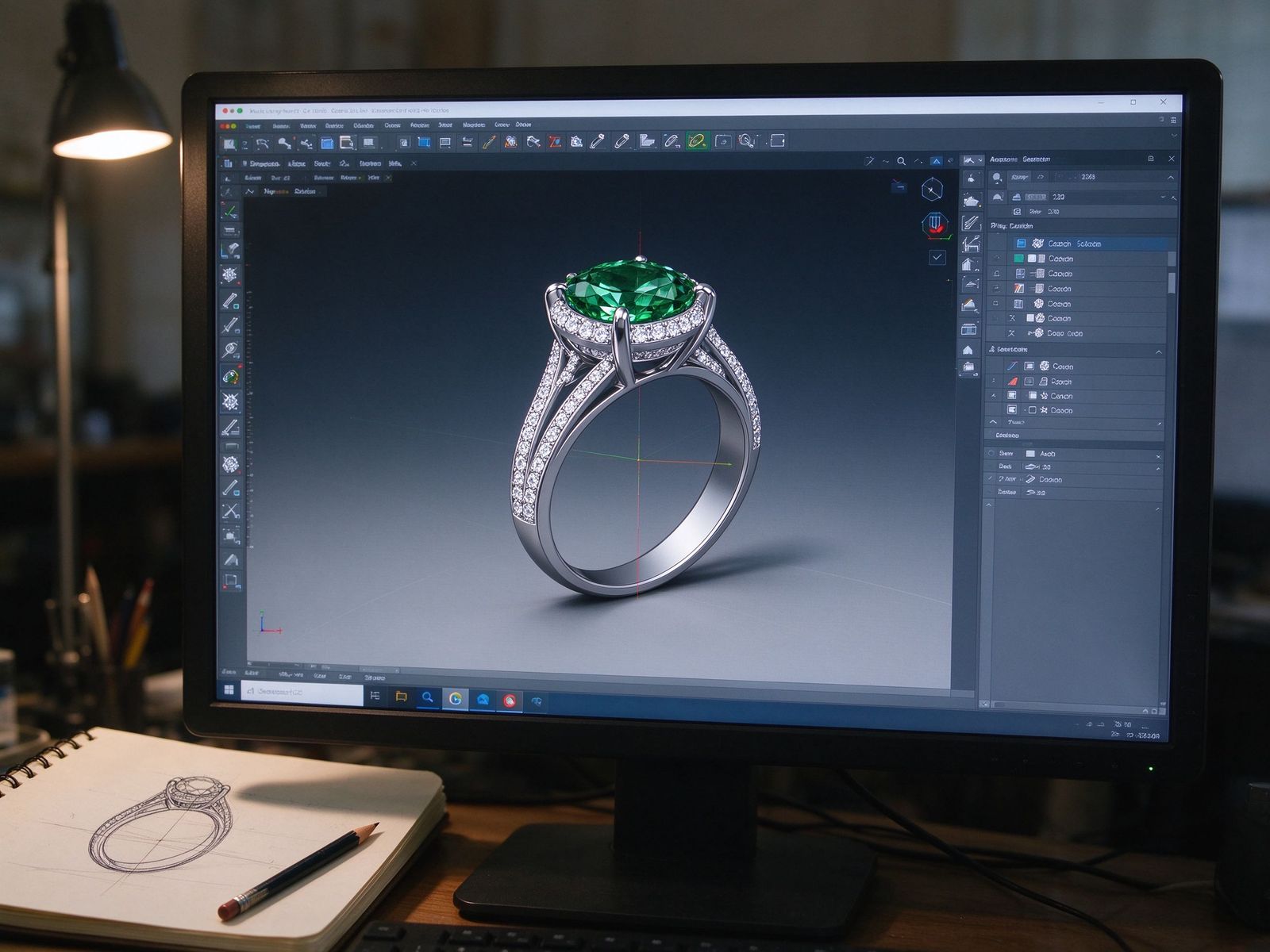
Step One: The CAD Render
After the consultation, our designer builds the ring in CAD software. You see a render from every angle: top, side, angle. You approve it or ask for changes. The render is not a guess. It is the exact geometry of the ring, to the millimeter. Once you approve, the CAD file is locked. Everything downstream is built from that file. If you want a change after approval, it means a new file, a new wax, and time. We encourage you to review the render carefully. It is your last chance to change anything for free.
Step Two: The Wax Pattern
The approved CAD file is sent to a 3D printer that builds a wax pattern, layer by layer. The wax is a resin-like material that looks and feels like jewelry wax. It is an exact miniature of the ring. We inspect it under magnification. If the wax has a defect, we reprint before casting. The wax is disposable; it will be burned away in casting. But it is the physical shape the metal will become.
Step Three: Casting
The wax is attached to a sprue, encased in a plaster-like flask, and heated in a kiln. The wax melts out, leaving a cavity. Molten gold or platinum is poured into that cavity, taking the exact shape of the wax. When the flask cools, the plaster is broken away and the ring emerges as a rough casting. It is the right shape but rough, pinkish, and covered in casting residue. This is the first moment the ring exists as metal.
- CAD render: the digital design you approve.
- Wax print: the physical model before metal.
- Casting: the wax becomes gold or platinum.
- Finishing: the rough casting becomes jewelry.
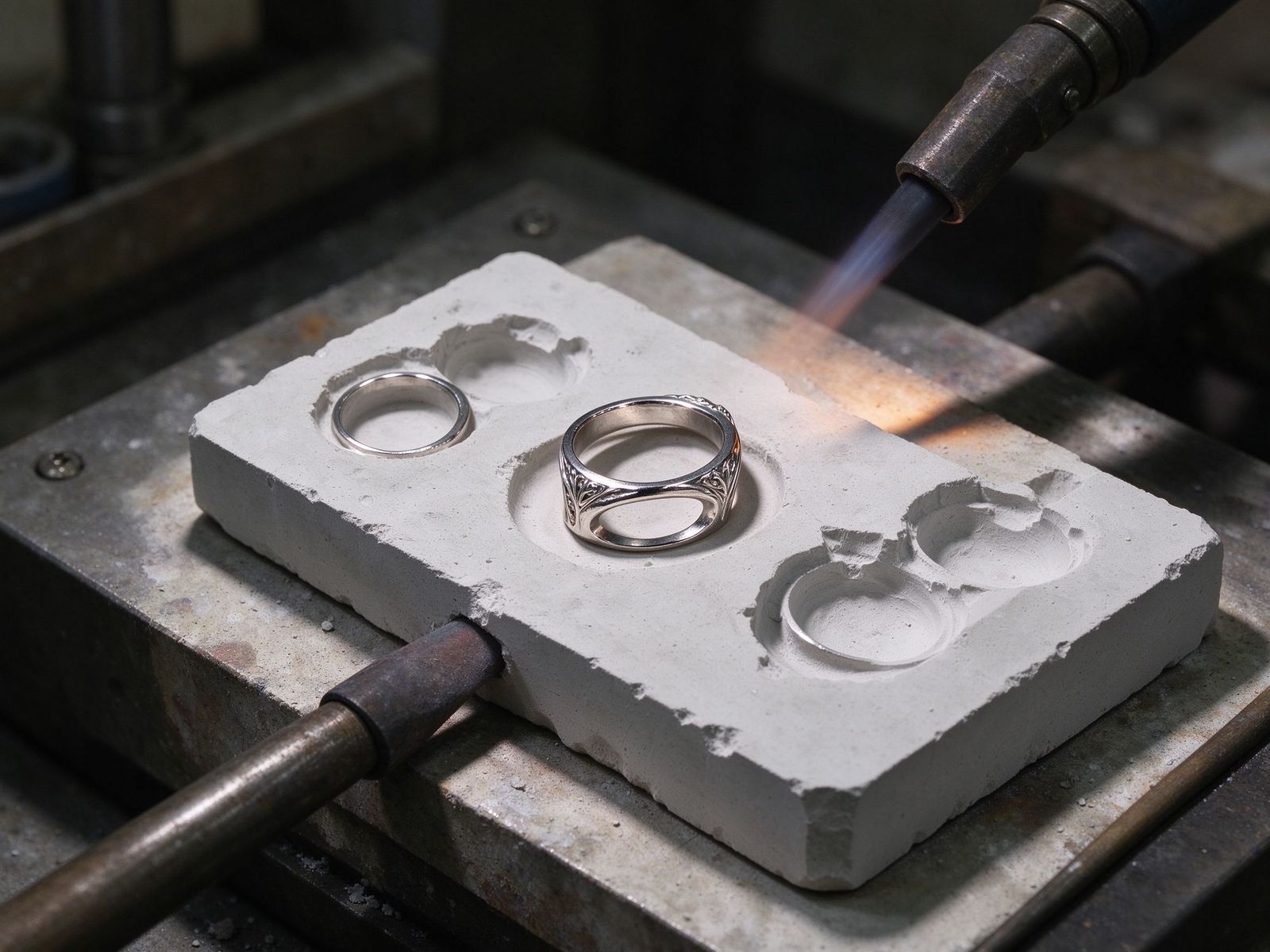
Step Four: Cleaning and Prepping
The casting is cut from the sprue, filed, and cleaned. The rough skin of the casting is removed. The ring is checked against the CAD to confirm it came out true. Gates and sprues are filed smooth. At this stage the ring looks like a rough version of itself, not yet polished, not yet set. It is metal, it is the right size, and it is ready for the next hands.
Step Five: Stone Setting
The stones are set. For a solitaire, the center stone is seated in the head and the prongs are bent over it. For pavé, each tiny melee is set by hand under magnification. Setting is where the ring goes from a piece of metal to jewelry. The stones are not glued. They are mechanically held by bent prongs or burnished metal. A good setting holds a stone for decades. A rushed setting loses it in months.
Step Six: Polishing and Finishing
After setting, the ring is polished. We hand-polish, going through progressively finer abrasives until the surface is mirror-bright. Engraving, if any, is added. The ring is cleaned, inspected, and boxed. This is the version you see at pickup. It is the result of every previous step, and the polish is what makes the design legible.
How Long the Whole Journey Takes
Typically six to ten weeks from approval to pickup. CAD takes a week. Wax and casting take a week. Setting and polishing take one to two weeks. Inspection and finishing take a few days. If you want changes, add time. Rush jobs exist but we discourage them. Each step needs its time. A rushed ring is a ring that skips an inspection, and skipped inspections are how stones loosen. We build on your timeline, not a faster one.
What You See Along the Way
You see the render for approval. You can request a photo of the wax before casting if you like. You see the finished ring at pickup. We do not drag you through every step, but you are welcome to watch. The workshop is open. Most clients come once, watch the polishing, and leave satisfied. The ring they collect is not magic. It is the result of six small, careful steps, each done by hand.
What You Approve At Each Step
You do not see every step, but you see the ones that matter. You approve the CAD render. You can, if you wish, see the wax before casting. You approve the finished ring at pickup. We do not make you watch the casting or the polishing, but those are open if you are curious. The key approval is the render. Once you sign off, the geometry is locked. If you want a thinner band, a lower setting, a different head, now is the time. After casting, changes mean starting over.
What Can Go Wrong, and How We Catch It
Casting can leave a small void. A stone can be set slightly off. A polish can miss a corner. We catch these at each stage. A void in the casting means a new casting. A tilted stone means a re-seat. We do not ship a ring with a known flaw. The journey is not linear; sometimes a ring goes back a step. That is normal. The goal is the finished ring, not the speed. A ring that goes back twice is a ring that arrives right.
Why It Takes Weeks, Not Days
Each step needs its own time. The kiln cycle takes hours and cannot be rushed. Setting requires a rested hand. Polishing compounds need to cure. Inspection needs a fresh eye. A ring built in a week is a ring that skipped a rest step. We build in six to ten weeks because that is the rhythm the work requires. Rush the rhythm and the ring shows it. We would rather deliver a great ring slightly late than a fine ring on time.
Frequently Asked Questions
Can I visit during the process
Yes. Book a time and we will show you the bench. Most clients come once.
What if I want changes after casting
Changes after casting mean a new ring. We lock the design at the render stage on purpose.
Do you rush jobs
We can, but we advise against it. Rushing skips rest and inspection time.
The Tools Behind the Bench
People ask what a modern atelier actually uses. The designer works on a CAD workstation with a professional jewelry design program, not a generic 3D tool. The wax printer is a resin printer tuned for casting burnout. The kiln is a programmable burnout oven that ramps and holds temperature on a schedule. The casting is done by centrifuge or vacuum, depending on the piece. The setter works under a binocular microscope. The polisher uses hand-held arbors with progressively finer compounds. None of these tools replaces the hand. They extend it. The CAD workstation does not decide the shank width. The printer does not know which way the light hits. The tools do the math. The bench team does the judgment.
A Typical Week on the Bench
Monday, we triage. Rings that arrived over the weekend are inspected, quoted, and routed. Tuesday through Thursday, the work happens: wax printing in the morning, casting in the afternoon, setting while the castings cool. Friday is polishing, inspection, and pickup. A ring started on a Monday is usually ready by the following Friday. Rush jobs happen, but they jump the queue at someone else's cost. We protect the rhythm because the rhythm is what makes the quality consistent. A ring built on a relaxed Tuesday is a different object than a ring rushed on a Friday afternoon.
What Clients Often Ask
Can I change the design after I approve the render
Before casting, yes, at no cost. After casting, a change means starting over. The render is the last cheap moment to adjust.
How do I know the ring matches the render
We measure the casting against the CAD. If it drifts, we fix it before setting. You see the finished piece at pickup and compare it to the render.
What if my ring is delayed
We tell you early. Delays happen, usually because a stone is sourced late. We will not surprise you on pickup day.
How We Quote Bespoke Work
When you walk in with a sketch, we quote three numbers: the stone, the setting and labor, and the finishing. You see each line. You can approve, trim, or adjust. We do not hide the labor inside a single number. Transparent quoting is how you know the split is fair. If the quote changes mid-build because a stone turns out to be more expensive than expected, we come back to you before we proceed. You are never surprised by the final bill.
How We Handle a Matching Wedding Band Later
This is one of the most common follow-up jobs. A couple bought the engagement ring two years ago, and now they want a wedding band that sits flush against it. Because we kept the CAD file, we pull it up and design the band to the exact shank width and head geometry. No re-measuring, no guessing. The band prints as a new wax, casts, and finishes. The whole job takes a couple of weeks. This is why we archive every design. The file on disk is worth more than the ring itself over a lifetime of matching pieces.
When the Stone Arrives Late
Stones source on their own schedule. Sometimes a center stone the client ordered is delayed, and the setting sits waiting on the bench. We do not start casting the setting until the stone is in the house, because we need to measure the seat to the actual stone, not the spec sheet. If the stone is late, the setting waits. We tell the client honestly. A ring built to a stone that has not arrived is a ring that will not fit. We would rather be late than be wrong.
The Day You Pick Up the Ring
Pickup is not just a handoff. We sit with you, put the ring on your finger, check the size, look at it under the loupe together, and go over the care instructions. We tell you when to bring it back for a free prong check. We photograph it. We hand you the box, the papers, and the certificate. Most clients are quiet when they see the ring. That is normal. The ring they imagined on a screen is finally on their hand. We give them a moment. Then we explain the warranty. The whole pickup takes fifteen minutes.
Why We Do Not Rush the Kiln
The burnout cycle takes hours. The kiln ramps slowly, holds temperature, and cools slowly. If we rush it, the wax boils and leaves residue, or the flask cracks. We cannot speed the kiln. We schedule casting days around the kiln cycle. This is why bespoke rings take weeks, not days. Each step has a physical minimum time. We respect that. A ring pulled out of a rushed kiln will have defects that show up months later. The slow kiln is the difference between a ring that lasts and a ring that fails.
What Your Ring Smells Like
When a ring first comes out of casting, it smells like burnt wax and metal. We clean it thoroughly. By the time it reaches pickup, it smells like nothing, just polished metal. The casting smell is gone. If you ever smell a new ring and it smells burnt, that is the residue of a rushed clean. We do not ship rings like that. The clean is part of the process, not an afterthought.
Closing Thought
A bespoke ring is not printed. It is built. The CAD is the blueprint, the wax is the model, the casting is the first metal, and the hands are what turn metal into jewelry. When you wear a bespoke ring, you are wearing the work of six different craftspeople. That is why it feels different from a shelf. It was made for your hand, step by step, and every step shows.