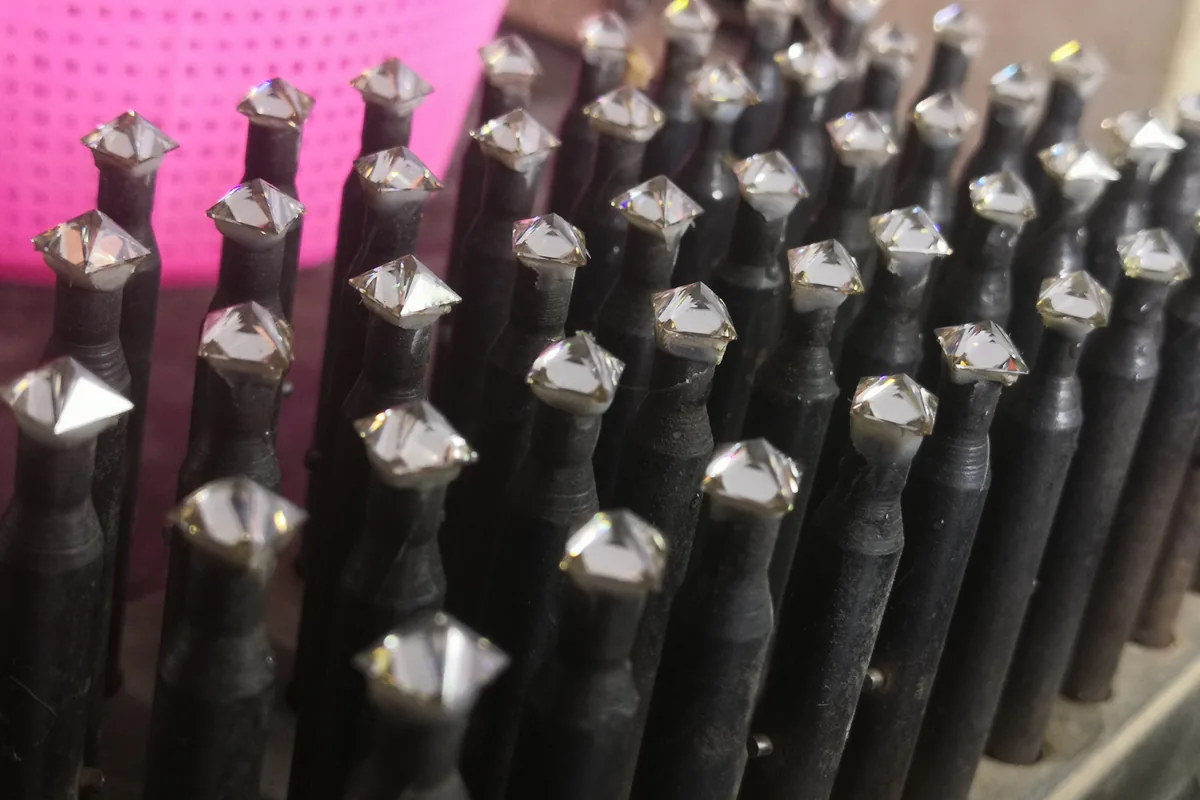
Every casting in the shop begins as a shape that someone removed material from. In the CAD era, that shape comes from a 3D printer, but hand-carved wax is still the fastest way to explore a form that has to be felt in the fingers: a signet top, a sculpted band, a relief charm. Wax carving is subtractive, forgiving, and cheap to redo, which is exactly why it survives next to the mill and the printer.
The waxes themselves
Carving wax comes in three families. Hard waxes (blue and green blocks) are firm, hold a fine edge, and are used for detailed carvings and ring models. Soft waxes (red, pink) are bendable at room temperature and are used for forming shanks and rounded bands where you want to shape rather than cut. Injection waxes are harder, higher-melt materials used for rubber-mold production; they are not carved by hand.
Block wax is bought in sheets and tubes of standard ring sizes, so a carver starts near the final dimension rather than from a raw block. A tube of wax for a size 7 shank is roughly 2 mm thick; the carver removes material from the outside and the inside rather than trying to build up.
The tool set is small on purpose
A carving bench does not need much. The core tools are: a set of wax files (flat, half-round, round), a set of wax drills and burrs in small diameters, a scraper, a wax pen (heated tip for welding wax pieces together), and a set of abrasives—0000 steel wool and fine wet-or-dry paper used wet. A pin vise with a small drill bit handles holes.
The heated wax pen is what makes carving forgiving. A mistake is not scrap; it is a dollop of wax welded back on, filed down again. That loop—remove, check, add back, refine—is how a form gets to final geometry without ever touching metal.
Carve with casting in mind
A carver who does not think about the foundry upstream produces waxes that come back pitted, thin, or lopsided. Three rules carry most of the work:
- Wall thickness. A wax wall under 0.6 mm often casts thin or breaks in burnout. Keep minimum sections above 0.8 mm unless the design truly demands it.
- No undercuts. If the wax will go into a rubber mold, undercuts lock the pattern in the mold and tear it on withdrawal. Direct-printed waxes have more freedom, but hand-carved production waxes should be drafted so they pull out clean.
- Sprue points. Leave a flat, accessible area where the foundry can attach a sprue. A sprue attached to a visible face leaves a nub that has to be ground away; a sprue attached to the back or inside the shank does not.
From wax to metal
Once the wax is carved, it is sprued to a rubber base, invested in a plaster-like flask, burned out in a kiln, and centrifugally or vacuum-cast. The metal that comes out is the exact negative of the wax. Every file mark, every fingerprint in the wax, every micro-scratch is reproduced in gold, silver, or platinum. The carver's job is therefore not only to make the shape but to make the surface—the casting will not improve on its own.
Finishing the wax surface before burnout
A carved wax does not go straight from the bench to the flask. The carver takes it through a sequence of abrasives, used wet, to remove file lines and any fingerprint left from handling. A wax that carries file marks into the kiln comes out as a casting that carries those same marks in gold, and the polisher spends hours chasing scratches that the carver could have removed in minutes. The final step on the wax is a pass with a cotton cloth dipped in mild soapy water, which brings up a clean surface without softening the detail. Once the wax is clean, it is handled only with tweezers or gloves; the oils in fingertips leave a dull patch that reproduces in the casting.
When carving beats CAD
Hand carving is slower to start but faster to iterate on organic forms. A sculpted band that takes an afternoon to carve may take three times that long to model in CAD, because the software fights you on asymmetry. For one-off sculptural pieces, signets, and textured surfaces, carving remains the default. For repeat production, the carved wax gets molded and the mold goes into regular production.
Buyers developing a line often ask whether to start with CAD or carving. The honest answer is that the first prototype is cheaper in either wax or resin; the decision is about the form, not the technology. For custom work, our team keeps carving tools on the bench next to the custom design station so a client can see a form in hand before it is quoted for production.
Independent background on moissanite — how its hardness and refractive index compare with diamond — is documented in the Wikipedia article on moissanite.
Frequently Asked Questions
How do I verify a factory before placing a bulk order?
Request a production video, business license, export records and a paid sample run. A factory that accepts a 50-piece test order is usually a real manufacturer.
What payment terms do you offer?
30% T/T deposit with the balance against the bill of lading. This protects both sides on first orders and can move to net terms after a track record.
What is your normal reject rate?
3–5% under 10x loupe inspection for cast and set pieces. Defective units are replaced free in the next shipment.
Where is the factory located?
Wuzhou, Guangxi, China—the core lab-grown and moissanite manufacturing cluster. Shipments go via Guangzhou or Shenzhen ports.


