CAD Design in Jewelry: How Digital Design Powers Modern Ateliers
Computer-aided design, known as CAD, has quietly revolutionized how jewelry is made. Where a generation ago every piece began as a hand-carved wax, today most wholesale and custom jewelry starts as a three-dimensional digital model on a screen. CAD does not remove the artisan; it moves the artistry from carving wax pixels and geometry, and it enables consistency, complexity, and speed that hand carving alone cannot match.
This guide explains how CAD design works in a modern jewelry atelier, what a designer actually builds on screen, how the digital model becomes a physical wax, and why CAD has become essential for both custom commissions and wholesale production. If you have ever wondered how a ring goes from an idea to a 3D-printable shape, this is the process.
What Jewelry CAD Actually Is
Jewelry CAD is specialized 3D modeling software designed for the constraints of casting and stone setting. A designer builds the piece as a watertight digital solid, defining wall thicknesses, prong shapes, stone seats, and comfort fits. Unlike generic 3D modeling, jewelry CAD must account for manufacturing realities: the model must be castable, the stones must fit, and the finished piece must be wearable. The software measures in millimeters, because a fraction of a millimeter changes how a ring sits.
A designer typically starts by importing reference measurements, such as the diameter of the center stone and the desired ring size. They build the shank, the head that holds the stone, and any pavé or halo, then refine the curves. The model can be rotated, sectioned, and measured on screen, which lets the designer catch structural problems long before any metal exists. This precision is the core advantage of CAD: errors are caught virtually, where they cost nothing to fix.
Modern jewelry CAD also includes libraries of standard stones, prongs, and findings, so a designer does not build every component from scratch. A skilled CAD artist combines these standard parts with custom sculpted surfaces to create a piece that is both manufacturable and beautiful. The result is a digital twin of the final metal object.
Designing for Casting and Wear
A jewelry CAD model must be designed for the real world of casting. Thin walls can break during casting, sharp internal angles trap air, and undercuts prevent the piece from being removed from a mold. The designer builds in enough metal at stress points, adds fillets where surfaces meet, and ensures the model has uniform wall thickness. These decisions are invisible in the finished piece but essential for a successful casting.
Comfort fit is another CAD concern. The inside of a ring shank is shaped so it slides over the knuckle smoothly, which the designer models precisely. Ring width, shoulder height, and the angle of the head all affect how the ring feels on the finger. A well-designed CAD model considers ergonomics, not just appearance. A pendant's bail is sized to fit the intended chain width; an earring's post is placed so the drop hangs at the right angle.
Stone seats are cut digitally to exact gem dimensions. The designer places each stone so it sits level, with enough metal around its girdle to hold it securely. Pavé stones are positioned so their seats do not overlap and weaken the shank. This digital planning means that when the physical piece reaches the setter, the stones already fit, reducing setting time and errors. CAD turns the jeweler's intuition into measurable geometry.
From Digital Model to 3D-Printed Wax
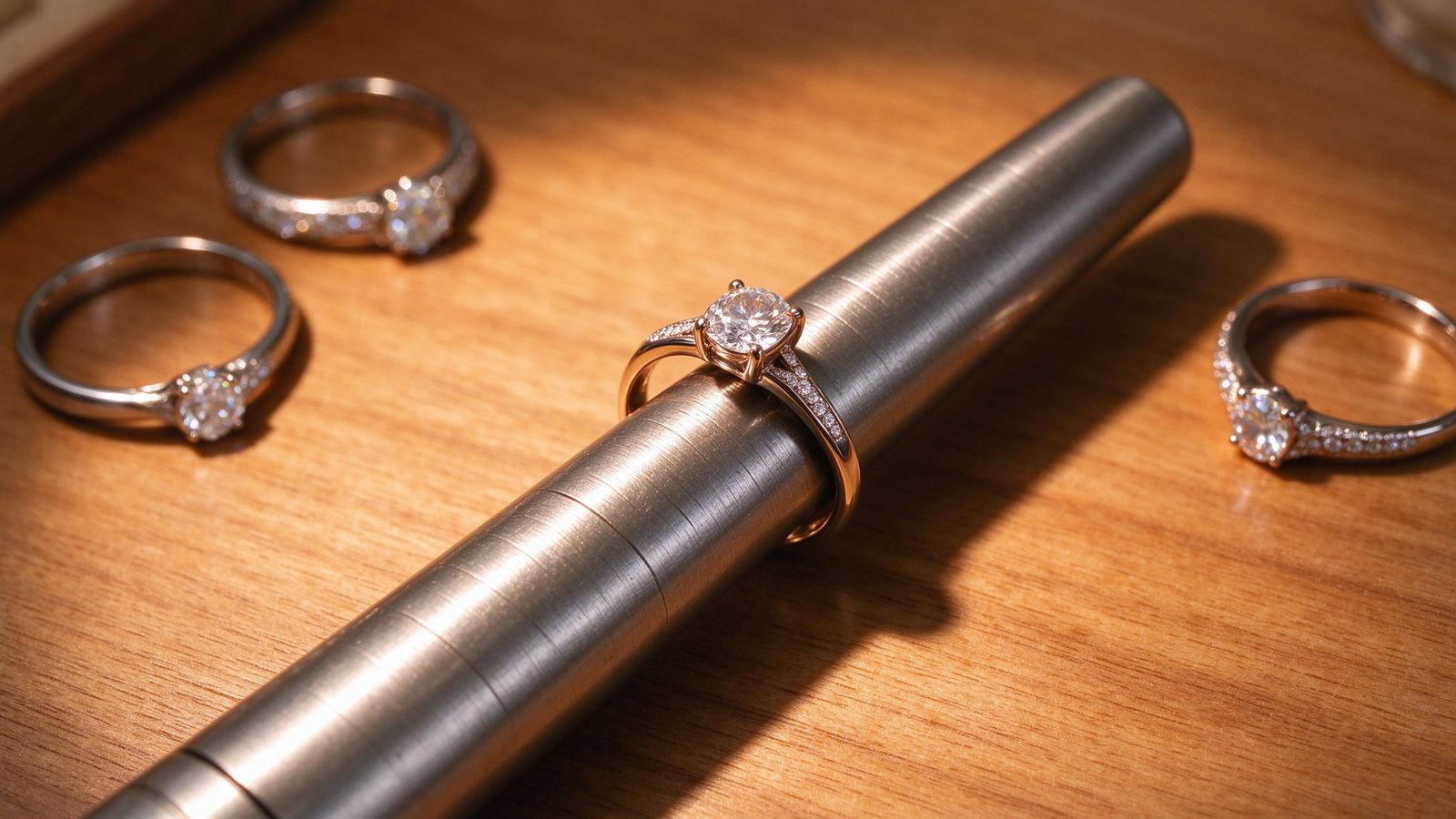
Once the CAD model is approved, it is exported as an STL file and sent to a 3D printer. Modern jewelry printers use stereolithography or binder jetting to build a wax-like resin or wax layer by layer. The printed object is a physical, slightly rough master that exactly matches the digital model. This step is where the digital becomes physical, and it is extraordinarily accurate, reproducing details as fine as a textured surface or a tiny engraved pattern.
The printed master is then cleaned, cured, and inspected. A wax finisher removes support marks, smooths layer lines, and adds any fine detail the printer could not reproduce. For a production line, this master is used to create a silicone rubber mold into which injection waxes produce identical copies. For a one-off custom piece, the printed wax is cast directly. Either way, the digital model lives on as the template.
The ability to print and inspect a wax before casting is a major advantage. A designer can see whether the proportions look right in three dimensions, adjust the CAD file, and reprint, all before spending metal. This rapid prototyping is why custom jewelry is faster and more accurate than it was a generation ago. The digital model, not the sketch, is now the true blueprint.
CAD for Custom Commissions
CAD has transformed the custom commission experience. A customer can approve a photorealistic 3D rendering of their ring, see it from every angle, and request changes before anything is made. This eliminates the surprise of a finished piece that does not match expectations. The designer can show how different stones, metals, and band widths look, and the customer chooses from realistic options.
For a commission involving a family stone or an heirloom, CAD lets the designer model the existing stone exactly and build a setting around it digitally. The customer sees the result before the old setting is touched. This has made bespoke jewelry accessible: whereas hand-carving several waxes was expensive, iterating in CAD is cheap, so customers can refine the design to their taste.
The trade-off is that CAD pieces can look slightly uniform if the designer relies too heavily on libraries. The best CAD artists sculpt organic details by hand within the software, giving each piece character. When combined with hand finishing and setting, a CAD-made piece can be every bit as personal as a hand-carved one, with the added benefit of accuracy.
| CAD Stage | Purpose |
|---|---|
| Modeling | Build 3D geometry to spec |
| Wall thickness check | Ensure castability |
| Stone seats | Fit gems exactly |
| 3D print | Produce wax master |
| Wax finishing | Smooth and detail |
CAD for Wholesale Production
For wholesale jewelry, CAD's greatest value is consistency. A design built once in CAD can be reproduced in hundreds or thousands of identical pieces, all cast from the same rubber mold. This means a jewelfmfg.com customer can reorder a popular ring months later and receive a piece that matches the original exactly. Hand-carved pieces, by contrast, vary subtly each time.
CAD also enables complex designs at scale. A detailed pavé halo or an intricate filigree pattern can be modeled once and printed repeatedly, which would be slow and inconsistent to carve by hand. This is why modern wholesale jewelry can offer elaborate designs at accessible prices. The investment in the CAD model is amortized over many castings.
Wholesale buyers benefit indirectly: the designs they stock are dimensionally consistent, the stones fit predictably, and reorders match. When evaluating a supplier, ask whether they control their own CAD and printing, because an in-house atelier that designs, prints, and casts in one facility has far tighter quality control than one that outsources each stage.
The Limits and Future of Jewelry CAD
CAD is powerful but not magic. A digital model is only as good as the designer's understanding of casting and setting. A beautiful on-screen model that ignores wall thickness will fail in the kiln. This is why experienced jewelers, not software operators, build jewelry CAD: the software is a tool for applying craft knowledge. CAD also cannot replace hand carving for genuinely organic, sculptural pieces where irregularity is the point.
Modern CAD is evolving toward faster rendering, automated stone-setting layouts, and integration with scanning existing pieces. A jeweler can scan a ring to be copied, refine it in CAD, and reprint it. This technology makes repair and replication more accurate. But the human judgment of what looks right, what wears comfortably, and what is structurally sound remains the bottleneck.
For buyers, understanding CAD explains why modern jewelry is so consistent and detailed. The next time you admire a precisely set row of pavé or a perfectly balanced halo, know that a designer planned every millimeter on a screen, and a printer turned that plan into wax. CAD has become the backbone of the modern atelier, preserving craft while making it scalable.
CAD Mistakes That Cause Casting Failure
A digital model that looks perfect on screen can still fail in the kiln. Common CAD errors include walls that are too thin, internal angles that trap air, undercuts that block mold release, and prong tips that are too short to grip the stone. Experienced CAD designers check for these before sending a model to print, because a failed casting wastes metal and time. This is why jewelry CAD is a skilled trade, not just software operation.
Thin walls break during casting or wear quickly on the finger. Sharp internal corners hold investment and create pits. Prongs that are too short leave stones loose. A good designer builds in fillets, adequate wall thickness, and comfortable ergonomics, then reviews the model as if it were already metal. Catching these issues digitally is free; fixing them after casting is expensive.
The Designer's Eye on Screen and in Hand
CAD renders a piece photorealistically, but the physical wax and metal reveal proportions the screen hides. A designer who knows both mediums adjusts on screen based on experience of how a casting will feel. A band that looks sleek in CAD may be too thin to wear, so the designer thickens it. This marriage of digital precision and physical intuition is what makes modern CAD work well. The best ateliers print a wax, feel it, and refine the model before casting.
This iterative loop is invisible to customers, but it shows in the finished piece. A ring that sits comfortably, a pendant that hangs at the right angle, a clasp that feels solid, all come from a designer who tested the digital and physical versions. CAD has not removed craft; it has focused craft on getting the geometry right before the metal exists.
Why CAD Matters to Wholesale Buyers
For wholesale buyers, CAD is the reason modern jewelry is so consistent and affordable. A design built once can be reproduced identically, so reorders match the original. Complex pavé and filigree that would be slow to carve by hand can be printed and cast precisely, making elaborate designs accessible. When you source from an atelier with its own CAD and printing, you get dimensionally consistent pieces, predictable stone fit, and fast reorders. Ask whether the workshop designs in-house, because that capability signals both quality control and design flexibility. A supplier that controls its own CAD can also adapt designs to your requests, which is a valuable advantage for a custom or private-label line. The digital backbone of modern jewelry is what lets a small brand offer detailed, well-fitting pieces at accessible prices.
How Our Designers Turn an Idea Into a Model
The CAD desk is where a sketch becomes manufacturable. A designer at our bench starts with the customer's vision, then builds the ring as a watertight digital solid, measuring every millimeter. They check that the shank is thick enough, the head holds the stone securely, and the inside is shaped for comfort fit. A model that looks beautiful on screen but would cast poorly is sent back, because we know the kiln punishes bad geometry. This careful digital planning is why our castings come out clean and our stones fit perfectly.
Once approved, we 3D-print the wax and often let the customer approve a rendering before any metal exists. That removes surprises. The digital model is then cast, and the hand finishing begins. What looks like software is really the designer's craft, applied to geometry. For customers, this means the piece they ordered is the piece they receive, accurate to the millimeter, every time. CAD has made our work more precise, not less human.
From Model to Manufacture
Once a CAD model is approved, the real craft of turning it into metal begins. The model is exported as a mesh and 3D-printed in a high-resolution resin wax. Our team then reviews that printed wax for fit and finish before it ever reaches the kiln, because a digital perfect model can still reveal surprises in the physical wax. If a prong feels thin or a shank edge sharp, we go back and adjust the model rather than cast a flawed piece. This loop between screen and physical wax is what makes our CAD work reliable.
For wholesale customers, this means reorders are exact. The same model file produces the same ring every time, so a size six reordered next year matches the original. We can also tweak a design quickly, changing a ring width or stone size in the model without starting from scratch. CAD has not removed craft; it has moved the craft upstream, so that by the time metal is poured, the design is already proven. The result is jewelry that is both precise and comfortable, built once on screen and reproduced consistently.
Frequently Asked Questions
What software do jewelers use for CAD?
Specialized jewelry CAD packages build watertight, castable models with exact stone dimensions. These differ from generic 3D tools because they account for casting and setting constraints.
Is CAD jewelry better than hand-carved?
CAD offers consistency, accuracy, and rapid iteration; hand carving offers organic character. The best workshops combine CAD for structure with hand finishing and setting.
How does a CAD model become a physical ring?
The digital model is exported and 3D-printed as a wax or resin master, which is then invested and cast in metal using the lost wax process.
Can I see my custom ring before it is made?
Yes. CAD lets a workshop show you a photorealistic 3D rendering from every angle, so you can approve or adjust the design before any metal is cast.
Why is CAD important for wholesale?
It lets one design be reproduced identically at scale. Reorders match, stones fit predictably, and complex pavé designs become affordable.
CAD is the invisible backbone of modern jewelry. It turns sketches into precise digital models, those models into 3D-printed wax masters, and those waxes into consistent castings. It makes custom commissions transparent and wholesale production repeatable. Yet CAD remains a craft tool, guided by artisans who understand casting and setting. When you buy from an atelier that designs digitally and finishes by hand, you get the best of both: the accuracy of engineering and the warmth of handcrafted jewelry.