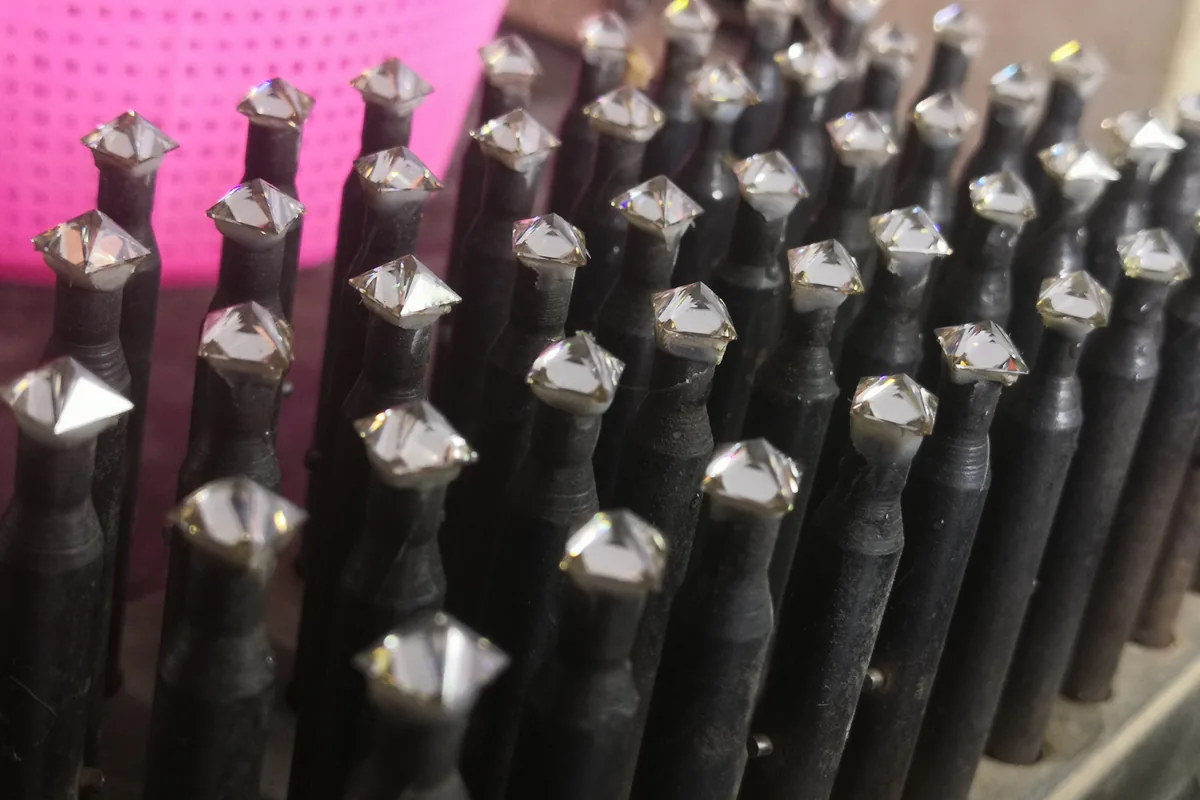
A buyer once sent us a photo of a competitor's ring: the center stone sat crooked, one prong was folded over the girdle instead of the crown, and the finish around the seat looked chewed. The buyer assumed the setter was untrained. More often, the problem is the bench itself. A setter with the wrong burrs, no proper seat-cutting setup, and a 10x loupe instead of magnification cannot make a tight setting no matter how skilled they are. Stone setting is half hand, half tooling, and the tooling is what scales across a production run.
The core kit on a production bench
Forget the romance of a single goldsmith's hammer. A setting bench running 30 to 50 pieces a day relies on repeatable geometry. The essentials include: a flex shaft with a foot pedal for seat cutting; a set of setting burrs (cup, Hart, and setting bud) sized to each stone; a beeswax stick or shellac stick to hold the stone while seating it; a prong pusher or bezel pusher sized to the metal; a burnisher for closing bezels; a pair of half-round pliers for prong alignment; and a minimum 10x loupe or, better, a stereo microscope at 10x to 40x for inspection. We bench-mount microscopes on our setting stations because the difference between a prong touching the pavilion and hovering 0.2mm off it is invisible at arm's length.
The stone itself dictates the seat. A 6.5mm round brilliant needs a seat cut to its girdle diameter, with the pavilion supported so the culet does not touch the metal and crack on impact. Color, clarity, and cut grade from a reference such as the GIA 4Cs tell the setter how much pressure the stone can take: a heavily included stone will flex and crack under a pusher where a clean, well-cut stone closes without complaint.
What changes between one-off and production setting
In a one-off repair, a setter hand-fits each seat. In production, the seat geometry must be pre-engineered into the wax or CAD so the setter is closing metal, not carving it by eye. That is why we cut seat templates from the actual stone size on a master ring, then check each production seat against it. The tolerance we hold is about +/- 0.15mm on the seat diameter; beyond that, prongs either do not close or overhang the crown and snag on fabric.
Tool wear is a silent failure point. A setting burr that has cut 400 seats starts to round over and leaves a scalloped, uneven seat. We log burr life and rotate them on a fixed schedule rather than waiting for a bad piece to appear. The same logic applies to pushers: a pusher with a burred tip will mar the prong finish and leave a mark that requires extra polishing to remove, which thins the prong and weakens it over time.
How this shows up in your QC
When you inspect a production setting, look past the sparkle. Under magnification, each prong should contact the stone evenly, the girdle should sit level, and there should be no daylight gap under the seat. Tug each stone gently. A properly set stone does not move. If you are running a program with matched stones, pair setting precision with disciplined stone color and grade selection, because even a perfect seat cannot hide a stone that is the wrong shade for the lot.
Setting also interacts with repair. A prong that was closed too aggressively cracks later, which is why we evaluate shank and prong repairs as weld versus remake decisions rather than patching every failure. And high-volume setting programs often begin with a 3D-printed wax pattern that sets the seat geometry before casting, which is where resolution and fit notes matter.
One more detail shops rarely put in quotes but buy repeatedly: heat control. A flex shaft held too long on one spot softens the prong and warps thin shanks, so operators work in short bursts and let the part cool. We also keep a dedicated seat burr per stone size and log how many seats each has cut, because a worn burr is invisible until 200 rings come back with uneven prong closure. For buyers, ask whether the bench logs tool life; the answer separates a measured shop from one that waits for defects to appear.
FAQ
Do you set every stone under magnification?
We inspect every seat and prong under a stereo microscope at QC. The setter works at the bench, and a second station confirms each piece before it moves to finishing.
What stone shapes require the most setup?
Fancy shapes such as ovals, pears, and cushions need custom seat burrs and more alignment time than rounds. Budget 30 to 50 percent extra setting labor on irregular shapes.
How tight should prongs be after setting?
Prong tips should contact the crown evenly with no visible gap, and the stone should not shift under light finger pressure. Over-tightening risks chipping the girdle; under-tightening risks a lost stone in the field.
Running a production setting program? HOLYCOME sets diamonds, moissanite, and colored stones to +/-0.15mm seat tolerance under magnification, with matched stone grading per lot. Tell us your stone size and quantity for a custom manufacturing quote.
Frequently Asked Questions
How do I verify a factory before placing a bulk order?
Request a production video, business license, export records and a paid sample run. A factory that accepts a 50-piece test order is usually a real manufacturer.
What payment terms do you offer?
30% T/T deposit with the balance against the bill of lading. This protects both sides on first orders and can move to net terms after a track record.
What is your normal reject rate?
3–5% under 10x loupe inspection for cast and set pieces. Defective units are replaced free in the next shipment.
Where is the factory located?
Wuzhou, Guangxi, China—the core lab-grown and moissanite manufacturing cluster. Shipments go via Guangzhou or Shenzhen ports.


