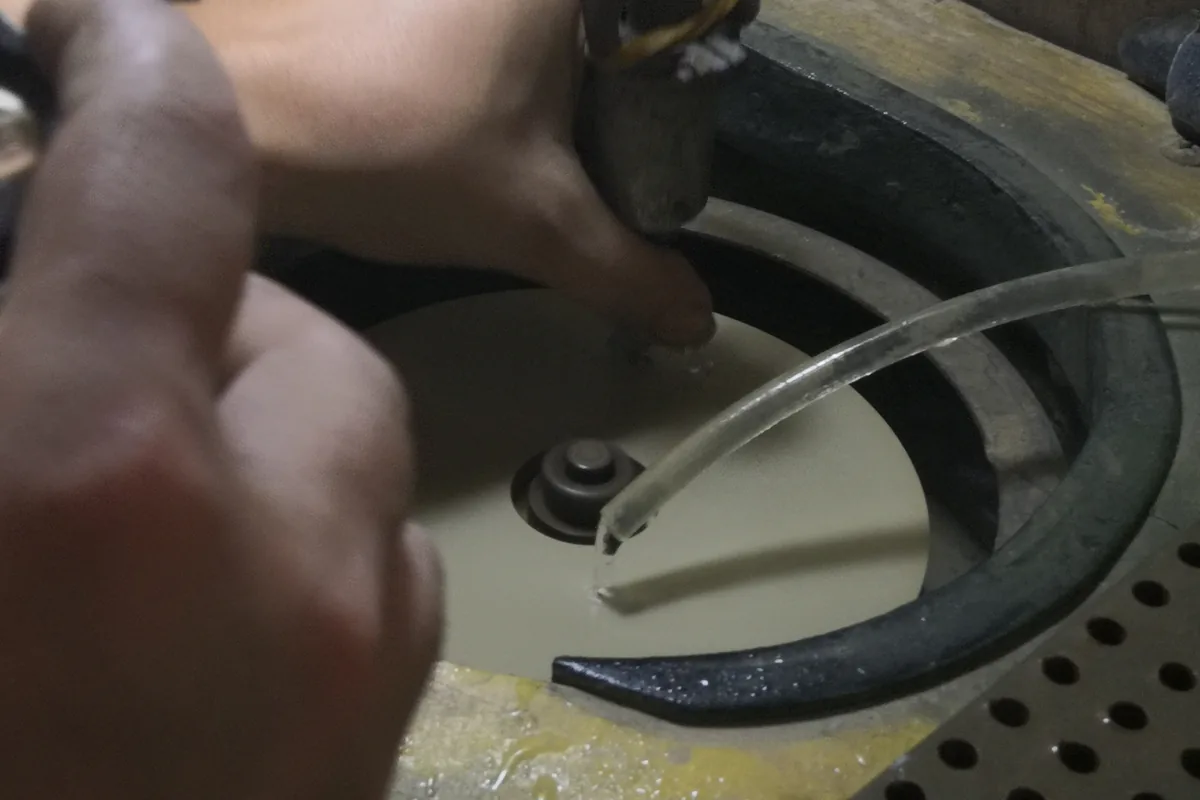
There is a moment in every ring we make that happens between the last solder seam and the first trip to the polishing room. The ring sits on the mandrel, filed straight, measured for size, and the bench jeweler picks up a hardened steel tool called a burnisher and runs it, firmly and steadily, along every outside edge of the shank. No heat, no cutting, no abrasive. Just pressure. That step is called burnishing, and it is the difference between a ring that wears smooth for twenty years and one that starts to feather at the edges within two.

What burnishing actually does
Metal, after filing and sanding, has a microscopically ragged edge. Look at it under a loupe and it is not a clean line — it is a fringe of tiny burrs and folds, almost like frayed cloth. A polish wheel will shine that fringe, but it will not remove it entirely. The first time the ring brushes against a counter or another piece of jewelry, those micro-burrs catch, fold, and begin to lift. Six months later, the ring has a faint “feathered” edge that looks worn before its time.
Burnishing does not cut anything. It pushes the surface metal sideways and down, folding that fringe flat against the shank and work-hardening it. The result is a dense, smooth edge that the polishing wheel can then bring to a true, even shine. We wrote about the wider family of surface finishes in metal finishing, brushing, and patina, but burnishing is a distinct step that happens before any of those.
The tools
A burnisher is a piece of very hard, highly polished steel — often agate or horn on older European bench tools — shaped to a rounded point or blade. We keep several on the bench because the right shape depends on the geometry: a narrow burnisher for inside shanks, a wider curved one for outside bands, a pointed one for shouldering around settings. The tool itself must be mirror-smooth; a scratched burnisher will leave lines in the metal instead of closing them.
When we burnish
It is not a one-time event. We burnish:
- After filing and before polishing on every new band, to close the outer and inner edges.
- After stone setting, around the base of prongs, to tuck the metal down against the girdle so the prong grips rather than leans.
- At refurbishment, when an old ring comes in with feathered edges, to reset the edge without adding metal.
That third point is worth dwelling on. A lot of “worn out” rings are not worn out at all — they just have ragged edges from years of catching on things. A burnish, a quick polish, and a prong check can bring a fifteen-year-old ring back to factory edges without a single drop of solder.
Why machines do not replace it
Some automated finishing systems use tumblers or rotary burnishing with media, and those are useful for bulk chains and castings. But on a bespoke ring, around a setting, next to an engraved detail, the human hand controls pressure the machine cannot. The burnisher responds to resistance; the jeweler feels where the metal wants to fold and adjusts. That is why we still do it by hand, and why it is one of the steps that separates a hand-finished piece from a cast-and-buffed one — a distinction we unpack in handcrafted vs. machine-made jewelry.
How to tell if it was done
Run a fingernail along the outer edge of a well-finished band. It should feel like continuous, rounded glass, with no catch at any point. If you feel a faint line or a catch, the edge was likely polished without being burnished first. On a new ring you are buying, that is a quiet signal about how the shop runs its bench.
Burnishing is invisible when it is done right — which is exactly the point. The customer should never see the edge. They should only feel, years later, that the ring still sits smooth on the hand.
What happens when a shop skips it
You can usually tell, if you know what to look for. A ring that was cast, sanded, and sent straight to the buffing wheel will look perfectly shiny on day one. Run a fingernail along the shank edge, though, and you will feel a faint, almost microscopic catch. Over a year of desk work, hand-washing, and brushing against other jewelry, that catch becomes a visible bevel — the edge looks worn, even though the metal underneath has barely moved. A burnished edge, by contrast, stays crisp because the surface metal is dense and work-hardened rather than frayed. The difference shows up at the two-year mark, not the two-week mark, which is why it is so easy to overlook when you are comparing finished pieces on a shelf.
We burnish every band we ship, whether it is a simple wedding ring or a multi-stone commission. It adds maybe ten minutes to the bench time. It is also one of the cheapest, most reliable ways to make a piece feel like it was made by hand rather than poured out of a mold — which is the whole reason we keep doing it.
Independent background on moissanite — how its hardness and refractive index compare with diamond — is documented in the Wikipedia article on moissanite.
Related reading: Hand Polishing: Why We Finish Every Ring by Hand, Prong Checks: The Signs Your Ring Needs a Bench Visit Before It Loses , Hand Setting Diamonds: Behind the Bench With Our Setter.
Frequently Asked Questions
How do I verify a factory before placing a bulk order?
Request a production video, business license, export records and a paid sample run. A factory that accepts a 50-piece test order is usually a real manufacturer.
What payment terms do you offer?
30% T/T deposit with the balance against the bill of lading. This protects both sides on first orders and can move to net terms after a track record.
What is your normal reject rate?
3–5% under 10x loupe inspection for cast and set pieces. Defective units are replaced free in the next shipment.
Where is the factory located?
Wuzhou, Guangxi, China—the core lab-grown and moissanite manufacturing cluster. Shipments go via Guangzhou or Shenzhen ports.


