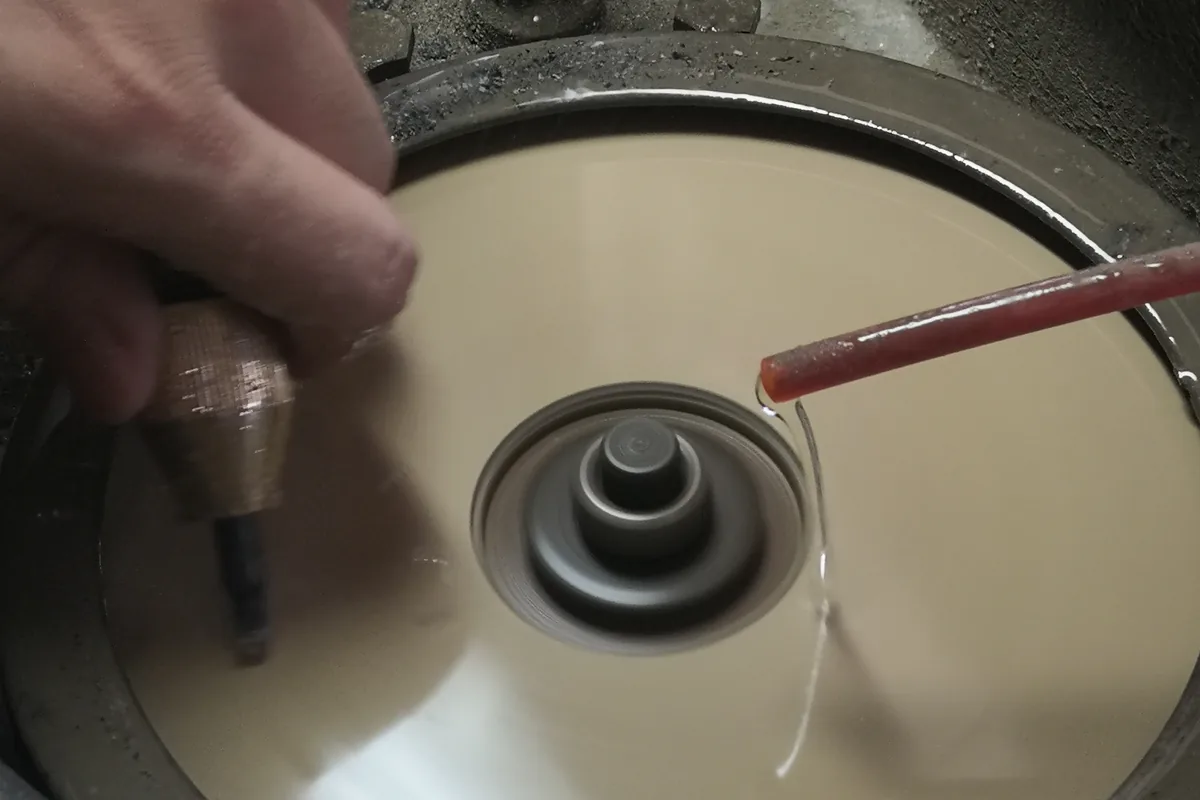
A brand in Sydney sent us back a photo shoot of their new 925 silver band line. The CAD was clean, the casting was clean, but every product shot looked grey. The photographer blamed the lighting; the buyer blamed the plating. The real cause was the last polishing step: the factory had buffed with rouge on a dirty mop that carried tripoli residue, and the red compound could not cut through. Final rouge is where a ring either looks expensive or looks cheap. Here is how our bench runs it.
Why rouge is a finishing step, not a starting point
Rouge (iron oxide) is a cutting compound with the finest grit in the polish family. It only works on a surface that is already 90% flat. If you hit a scratched casting with rouge, you spend ten minutes on a buff and move a fraction of a micron; the scratch stays. The sequence has to be rough to fine: sanding belts, then tripoli (brown) to cut, then white diamond to refine, then red rouge to color. Skipping ahead is the most common finishing mistake we see in outside samples.
Sterling silver shows haze faster than gold because it is softer and burns on the mop at lower RPM. Our bench runs silver at 3,500 RPM and gold at 4,500. Read the background on our full high-shine sequence and which mop pairs with which compound. The metal itself is covered in the sterling silver reference on Wikipedia.
Our rouge bench rules
Dedicated mop, never shared
Rouge lives on a loose calico mop that touches nothing else. A mop used for tripoli leaves brown grit embedded in the cloth; rouge on it drags that grit across a finished surface and writes micro-scratches you only see under angled light. We color-code mops and hang them by compound.
Light pressure, cool work
Pressing hard burns silver and lays a smeared layer over the surface that looks bright in the room but looks hazy under store spotlights. We use finger-tip pressure and keep the piece moving, dipping it into water between passes when it gets warm. A hand can hold a properly buffed ring; if it gets too hot to touch, the bench is working wrong.
Inside the shank first, faces last
We finish the inside of the band and the gallery rails before the outer face, because holding the ring to buff the inside scuffs the face. Faces get the final rouge pass, then the piece goes straight into the ultrasonic. Anything left on the rag after the face is done is off the list.
| Stage | Compound | Mop | Time per ring |
|---|---|---|---|
| Cut | Tripoli (brown) | Stitched sisal | 40-60 s |
| Refine | White diamond | Soft calico | 30-45 s |
| Color | Red rouge | Loose calico | 20-30 s |
After rouge the piece goes through a 90-second ultrasonic in warm soapy water, then a steam clean, so no rouge dust dries in engraving channels. We compare this against the full compound ladder and when hand finishing beats barrel finishing.
How we test the shine before plating
We hold every fifth ring up at 45 degrees under a 5,000 K LED bar. A true high shine throws a long, straight reflection. A hazed surface scatters that reflection into a fog. If we see fog, that ring goes back to white diamond and gets re-rouged. Rings that pass the light test plate more evenly because rhodium follows the surface it is given; a hazy base plate looks thin even at the correct 0.5 micrometre thickness.
Frequently Asked Questions
Can I use rouge to remove deep scratches?
No. Rouge removes about 0.1 micron per pass. A scratch needs sanding belts and tripoli first. Trying to rouge out a scratch wastes mops and burns the surface.
Why does my silver look grey after polishing?
Almost always a contaminated rouge mop or a burnt surface from too much pressure. The fix is a clean loose calico mop and lighter touch, not more time on the buff.
Does gold need a different rouge than silver?
We use the same red rouge for both, but gold at higher RPM and shorter passes. Rhodium-plated white gold and silver get a final rouge before plating; yellow gold wears it as the final finish.
How long does a hand-rouged ring take?
About two minutes total per simple band after sanding. Detailed pavé pieces take four to five minutes because the setter has to avoid catching prongs on the mop.
Will plating cover a dull polish?
No. Rhodium is 0.5 micron thin and follows the base. A dull polish under rhodium reads as dull plating. The shine has to be right before the bath.
Key takeaways
- Rouge is the color step, not the cut step; sequence compounds coarse to fine.
- Dedicated mops per compound, color-coded, hung up between uses.
- Test the reflection at 45 degrees under a 5,000 K bar before plating.
Next step: send us a sample of your current finishing photos and we will flag which stage is failing. We quote bulk polishing as a standalone service or built into a custom manufacturing run from 20 pieces per SKU, with before/after light-test photos on every batch.


