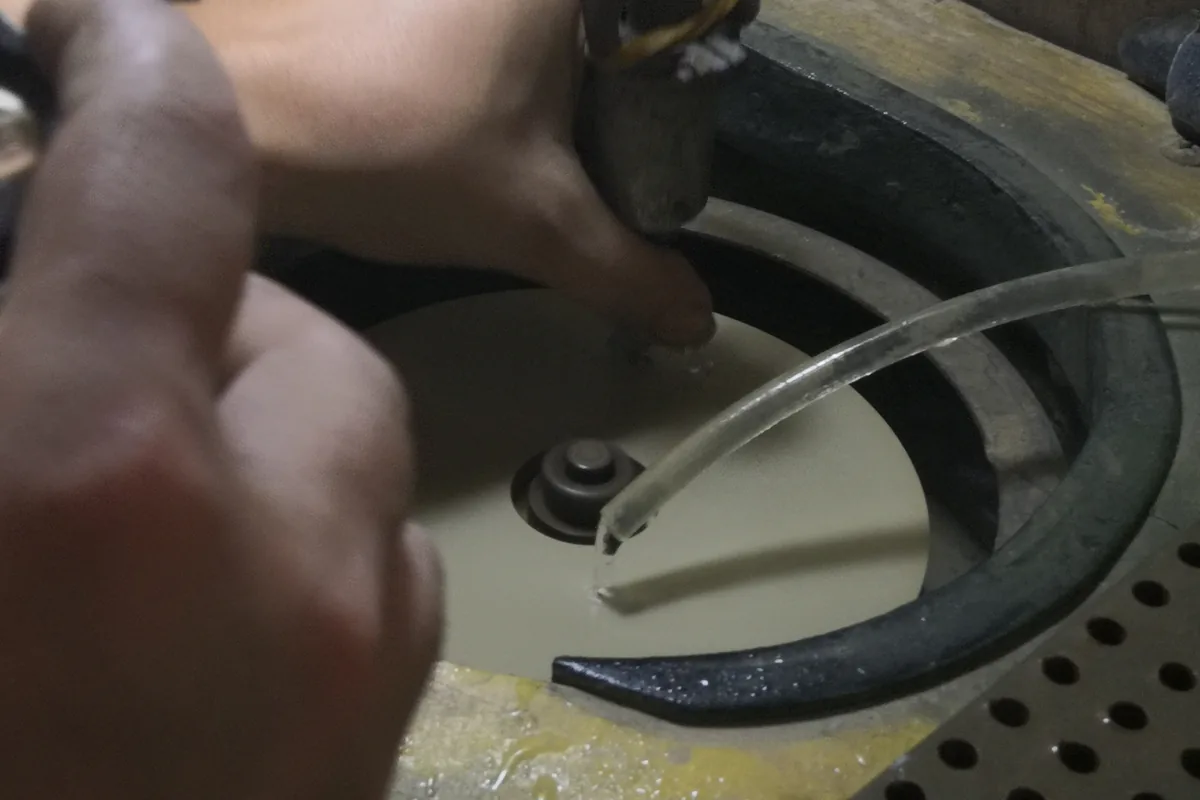
A batch of 300 sterling rings comes back from the plating house looking chalky under the light. The plater blames the polish room, the polish room blames the barrel, and the brand's product manager wants to know who pays. The root cause is almost never the plating bath itself. It is the final high-shine sequence on the bench: the buff was stopped at tripoli, the rouge was applied dry, and nobody burnished the shank before the piece went into the rack. A jewelry-grade mirror is built in three specific steps, and skipping any one of them shows up the moment rhodium hits the surface.
Why high shine is a sequence, not a compound
Each polishing compound cuts a specific grit depth. Tripoli leaves roughly 10 to 15 micron swirls; rouge cuts those down to 2 to 3 microns; burnishing with a steel or agate tool compresses the surface below 1 micron. If you jump from 220 grit sanding straight to rouge, the rouge buff spends its day chasing scratches it cannot remove, and the piece looks hazy under 10x. Our earlier write-up on bench polishing compounds and mop sequence covers the rotary setup; this article is about the last three compounds before plating, where the shine actually lives.
Tripoli to rouge: grit drop and buff speed
Tripoli runs on a stitched cotton buff at 3500 RPM with light pressure, about 5 to 8 Newtons of finger force. The buff should flex 5 to 10 mm against the ring. Move to a loose cotton rouge buff at the same speed, but cut the pressure to 2 to 3 Newtons. Any harder and the buff burns the surface, leaving a yellow-brown heat tint on silver that rhodium will not hide. Inside shanks and under heads we switch to a 25 mm felt bob charged with white diamond compound at 1800 RPM, because a cloth buff cannot reach 5 mm deep into a cathedral head. The sterling silver reference on Wikipedia notes the copper content that oxidizes under heat, which is exactly the heat tint we are avoiding.
Burnishing and the post-plate touch-up
After rouge, we burnish high-contact spots: the outer edge of the shank, the top of the head, and the tips of prongs. A steel burnisher at 2000 RPM, moved in short 5 mm strokes, compresses the surface and closes the micro-scratches that plating would otherwise amplify. This step is why hand polishing beats mass finishing on engagement rings. After rhodium plating comes back, we do a 10-second touch-up on a clean soft buff with no compound, just to knock off the rack marks. The connection between finishing stages and compound choice is that each stage is smaller in grit than the last; mixing them up is the most common shop error.
Bench numbers we log
Tripoli buff: 3500 RPM, 5 to 8 N pressure, 8 to 12 seconds per ring. Rouge buff: 3500 RPM, 2 to 3 N pressure, 10 to 15 seconds. Felt bob in shank: 1800 RPM, white diamond compound, 5 seconds per side. Burnisher: 2000 RPM, 3 short strokes on shank edge. We also knock back the pre-polish file and grit stages to a 600 grit finish before tripoli; anything coarser leaves swirls that rouge cannot chase. A barrel finishing cycle can prep the back of a pendant, but it never replaces the bench final on a face-up ring. We log the buff color change on the rack tag: when tripoli stops leaving a black smear on the buff, the piece is ready for rouge.
FAQ: Final high shine on the polishing bench
Why does my ring go dull after rhodium plating?
Because the pre-plate surface was not actually mirror. Rhodium is 0.1 to 0.3 micron thick and it photographs every swirl below it. If you can see a faint haze in a 5x loupe, the plater will amplify it.
How hard should I press on the rouge buff?
Two to three Newtons, roughly the weight of a AA battery. Harder pressure generates heat that tints silver and burns the rouge into the buff itself.
Do I need a felt bob inside shanks?
Yes on any ring wider than 4 mm or with a closed setting. A cloth buff cannot reach the inner curve, and the customer sees the inside of the shank when they try the ring on.
Can I skip tripoli and go straight to rouge?
Only if the piece came off a 600 grit wet-sanding station that left a uniform satin. On cast pieces with radial scratches, skipping tripoli costs you three times the rouge time and still ends up hazy.
Bring your finished pieces to our polishing bench for a final high-shine pass before plating. We run tripoli, rouge, and burnishing as a logged sequence with buff speeds and pressure notes on every rack. Small-batch OEM custom manufacturing starts at 30 pieces per design; send the castings and we will return them mirror-ready for plating.
Frequently Asked Questions
How do I verify a factory before placing a bulk order?
Request a production video, business license, export records and a paid sample run. A factory that accepts a 50-piece test order is usually a real manufacturer.
What payment terms do you offer?
30% T/T deposit with the balance against the bill of lading. This protects both sides on first orders and can move to net terms after a track record.
What is your normal reject rate?
3–5% under 10x loupe inspection for cast and set pieces. Defective units are replaced free in the next shipment.
Where is the factory located?
Wuzhou, Guangxi, China—the core lab-grown and moissanite manufacturing cluster. Shipments go via Guangzhou or Shenzhen ports.


