Two quotes for the same ring, same alloy, same quantity, differ by 25%. The buyer assumes the cheaper shop is skimping on material. More often, the difference is finishing: one quote prices a barrel or vibratory cycle, the other prices a bench polisher. Both produce a shiny ring. They do not produce the same ring, and the buyer who has not specified the finish will find out after delivery, usually within the first season of wear.
What mass finishing actually does
Vibratory tumblers and centrifugal barrels throw abrasive media (ceramic triangles, walnut shell, or plastic pellets) at the cast pieces for 30–90 minutes. The media reaches inside engravings and around pavé settings that a buff cannot touch. It is cheap, repeatable, and removes roughly 5–15 microns of metal across every surface. That last number is the catch: mass finishing rounds sharp corners, wears down prong tips, and softens hand-engraved texture. For simple domed bands and cast pendants, that is fine. For rings with crisp milgrain or fine filigree, it is destructive. We once saw a barrel cycle that rounded a 0.3 mm milgrain bead into a smooth bump — the piece had to be re-cast.
What hand polishing adds
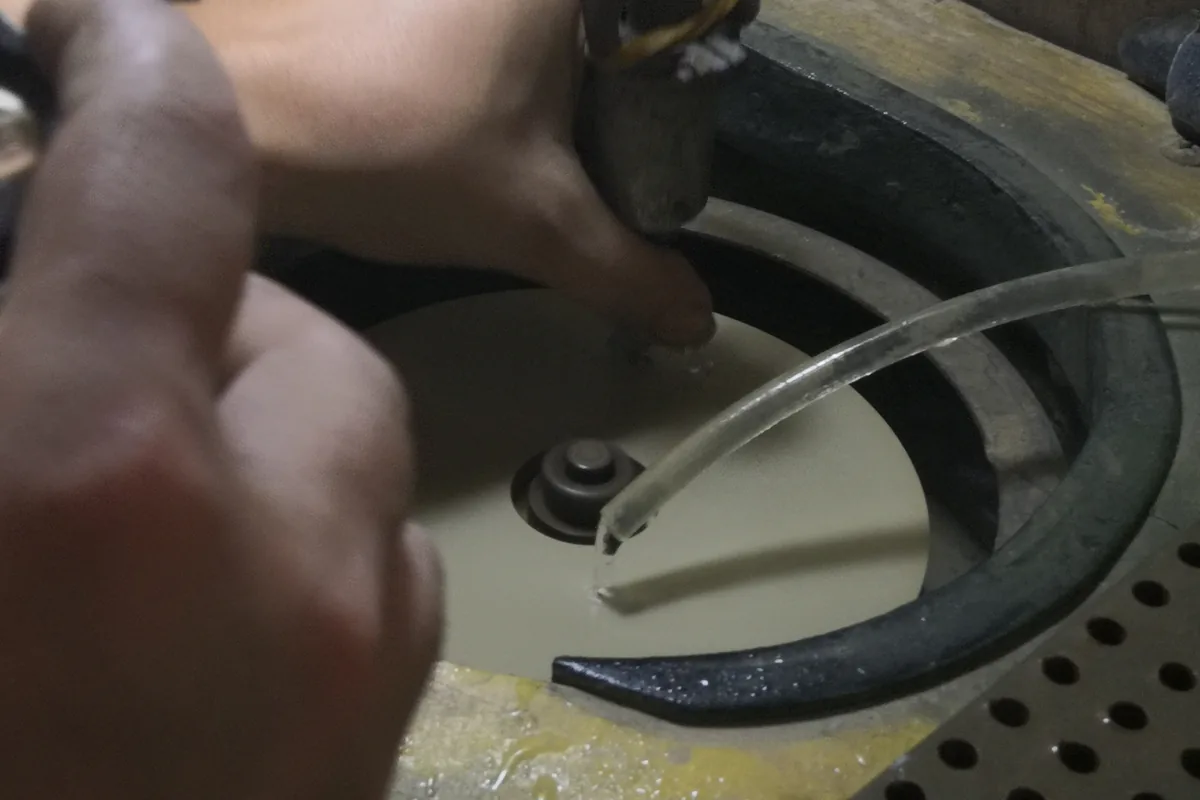
A bench polisher uses cloth mops with rouge or tripoli compounds, working the piece by hand. Hand polishing can raise a mirror finish on flat faces, leave brushed texture exactly where the design calls for it, and — critically — avoid rounding details. It is also where the labor cost lives: a complex ring can take 15–25 minutes on the bench versus 5 minutes in a barrel. The industry standard for engagement rings and high-fashion pieces is hand polish for the visible surfaces, then a short vibratory deburr for the inside. Hand polish also lets us control the finish direction — a brushed band gets consistent line marks that a tumbler cannot reproduce.
The hybrid most factories use
Rarely is it all-hand or all-barrel. The efficient line is: (1) tumble-cast pieces in ceramic media for 20 minutes to remove investment residue and sprue flash; (2) file and buff the visible faces by hand; (3) vibratory finish with steel shot for 15 minutes to brighten the inside and recesses; (4) final hand rouge on the top surface. This hybrid delivers the detail of hand work at roughly 60% of the cost of all-hand finishing. It is the process we specify for custom ring runs and most small-batch OEM orders. The cost delta between hybrid and all-hand on a simple band is small; on a pavé ring it is substantial.
What the QC should catch
The visible signs of over-mass-finishing are: rounded prong tips (a setting failure waiting to happen), flattened milgrain, and a dull gray cast on engraved details. Our QC checklist includes a corner-radius check on engraved pieces: if the design calls for a sharp V-channel and it comes back U-shaped, the barrel time was too long. Pieces that have been laser-welded almost always need hand polishing at the weld zone, because the heat-affected area will not clean up in a barrel. We also flag any piece where the hallmark has been polished partially away — that is a marking issue under the FTC Jewelry Guides.
Which to spec for your line
Budget fashion pendants and simple stud earrings: mass finishing. Bridal and designer bands: hybrid. Heirloom one-offs: all-hand. The difference shows up within the first 90 days of wear, because the buyer who paid for hand polish will notice if prong tips have been rounded off by a barrel. When in doubt, send us a reference photo of the finish you want — we will match it and tell you which process we used. We also keep a small finish sample board in the showroom so buyers can see the difference between a tumbled satin, a hybrid polish, and a hand mirror before they commit to a run.
Does mass finishing weaken prongs?
Over time, yes — a 90-minute barrel cycle can thin a 0.8 mm prong tip by 10–15%. That is why we pull set pieces out of the tumbler early and finish them by hand.
Can a tumbler produce a mirror finish?
No. Vibratory steel-shot produces a bright satin, not a true mirror. Mirror finish requires hand buffing with rouge on a cloth mop.
Is hand polishing worth the cost?
On visible-top bridal and designer pieces, yes. On the inside of a band, no — that is what the tumbler is for. We price the two separately on quotes so buyers choose deliberately.
Choosing a finish spec for your line? HOLYCOME runs hybrid finishing on most OEM orders and all-hand on bridal. Send us a sample photo of the finish you want; we will quote the process, not just the price. Start a small-batch order today.
International fineness and hallmarking requirements for precious metals are defined in the ISO standard for jewellery and precious metal fineness.
Frequently Asked Questions
How do I verify a factory before placing a bulk order?
Request a production video, business license, export records and a paid sample run. A factory that accepts a 50-piece test order is usually a real manufacturer.
What payment terms do you offer?
30% T/T deposit with the balance against the bill of lading. This protects both sides on first orders and can move to net terms after a track record.
What is your normal reject rate?
3–5% under 10x loupe inspection for cast and set pieces. Defective units are replaced free in the next shipment.
Where is the factory located?
Wuzhou, Guangxi, China—the core lab-grown and moissanite manufacturing cluster. Shipments go via Guangzhou or Shenzhen ports.


