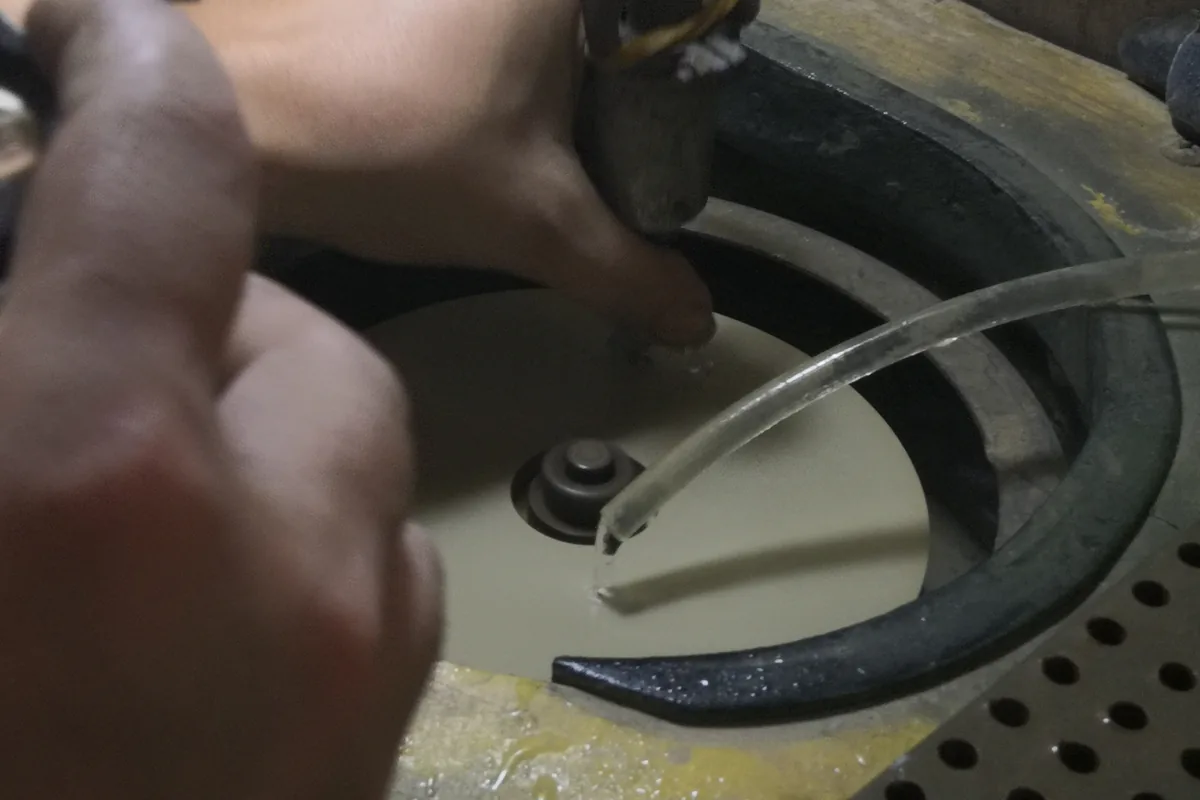
A B2B buyer sends a CAD file expecting a 50-piece production run and gets back a quote that is split into two very different numbers: one for a hand-carved wax prototype and one for a printed resin master. The sticker shock usually comes from not knowing why the two routes differ. Both are lost-wax (investment) casting at heart. Both burn out cleanly. But the geometry you can actually cast, the shrinkage you have to compensate for, and the break-even point at quantity are not interchangeable.
What the two routes share
Whether the pattern is carved from jeweler's wax by hand or printed on a wax-injection or resin DLP printer, the process after the pattern is identical. The pattern is attached to a sprue tree, invested in a plaster-like ceramic slurry, steam-burned out at roughly 700–750°C, and centrifugally or vacuum-cast with molten gold, silver, or brass. A factory that has run lost-wax for twenty years already owns the kilns, centrifuges, and steam cleaners. The difference lives entirely in how the positive pattern is made, and that difference propagates into every downstream step.
Hand-carved wax: tolerance, texture, and tooling cost
Carved wax (typically injection wax or hard carving wax) lets a modeler control undercuts, surface texture, and wall thickness by feel. A skilled carver can introduce a 0.4 mm rounded relief that a printer would struggle to reproduce, and can correct asymmetry in seconds with a wax knife. The cost is labor: a complex ring model can take 4–8 hours of bench time before it ever reaches the flask. At one piece, carving is usually cheaper than printing because there is no machine setup. At 50–200 pieces, the carved master is then used to make a rubber (silicone) injection mold, and every subsequent wax is injected in under a minute. The mold itself costs $40–$120 and lasts for roughly 500–1,000 pulls before detail begins to soften.
3D-printed wax/resin master: resolution, speed, and the mold question
Desktop DLP printers common in jewelry shops produce layer heights of 15–25 microns, which translates to surface detail finer than most hand carving can hold. Organic latticework, filigree, and micro-setting seats come off the plate ready to cast. Lead time collapses: a ring master that would take a day to carve can be printed overnight. The trade-offs are material-specific. Castable resin (not generic resin) must ash out completely; poorly formulated resin leaves carbon residue that shows up as porosity in silver. Printed patterns also shrink differently — a resin master may contract 0.5–1.5% during burnout, versus roughly 1–2% for injected wax, so the CAD file must be scaled up in advance. We scale by 1.3% for resin and 1.6% for injected wax as our starting numbers, then adjust after first-piece measurement.
Break-even: when printing wins, when carving wins
For a single prototype or a one-off custom piece, printing almost always wins on speed and detail. For runs above 30–50 pieces, the printed master becomes the “father” from which a production silicone mold is pulled, after which injected waxes cost pennies each. The real economic inflection is not printing vs carving — it is whether you need a production mold at all. If the run is a one-off, skip the mold. If it is a reorderable style, the mold pays for itself inside the second order. We walk through the full schedule in CAD to production: a custom ring timeline, and the finishing choices that follow casting are compared in hand polishing vs mass finishing.
Sizing and rework after casting
Neither route changes what happens next. Cast pieces still require laser welding to fix sprues, stone setting, and a final polish. A common buyer mistake is assuming a printed master means zero handwork — the printed pattern is more accurate, but the cast alloy still behaves the same. We have seen printed-master runs come back with the same shrinkage and porosity as carved runs, because those defects come from the alloy and the flask, not the pattern. For disclosure and marking rules that apply to finished pieces regardless of how the master was made, see the FTC Jewelry Guides.
Can I cast a 3D-printed wax directly, or do I need a mold?
Either works. One-off pieces cast the printed pattern straight into a flask. For runs over ~30 pieces, pull a silicone mold from the printed master and inject waxes. The mold is the step that makes reorders cheap.
Does 3D printing change the shrinkage I should design for?
Yes. Resin masters shrink roughly 0.5–1.5% in burnout; injected wax shrinks 1–2%. Scale the CAD file to match the pattern material, not a generic number, and verify on the first cast piece.
Which gives finer detail, hand carving or printing?
Printing at 15–25 µm layers wins for filigree and micro-texture. Hand carving wins for controlled relief, undercuts, and organic texture that needs bench correction.
Need a castable master or a production mold built to your spec? HOLYCOME runs both carved and printed lost-wax lines in-house, from one-off prototypes to 500-piece reorders. Ask about our small-batch OEM program — send us your CAD and target quantity for a same-day route recommendation.
For the legal text behind our material compliance, see the REACH Regulation (EC) No 1907/2006 on EUR-Lex.
Frequently Asked Questions
How do I verify a factory before placing a bulk order?
Request a production video, business license, export records and a paid sample run. A factory that accepts a 50-piece test order is usually a real manufacturer.
What payment terms do you offer?
30% T/T deposit with the balance against the bill of lading. This protects both sides on first orders and can move to net terms after a track record.
What is your normal reject rate?
3–5% under 10x loupe inspection for cast and set pieces. Defective units are replaced free in the next shipment.
Where is the factory located?
Wuzhou, Guangxi, China—the core lab-grown and moissanite manufacturing cluster. Shipments go via Guangzhou or Shenzhen ports.


