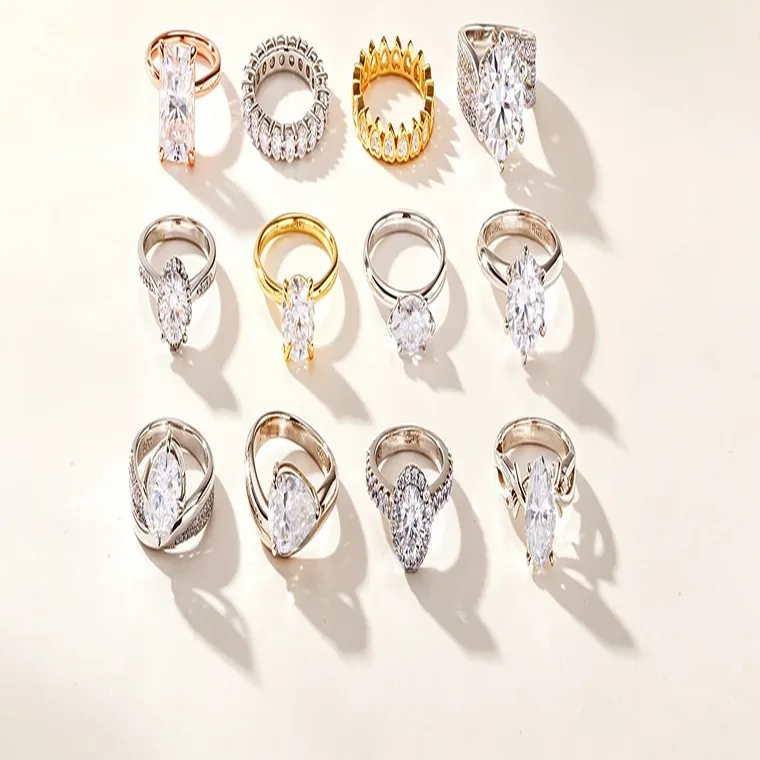
A 925 sterling silver order comes back from the caster with tiny pinholes on the inside of a ring shank. The buyer calls it a quality problem; the caster calls it silver being silver. Both are right. Sterling silver (92.5% Ag, 7.5% copper) has a wider freezing range and absorbs hydrogen readily, which makes it the most porosity-prone common jewelry alloy. The defects are not random — each one points to a specific step in the melt, the flask, or the gating.
What “925” actually means
ISO 9202 and the Wikipedia entry on sterling silver both anchor the standard: 925 parts per thousand silver, the balance usually copper. Copper hardens silver but also raises the freezing range to roughly 893–899°C, a narrow but real mushy zone where gas bubbles get trapped. Fine silver (999) casts cleaner but is too soft for rings; 925 is the engineering trade-off. Recycled 925 scrap, if not properly fluxed, brings in oxide and gas that primary-alloy ingots do not — which is why scrap percentage in a melt matters.
Pinholes: the gas-absorption defect
Tiny, round, often surface-breaking holes (0.1–0.5 mm) scattered on a flat surface are almost always hydrogen porosity. Silver picks up hydrogen from flame moisture and from recycled scrap that has not been properly melted under flux. The fix is degassing: either a dry/nitrogen cover or a proprietary degassing tablet poured just before casting. A caster who melts with an oxygen-gas flame on a wet bench will see pinholes regardless of alloy quality. Pinholes are the defect that shows up first on printed wax patterns, because castable resin outgasses slightly in burnout and the gas has nowhere to go but into the silver.
Blowholes and shrinkage cavities
Larger, irregular voids near thick sections (beads, shank-to-head junctions, heavy decorative nodes) are shrinkage cavities. They happen because the sprue does not feed metal as the thick section solidifies. The fix is gating design — a caster who studies the tree and adds a feed sprue to the heaviest mass eliminates most shrinkage. Blowholes, by contrast, are larger voids aligned with the sprue seat and indicate trapped investment or steam. They are the defect that ruins whole flasks, not single pieces, and they are the reason we pre-dry investment molds for 6 hours before burnout.
Firestain: the oxide under the surface
Copper in sterling oxidizes during casting and annealing, forming copper-oxide sub-surface layers that show as brown or purplish staining after pickling. Firestain is not a porosity defect but it behaves like one in QC: it must be ground and polished away, often 0.05–0.1 mm deep. Factories that cast silver under a protective atmosphere and pickle aggressively in dilute sulfuric acid keep firestain to a minimum. Buyers should ask about this specifically — it is why two quotes for the same 925 ring can differ in labor cost. A shop that skips atmosphere casting will spend twice as long polishing out firestain.
Alloy choice: fine silver vs 925 vs 935
Some buyers ask why we do not cast in 999 fine silver, which is cleaner. The answer is wear: fine silver is soft enough that prongs bend and bangles deform in normal use. The 7.5% copper in 925 brings the hardness up to a usable level for rings and bracelets. A 935 alloy (slightly less copper) sits between, casting a touch cleaner but still softer, and is used for items where firestain matters more than structural strength. We recommend 925 for most jewelry and 999 for cast pendants and charms that are not under stress.
How a production factory catches it
We sort silver cast pieces three ways: visual under 3x on the sprue side, ultrasonic dye-penetrant on high-wear parts, and weight check against the solid CAD volume. Pieces that show pinholes on the inside (where polish will not reach) are scrapped, not filled. This is part of our pre-ship QC checklist. After casting, silver pieces go straight to finishing, because delayed polishing lets firestain oxidize deeper into the copper-rich layer. We also keep a defect log by flask — if two flasks in a row show pinholes, we stop and check the degassing step before casting more.
Are pinholes in sterling silver normal?
Minor surface pinholes under 0.2 mm on non-visible surfaces are common. Pinholes on the face or inside the shank are a reject. We photograph and discard any piece with visible porosity on a wear surface.
Can porosity be filled with epoxy?
Factories that fill porosity with epoxy and polish it smooth are cutting corners. The fill falls out in 6–12 months and tarnishes around the edge. A reputable caster re-casts the piece.
Which is worse, shrinkage or gas porosity?
Shrinkage near a joint is structural and must be fixed by gating. Gas porosity on the surface is cosmetic and can sometimes be saved by polishing deeper, but only if the void does not break through to the inside.
Sourcing 925 silver? HOLYCOME casts sterling under atmosphere-controlled melting, degasses every pour, and rejects pieces with visible porosity on wear surfaces. Talk to us about a small-batch silver OEM run.
Frequently Asked Questions
How do I prevent sterling silver from tarnishing in storage?
Use anti-tarnish bags with a sulfur absorber, keep humidity under 60% and avoid paper wrapping. Rhodium plating adds a further barrier on high-turn SKUs.
Is rhodium plating worth the added cost?
Yes for display and gift lines. It resists tarnish for 12–18 months and keeps shelf pieces bright, which reduces markdowns.
What purity do you supply?
925 sterling silver, stamped and hallmarked. Fine silver (.999) is available for beads and bullion-style pieces.
What is the MOQ and lead time?
50 pieces per design, samples 3–5 days, bulk 15–20 days.


