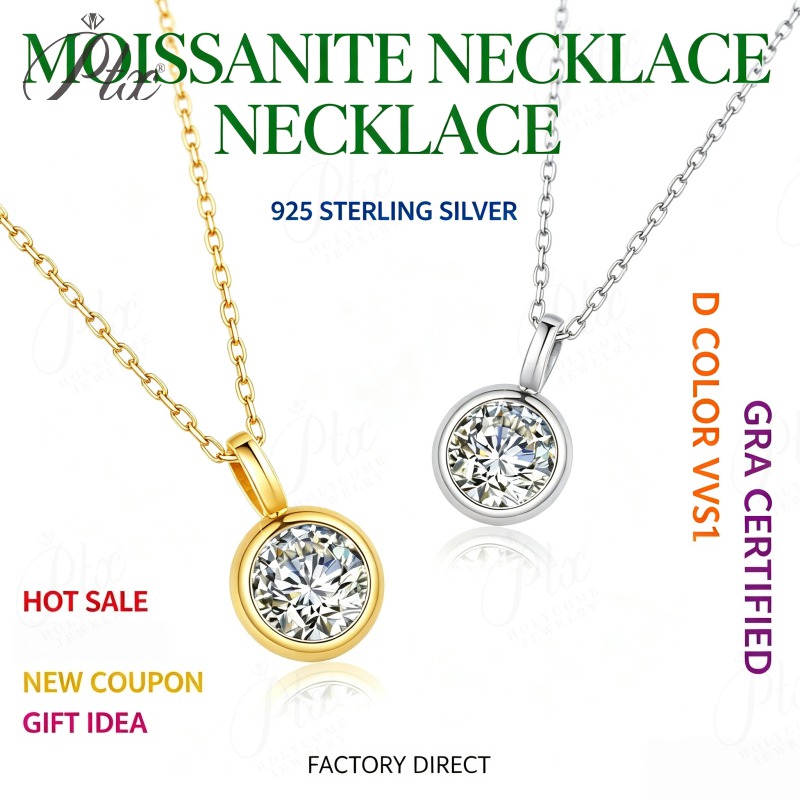
Necklaces look simple from a retail perspective—a chain, a pendant, a clasp, done. The reality is that necklaces have more failure points per piece than any other jewelry category. Clasps break. Chains kink. Jump rings open. Pendants flip forward instead of lying flat. Chain breaks at the solder point where the pendant attaches. Lobster triggers jam. Spring rings lose spring tension. When you factor in that necklaces hang from the wearer's neck and touch skin, clothing, hair, perfume, and sweat 8–16 hours a day, the engineering matters more than most buyers realize.
HOLYCOME manufactures custom necklaces for over 250 jewelry brands from our Guangzhou factory, producing 60,000+ pieces annually across pendants, chains, tennis necklaces, lariats, chokers, and layered sets in sterling silver and solid gold. This article explains how we design and manufacture necklaces, the chain types we produce, clasp options, pendant attachment engineering, QC standards, MOQ, lead times, and what to specify when commissioning custom necklace production.
Chain Types We Manufacture
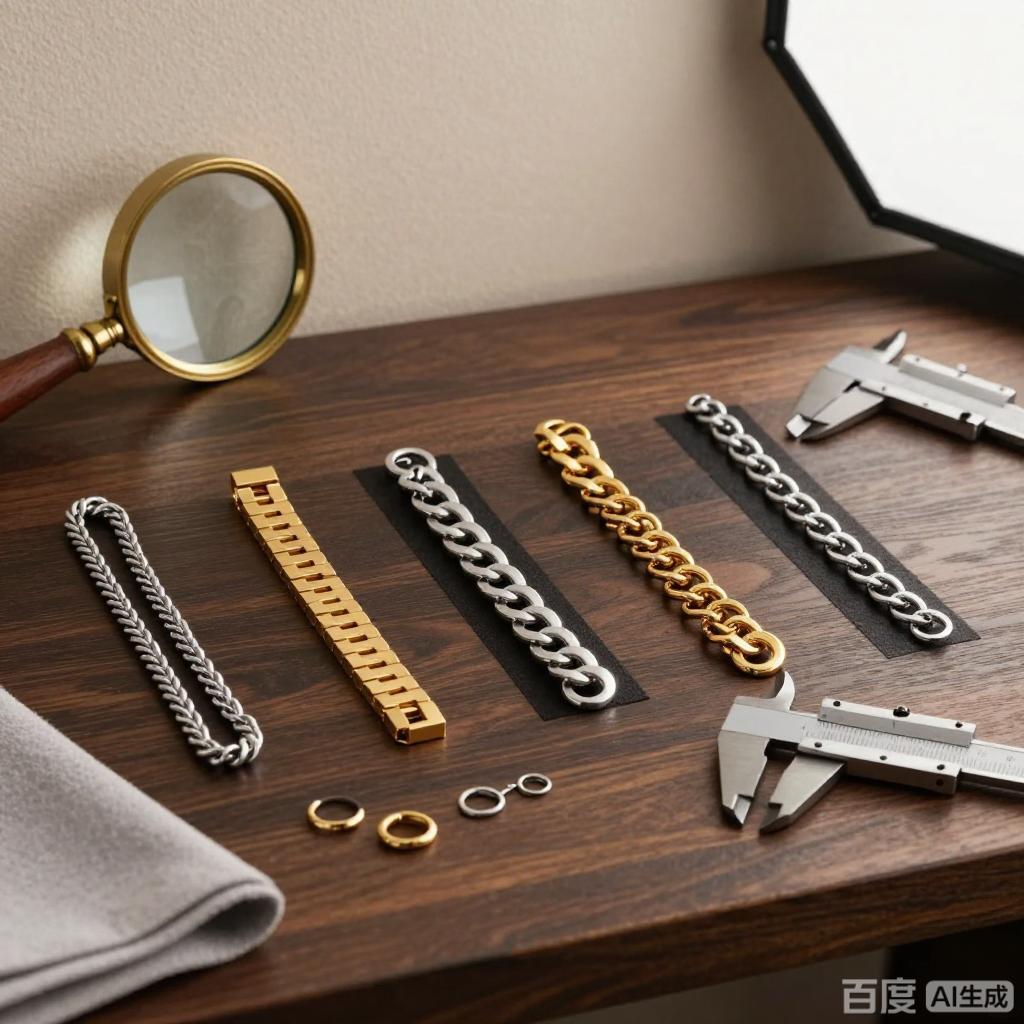
Chains can be machine-made, hand-assembled, or die-struck. Machine-made chains make up 90% of commercial jewelry chains because they are faster, more consistent, and less expensive than hand-made chains. We produce 14 chain types:
| Chain type | Construction | Strength | Pendant-friendly? | Common widths | Best use |
|---|---|---|---|---|---|
| Cable (Rolo) | Oval links connected one-to-one, classic chain | Good | Yes | 0.8–3mm | Everyday pendants, layered necklaces |
| Box (Venetian) | Square links folded from flat wire, smooth square profile | Good | Yes | 0.6–2mm | Minimalist pendants, men's jewelry |
| Curb (Cuban) | Twisted/flattened oval links that lie flat | Excellent | Yes (larger curb) | 1–12mm | Statement pieces, men's chains |
| Figaro | Pattern of 3 small links + 1 large elongated link | Very good | Yes | 2–8mm | Classic Italian-style chains |
| Rope | Multiple strands twisted in a spiral pattern | Good (prone to kinking under 1mm) | No (pendant slides poorly on twisted links) | 1–5mm | Standalone chains, vintage style |
| Singapore | Twisted and flattened curb chain that sparkles as it moves | Good | Yes | 0.8–2mm | Delicate pendant chains, bridal |
| Snake | Tight round wavy plates that form a smooth flexible tube | Fair (kinks easily, hard to repair) | Light pendants only | 0.8–3mm | Minimalist, modern pendants |
| Herringbone | Flat V-shaped links lying flat against each other | Fair (kinks, can't be repaired) | No | 2–10mm | Statement standalone chains |
| Wheat (Spiga) | Four strands of twisted oval links braided together | Excellent | Yes | 1–5mm | Durable everyday pendants |
| Byzantine | Complex woven link pattern (intricate, heavy) | Excellent | No (standalone statement) | 3–8mm | Statement, men's |
| Paperclip | Elongated oval links resembling paperclips | Very good | Yes | 3–10mm | Contemporary/modern, layered |
| Bead/Ball chain | Hollow balls connected by wire pins | Fair (pins can pull out) | Light pendants | 1–3mm | Dog tags, casual fashion |
| Tennis chain | Diamond/moissanite stones set in continuous four-prong links | See tennis chain section | No (standalone) | 2–5mm (stone size) | Bridal, luxury statement |
| Omega | Flat metal mesh band with a core wire, rigid flat profile | Fair (kinks with folding) | Slide pendants only | 2–10mm | Chokers, slide pendants |
Chain Manufacturing Process
Machine-made chains start with wire of the target alloy drawn to the exact chain gauge. The wire feeds into a chain-making machine that forms, cuts, and links each link at speeds of 80–200 links per minute, depending on chain type. After forming:
- Soldering: Each link joint is soldered closed (plasma or laser soldering on modern machines). Unsoldered links (called "open link" chain) pull apart easily. Our standard for all chains over 0.8mm is soldered-every-link; thinner chains (0.6–0.8mm fashion chains) alternate soldered links to retain flexibility.
- Twisting/forming: Curb and figaro chains are twisted and flattened after assembly to achieve the flat-lying profile.
- Hardening: Chains are work-hardened (by pulling through dies or tumbling) to prevent stretching under pendant weight.
- Polishing and plating: Chains are barrel-polished (tumbled with steel shot) before rhodium/gold plating for a uniform finish across all links.
We source chain-making wire from two certified suppliers in Shenzhen and Dongguan, and maintain 14 chain machines in-house producing cable, box, curb, figaro, rope, and wheat chains. Byzantine, snake, and herringbone chains are produced by specialized partner factories (these chain types require dedicated machines not economical to run in-house for our volume). All chain production—whether in-house or partner—passes through our QC before assembly.
Clasp Selection
The clasp is the highest-failure component on any necklace. We offer seven clasp types, matched to chain weight and necklace value:
- Lobster clasp (trigger clasp): Spring-loaded claw with a trigger lever. Our default for most necklaces. Reliable, easy to operate one-handed, available in 5 sizes (7mm–21mm). Recommended for chains under 20g total weight. We use stainless steel internal springs for longevity (brass springs corrode and lose tension in 1–2 years).
- Spring ring: Circular spring-loaded ring with a small trigger lever. Lower profile than lobster but slightly harder to operate. Used for delicate chains under 3g. Same stainless steel spring upgrade.
- Bolt ring / round trigger: Similar to spring ring but with a thicker trigger and stronger spring. Used on medium-weight chains.
- Toggle clasp: Bar slides through a ring—decorative, easy to fasten, but less secure than spring clasps (can unfasten if the necklace catches). Popular for statement necklaces and men's jewelry.
- Magnetic clasp: Rare-earth magnet closure with a safety catch. Convenient for customers with dexterity issues. Not recommended for pieces over 15g or high-value necklaces (magnet can detach if caught).
- Box clasp (figure-8 safety): Tongue-in-groove clasp with a figure-8 safety latch on the side. Used for heavier chains and tennis necklaces 15g+. High security, most expensive clasp type.
- Slide clasp / push clasp: Barrel or box-shaped clasp with a push-button release and safety catch. Used for premium necklaces and tennis chains.
Clasps are attached via soldered jump rings (never split rings, which can be pried open). We use two jump rings at the clasp attachment point for redundancy on necklaces over 5g (if one jump ring fails, the second holds the necklace).
Pendant Attachment Engineering
When a pendant hangs on a chain, three things determine whether it sits correctly or flips forward, tangles, or damages the chain:
- Bail size vs chain width: The bail (the loop that the chain passes through) must be at least 0.5mm wider than the chain on each side for smooth movement. A bail that is too tight makes the pendant sit stiffly at one spot; a bail that is too loose lets the pendant flip. Standard bail inner diameter is chain width + 1.5–2mm.
- Bail position: The bail must be positioned so the pendant's center of gravity is directly below the bail attachment point (at the top of the pendant, centered front-to-back). Off-center bails cause the pendant to tilt or sit crooked. We calculate and mark bail position in CAD, then verify on the first casting sample by hanging the pendant on a chain and checking that it hangs straight on a flat mannequin neck form.
- Chain thickness relative to pendant weight: Thinner chains (under 0.8mm) are not suitable for heavy pendants (over 8g). The solder joints on thin wire cannot support the constant pendulum stress, and chains will break at the link adjacent to the pendant within months. Our recommendation: minimum 1mm chain for pendants over 5g, 1.2mm minimum for pendants over 10g, 1.5mm minimum for pendants over 20g.
We offer several bail types: open jump-ring bail (chain threads through), closed bail (chain must be strung through), pendant bail with snap-on peg (for gemstone pendants), enhancer bail (clips onto any chain, removable), and hidden bail (attached to the back of the pendant, invisible from front).
Tennis Necklaces
Tennis necklaces—continuous lines of set stones in four-prong links—are our highest-growth necklace category over the past three years. They share engineering with tennis bracelets but operate under different stress conditions (necklaces move more and are not anchored by a wrist):
- Link construction: Each stone sits in an individual four-prong cup link connected by a small pin or hinge, allowing the chain to flex and curve naturally around the neck. Links must flex freely—tight links create a stiff necklace that sits awkwardly.
- Clasp: Box clasp with figure-8 safety latch as standard on all tennis necklaces. Lobster clasps are insufficient security for tennis necklaces (which can be high value) and are not used on this category.
- Two safety loops: On either side of the clasp, a short safety chain (8–10mm) connects the two sides of the necklace—if the clasp fails, the safety chain prevents total loss.
- Stone matching: Stones must be color-matched end-to-end. Even a single stone that is half a grade off in color will be visible as a mismatch in a continuous line. For necklaces over 17 inches (43cm) we color-sort stones in batches of 50+, matching to within one color grade across the entire run.
- Weight range: 2mm tennis necklace (2pt stones, 16"): 5–7g in silver, 12–15g in 14K gold; 3mm (3pt): 8–12g silver, 20–28g gold; 4mm (5pt): 12–18g silver, 30–40g gold; 5mm (10pt): 18–28g silver, 45–65g gold.
Our tennis necklaces (and tennis bracelets) go through a 30-stone tug test per piece (random selection of 30 stones tugged with a pusher) and a full-clasp open/close cycle test of 20 repetitions before packaging.
Length Options and Fitting
Standard necklace lengths (we stock chains in all of these):
| Length (inches) | Length (cm) | Position | Typical use |
|---|---|---|---|
| 14 inch | 35cm | Choker (hugs the base of the neck) | Chokers, formal, bridal |
| 16 inch | 40cm | Collarbone | Most popular pendant length, everyday wear |
| 18 inch | 45cm | Below collarbone, on upper chest | Second most common, works with most necklines |
| 20 inch | 50cm | Mid-chest | Men's, layering pieces, statement pendants |
| 22 inch | 55cm | Lower chest/sternum | Men's standard, long pendant |
| 24–36 inch | 60–90cm | Sternum to navel | Long pendants, lariats, layered looks |
We produce adjustable necklaces (with an extender chain of 2–3 inches allowing multiple length positions) as a default option for many SKUs—adjustable designs cover multiple length preferences with a single SKU, reducing inventory requirements for retail brands.
Quality Control for Necklaces
Our necklace QC checks 12 points before packaging:
- Link integrity: random pull-test of 10 links per chain (5kg tension) for chains supporting pendants; 3kg for fine chains under 1mm.
- Clasp function: open/close 20 times; spring tension must remain consistent.
- Clasp attachment: confirm double jump ring attachment soldered closed for necklaces over 5g.
- Jump ring security: pull-test 2kg on all jump rings (bail, clasp, charm attachment points).
- Bail alignment: hang pendant on chain, confirm it hangs straight without tilting on a neck form.
- Chain straightness: lay chain flat; check for kinks, twists, or uneven links.
- Pendant polish: back of pendant must be polished (not left rough) even though it is not visible in wear—rough backs catch clothing and scratch skin.
- Plating uniformity: no unplated spots on inside links or clasp interiors.
- Stone security (tennis/pavé): steel pusher test on every stone.
- Safety chain (tennis): present and correctly attached.
- Hallmark: clasp or hang tag stamped 925/14K/18K/PT950.
- Length accuracy: measure end-to-end, must be within ±3mm of specified length.
Our outgoing QC rejection rate for necklaces runs 2.8% across all categories. Most common rework causes: clasp spring tension (0.6%), kinked/twisted links (0.5%), bail misalignment (0.4%), soldering touch-up (0.4%), pendant not hanging straight (0.3%), loose stone (0.3%), plating touch-up (0.3%).
MOQ and Lead Times
| Order type | MOQ | Lead time |
|---|---|---|
| Sample necklaces (any style) | 1 piece (sample fee credited to bulk) | 7–14 days |
| Stock chains (no pendant, bulk lengths) | 5 pieces per width/length / $500 total | 7–14 days |
| Stock pendants with standard chains | 5 per SKU / $500 total | 10–18 days |
| Custom pendant OEM (silver) | 30 per SKU (mold fee $60–$150) | 25–35 days |
| Custom pendant OEM (gold) | 50 per SKU (mold fee $100–$250) | 30–45 days |
| Tennis necklaces (silver, moissanite/diamond) | 10 per length/width | 18–28 days |
| Layered necklace sets (2–3 chains coordinated) | 20 sets | 25–35 days |
| Name/letter/personalized necklaces | 20 pieces (can mix names) | 21–30 days |
FAQ
Do you supply adjustable length chains?
Yes. Any of our chains can be made adjustable with a 2" extender chain attached at the clasp. The extender chain ends in a small tag or charm (your logo tag, a pearl, a small bead, etc.) so customers can select any length up to the extender. Adjustable chains add $0.50–$1.50 per piece depending on chain thickness and extender length.
Why do some chains kink and others don't?
Kinking is caused when a twisted link deforms under bending force. Snake chains and herringbone chains are most prone to kinking because their links are flat plates without independent rotation—if you fold a snake chain, the plates bend permanently and cannot be straightened. Cable, curb, and wheat chains kink rarely because each link rotates independently. We advise against snake/herringbone for customers who will wear the necklace 24/7 or for pendants over 5g.
How do I choose the right chain thickness for a pendant?
Rule of thumb: pendants under 3g work on 0.8–1.0mm chains; pendants 3–8g work on 1.0–1.3mm chains; pendants 8–15g need 1.3–1.8mm; pendants over 15g need 1.8mm+. These minimums are important—thin chains under heavy pendants break at the link adjacent to the bail from repeated stress during movement, regardless of how well the chain is made.
Can pendants be produced without chains (pendant only)?
Yes. Many clients buy pendants from us and source chains separately, or vice versa. Pendant-only orders ship with the bail closed and ready to slide onto a chain. We can also ship pendants with open-bail (jump ring style) if you prefer to attach them yourself. Pendant-only MOQ is the same as pendant-with-chain.
Can you produce necklaces with engraving?
Yes. We offer laser engraving on pendant backs (text, logos, dates, coordinates, handwriting), pendant fronts (name necklaces, monograms), clasp tags (brand logo), and chain tags. Engraving adds $0.50–$2 per piece depending on complexity (simple text on the back is at the low end; deep relief carving or portrait engraving is at the high end). We also produce hand-engraved pieces for premium bridal and heirloom work.
Do you offer rhodium/gold plating over silver chains?
Yes. Sterling silver chains are standard rhodium-plated 2–3 microns with anti-tarnish e-coat, same as other silver jewelry. We also offer 14K/18K yellow, rose, and white gold vermeil (2.5+ micron gold plating over sterling silver, marketed as vermeil per FTC Jewelry Guides) on silver chains for demi-fine price points.
Most of the quality problems buyers encounter with necklaces happen at the connection points—clasps, jump rings, bail attachments—rather than in the chain body itself. A perfectly made chain is worthless if the clasp spring fails after three months and the necklace falls off. We address this with stainless steel springs on every clasp, double jump rings on necklaces over 5g, soldered links throughout, pull testing on a sample of links from every chain, and 20 open/close cycles on every clasp before it leaves the factory. These are small details, and they are the reason our necklace warranty return rate runs under 0.8% across 60,000+ pieces per year. Contact our custom necklace team to discuss your pendant and chain program.
Sterling silver terminology used in this guide follows the Wikipedia entry on sterling silver.
Related reading: Custom Engagement Ring Manufacturer, Custom Necklace Manufacturer, Custom Ring Manufacturer OEM Engagement China.


