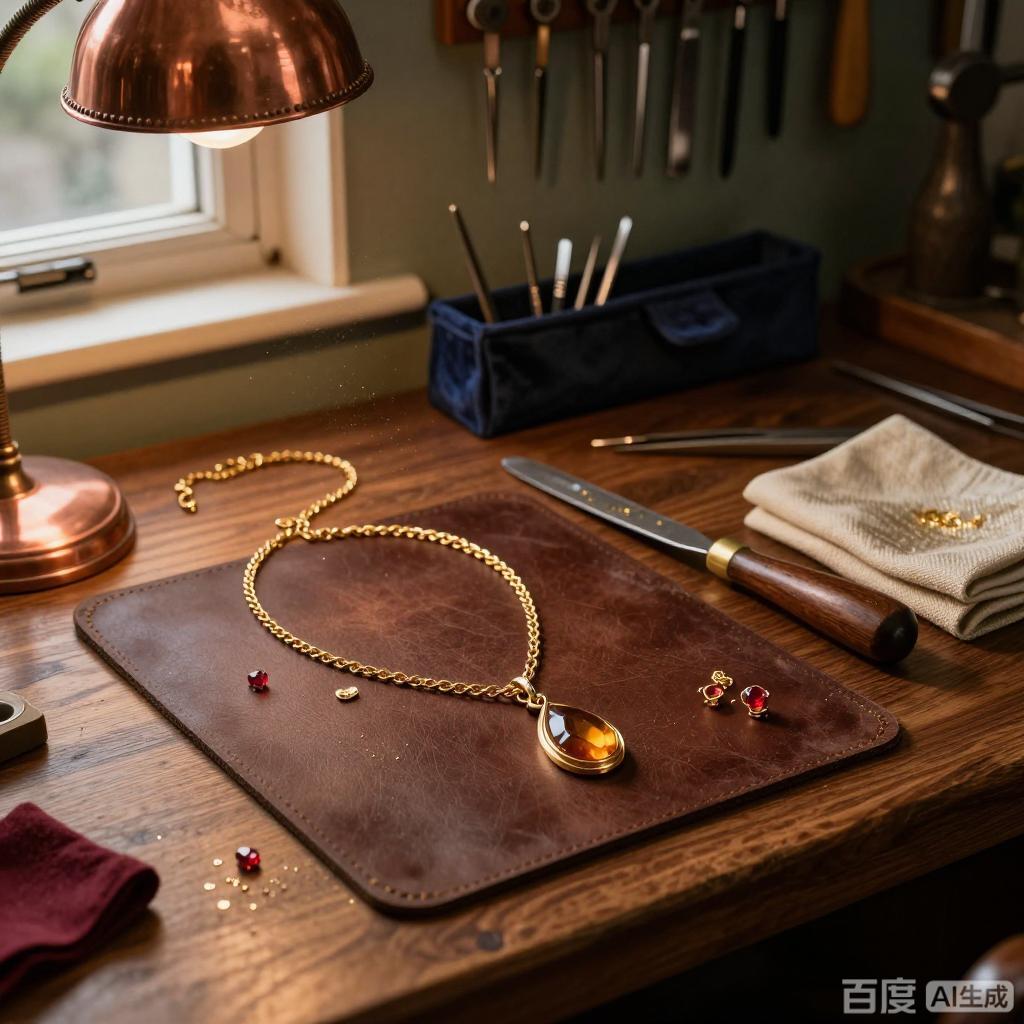
Building a custom necklace line that hangs right, wears comfortably, and survives daily contact with skin oils, perfume, and clothing friction is harder than most brands expect. A custom necklace manufacturer must control chain link geometry, clasp function, pendant bail clearance, stone security, and overall drape — all at the same time. HOLYCOME has been manufacturing custom necklaces for jewelry brands, bridal lines, and private-label retailers since 2013, producing everything from delicate cable chains with solitaire pendants to full diamond tennis necklaces with over 100 hand-set stones. This guide walks through our production process, quality standards, and the engineering decisions that separate necklaces that last from necklaces that come back as returns.
What Makes Necklace Manufacturing Different
Necklaces are unlike rings or earrings in three ways that demand specialized tooling and expertise.
Link Geometry and Chain Flex
A chain is only as flexible as its weakest link — literally. Every link must be formed from wire of consistent diameter, soldered closed with just the right amount of solder (too much and the link is stiff; too little and it pulls open), and tumbled so that links move freely without catching on each other or on hair and fabric. Chain making is a high-volume, high-precision operation that requires dedicated chain-making machines (we use Italian-made Sisma and Omec machines for our production chains) and careful inspection of every spool before assembly.
Drape and Weight Distribution
A tennis necklace that is too stiff sits up off the collarbone and looks rigid; one that is too flexible kinks when the wearer turns their head. The balance point of a pendant determines whether it hangs straight or flips forward. We calculate drape using both CAD simulation and physical prototypes worn on real neck forms — because digital simulation does not capture how a chain behaves when it crosses a collarbone or rests against a sweater.
Clasp Reliability Under Load
Necklace clasps carry the full weight of the piece, and they must open easily when the wearer wants them to open but never open accidentally. A spring ring on a heavy tennis necklace will fail within months; a lobster claw that is too strong is frustrating to fasten one-handed behind the neck. We match clasp type and size to the necklace weight and target customer — and we cycle-test every clasp for 200 open/close cycles before it leaves production.
Our Custom Necklace Manufacturing Process
Here is how a production run flows through our custom necklace line at HOLYCOME, from design brief to finished piece ready for retail.
Step 1: Design Brief and Style Selection
You send sketches, inspiration photos, length requirements, and target price point. We recommend chain style, clasp type, construction approach (cast pendant on manufactured chain, fully hand-fabricated piece, or fully assembled from component chain and findings), and alloy. MOQ varies substantially by necklace type: chain-only necklaces in sterling silver start at 100 pieces; gold pendants on manufactured chains start at 30 pieces; diamond/gemstone tennis necklaces start at 20 pieces due to higher per-unit value.
Step 2: CAD and Prototype
Pendants and solid components are modeled in RhinoGold, with special attention to bail size (must accommodate the chain thickness plus 0.5 mm clearance for movement) and pendant weight distribution. Chains are selected from our chain catalog or custom-manufactured to your spec (custom chain production requires a 100-meter minimum run for new link patterns). We always recommend a physical prototype for new pendant designs; a silver prototype costs $80-150 and ships within 7 days, and it lets you evaluate drape, bail clearance, and clasp operation on a real neck form.
Step 3: Component Production
Pendants and solid necklace components are cast or stamped using the same production methods as our other jewelry categories: investment casting in centrifugal machines for complex shapes, stamping for flat medallions and tags. Chains are either produced in-house on our chain-making machines (cable, curb, box, Figaro, rope) or sourced from our premium Italian and Chinese chain suppliers (specialty weaves like Singapore, herringbone, wheat). Clasps are either in-house manufactured (lobster claws in standard sizes) or sourced from premium findings suppliers for specialty clasps (toggle, magnetic, fishhook, barrel).
Step 4: Stone Setting (for jeweled necklaces)
Tennis necklaces, pendant halos, and station necklaces (where stones are set at intervals along the chain) all go through our stone-setting department. Tennis necklaces are the most setting-intensive pieces we produce: a 16-inch tennis necklace with 3 mm stones requires roughly 90-110 individual settings, each hand-cut and hand-set by a specialized tennis necklace setter. Every stone is seated to 12-15% girdle depth, and the entire necklace is flexed after setting to confirm no stones are pinched by the channel walls.
Step 5: Assembly and Soldering
Jump rings connecting pendants to chains, chain-to-clasp connections, and any multi-strand connectors are all soldered closed with matched-color solder. We never use unsoldered jump rings on structural connections. For tennis necklaces, individual setting links are connected by tiny pins or wires that are peened (flattened) on each end to prevent them from sliding out. Chain ends are soldered to clasp findings using dedicated end caps sized to the exact chain diameter.
Step 6: Polishing, Plating, and Finishing
Chains are tumbled in magnetic tumblers for several hours to achieve a consistent polish across every link, then hand-buffed at connection points where tumblers cannot reach. Pendants and cast components receive the same multi-stage hand polish as our rings and earrings. White gold pieces are rhodium plated at 0.5-1.0 microns. Gold-fill and vermeil pieces have their gold layer thickness verified via XRF (minimum 2.5 microns for gold-filled by FTC standards; minimum 1.5 microns for vermeil). All necklaces receive a final steam clean and inspection.
Step 7: QC and Packaging
Each necklace passes through dedicated necklace QC before packaging:
- Clasp function: 200-cycle open/close test; spring tension correct for necklace weight
- Chain integrity: every link visually inspected at 10x for proper closure, no open seams, no kinks
- Drape test: necklace laid out flat on a velvet surface to confirm it lies straight without twisting; checked on a neck form for proper hang
- Pendant security: jump ring soldered shut, bail clear of chain links (pendant rotates freely without binding)
- Stone security (for jeweled pieces): each stone tested with a probe; necklace flexed to confirm no stones are loose or pinched
- Length verification: measured from end clasp to end ring within ±3 mm of ordered length
- Hallmark: karat stamp and brand mark on clasp or end tab
Necklaces are packaged individually in anti-tarnish pouches or poly bags, coiled to prevent tangling, with clasps fastened to avoid chain snags. Standard production lead time from CAD approval is 18-28 business days depending on style complexity and stone count.
Necklace Style Comparison: Manufacturing Approaches
Different necklace types require completely different production setups. The table below compares the common categories we produce.
| Style | Construction | Key Quality Point | MOQ | Lead Time |
|---|---|---|---|---|
| Pendant on chain | Cast/stamped pendant + manufactured chain + clasp | Bail clearance; soldered jump ring; drape | 30 pcs (gold); 100 pcs (silver) | 15-20 days |
| Tennis necklace | Individual cast settings linked by pins; continuous channel or prong settings | Flexibility (no kinking); stone alignment; clasp security | 20 pcs | 25-35 days |
| Chain-only (cable, curb, Figaro, rope) | Machine-made chain, finished and clasped | Link closure; consistent finish; clasp tension | 100 pcs (silver); 50 pcs (gold) | 10-18 days |
| Station necklace (stones along chain) | Chain with soldered-on settings at intervals | Station spacing consistency; stone alignment with chain axis | 50 pcs | 20-25 days |
| Lariat/Y-necklace | Chain with adjustable slider and drop element | Slider tension (holds position without slipping); drop balance | 50 pcs | 22-28 days |
Chain Selection Guide
Choosing the right chain style is one of the most important decisions in custom necklace design. The chain affects drape, perceived value, durability, and price. Here is how we advise brands on chain selection.
Cable Chain
The classic oval-link chain, cable is the most versatile and affordable chain style. It drapes well, resists kinking, and comes in a wide range of widths (0.8 mm to 8 mm+). Cable chains are the standard for pendant necklaces because the pendant bail slides freely over the links. We produce cable chains in all alloys with either round wire links (most common) or flattened/diamond-cut links for extra sparkle.
Curb Chain
Curb chains have links that are twisted and flattened so they lie flat against the skin. They have a substantial, bold look and are popular in men's jewelry and unisex lines. Curb chains are durable because the flattened links interlock tightly, but they can catch on fine fabric if the edges are not properly beveled after flattening. Our curb chains go through an edge-beveling step after flattening to prevent fabric snags.
Box Chain (Venetian Chain)
Box chains are made from square links folded into smooth box shapes, creating a sleek, modern look that pairs well with contemporary pendants. Box chains are stiffer than cable chains and do not drape as softly, but they have a clean, geometric aesthetic popular with minimalist brands. They are also less likely to tangle than rope or Singapore chains.
Rope Chain
Rope chains are woven from multiple strands of wire twisted together to create a spiral effect with maximum sparkle. They are among the most popular gold chain styles in the US market. Rope chains are flexible and drape beautifully, but they are more prone to kinking if pulled and require careful link closure during production — a single open link in a rope chain can unravel several inches of weave. We inspect every rope chain link by link under magnification.
Figaro Chain
Figaro chains alternate between short round links and one longer oval link in a repeating pattern (typically three short, one long). Originally an Italian design, Figaro remains popular in men's and unisex lines. The pattern adds visual interest without sacrificing durability.
Specialty Chains
We also produce or source wheat chains, Singapore chains (twisted for extra sparkle), herringbone (flat, flexible, high-shine), mariner (anchor-style links), snake chains (smooth, round, flexible mesh), and bead chains. Specialty chains often have higher MOQ due to custom tooling requirements.
Clasp Selection: Matching Hardware to Weight
A necklace clasp must be easy to operate, secure under load, and proportionate to the necklace aesthetic. Here is what we recommend for different necklace weights:
- Spring ring clasp: Best for lightweight necklaces under 5 grams (fashion pendants, dainty chains). Affordable and discreet, but not strong enough for heavy tennis necklaces or chunky chains.
- Lobster claw clasp: The standard for most necklaces 3-20 grams. Secure, easy to operate one-handed with practice, and available in sizes from 6 mm to 20 mm. We use lobster claws on 90% of our production necklaces.
- Toggle clasp: A T-bar that slides through a ring. Decorative and easy to fasten, toggle clasps are popular in statement necklaces and artisan-style pieces. They are not recommended for fine, lightweight chains (the T-bar can slide out if the chain is pulled) but work well on medium-weight chains over 10 grams.
- Box clasp (with safety latch): The most secure clasp for heavy necklaces 15 grams and above, including diamond tennis necklaces. Box clasps have a figure-8 safety latch on the side for double security. Every tennis necklace we produce uses a box clasp with two safety latches.
- Magnetic clasp: Convenient for customers with dexterity issues, but magnetic clasps should not be used on valuable pieces (they can separate with a strong tug). We recommend magnetic clasps only for fashion jewelry and only when paired with a safety chain as backup.
- Bolo/slider clasp: Used for lariat and adjustable-length necklaces. The slider must have the right spring tension to hold position without slipping but still slide when pulled. We test slider tension on every adjustable necklace.
Tennis Necklace Production: The Most Demanding Category
Tennis necklaces deserve special mention because they are the most setting-intensive and quality-critical product we produce. A single 16-inch tennis necklace requires 90-130 individually set stones, each in its own cast setting that must align perfectly with its neighbors for a continuous line of sparkle.
There are two primary construction approaches for tennis necklaces:
Channel-Set Tennis Necklaces
Stones sit in a continuous metal channel with no metal between adjacent stones. This creates the sleekest, most seamless look but is the hardest to produce because every stone must be exactly the same diameter (we sort to ±0.02 mm) and the channel walls must be uniform along the entire length. Channel-set necklaces are slightly stiffer than prong-set.
Prong-Set Tennis Necklaces
Each stone is held by four prongs (or two shared prongs between adjacent stones). Prong-set tennis necklaces are more flexible, allow more light into stones for extra sparkle, and are slightly easier to resize. They are also slightly more vulnerable to prong snagging than channel-set, though well-made prongs are filed smooth to prevent this.
Every tennis necklace we produce goes through a flex test on a curved mandrel to confirm the necklace bends smoothly without kinking or pinching stones. We also perform a "shake test" where the necklace is held at one end and shaken to detect any loose stones that rattle in their seats.
Real-World Project: 100-Piece Mixed Pendant Collection
A Canadian minimalist jewelry brand came to us in Q1 2025 with a collection of eight pendant designs: three geometric shapes (circle, triangle, hexagon) in two sizes, one initial pendant, one evil eye pendant with a single CZ center, one pearl pendant, and two nature-inspired designs (leaf and moon). All pieces were to be produced in 14K gold fill on matching cable chains, with a target retail of CAD $95-175. The order totaled 420 pieces across the eight SKUs.
The project launched with design review and CAD in week 1. We flagged that the pearl pendant's bail, as designed, was too narrow (1.2 mm) for the 1.3 mm cable chain specified — it would bind and prevent the pendant from sliding freely. We widened the bail to 1.8 mm, preserving the aesthetic while adding functional clearance. CAD approval came on day 5.
Weeks 2-3 covered tooling (rubber molds for all cast pendants; stamping die for the geometric shapes that could be stamped rather than cast for cost savings) and first-article samples. Sample photos were approved by the client on day 18. Pearl matching was done by our Zhuji supplier, sorting 420 matched pairs (actually singles for pendants) in three size categories.
Weeks 4-5: full production run of 420 pieces. Casting, cleaning, pre-polish, pearl and CZ setting, chain cutting and clasp attachment, final polish, and quality control. QC rejected 18 pieces total: five with pearl glue that had seeped onto the pearl surface, three with clasps that failed the cycle test (weak springs), seven with soldering marks visible on pendant bails, and three with kinked chains. All rejected pieces were reworked or remade.
The order shipped on day 34 — four days ahead of our 38-day quote. The client launched the collection with influencer marketing in May 2025 and reordered within two months. For more on our production standards, see our manufacturing process page.
Common Custom Necklace Manufacturing Issues
After years of producing necklaces for brands worldwide, we see the same issues arise when factories cut corners.
Issue: Unsoldered Jump Rings
The single most common failure point is the jump ring connecting a pendant to its chain. If the ring is just twisted closed (not soldered), it pulls open with enough force — and the pendant falls off. We solder every structural jump ring closed, period. Non-structural rings (like extension chains on adjustable necklaces) use heavy-gauge wire that resists opening.
Issue: Mismatched Chain Lengths
A batch of necklaces marketed as "18-inch" should all be within ±3 mm of 18 inches (457 mm). Budget factories often cut chains to length by eye, resulting in variations of 10 mm or more within a batch — customers who order two identical chains receive noticeably different lengths. We cut all chains on a measured jig with a digital stop and verify every necklace length with a soft measuring tape before packaging.
Issue: Rhodium Plating on Chain Articulation Points
Thick rhodium plating can build up between chain links and make the chain stiff out of the package. We plate chains in a moving bath that circulates plating solution evenly and prevents excess buildup in link crevices. After plating, chains are tumbled and flexed by hand to break any micro-bonds between links.
Issue: Pendant Bail Catching on Chain Links
A bail that is too small for the chain, or that has a sharp seam at the soldered joint, will catch on chain links and prevent the pendant from sliding freely. We size all bails with 0.5 mm of clearance over the chain thickness, and every bail seam is filed smooth and polished after soldering.
Issue: Weak Clasp Springs
Cheap clasps use weak springs that lose tension within months, causing the necklace to fall off. We source clasps from premium suppliers with music-wire springs that retain their tension for years, and we cycle-test every clasp 200 times before assembly as a batch check.
Pricing and MOQ Reference
Custom necklace pricing varies by alloy, chain style, stone content, and construction complexity. Reference pricing for volume orders:
- Sterling silver cable chain (18") with simple cast pendant: $12-22 per piece at 100-piece MOQ
- Sterling silver curb chain (20", 3 mm): $8-16 per piece at 100-piece MOQ
- 14K gold cable chain (18") with cast pendant (no stones): $85-145 per piece at 30-piece MOQ
- 14K gold pearl pendant on cable chain: $95-165 per piece at 30-piece MOQ
- 14K gold diamond tennis necklace (3 mm stones, 16"): $850-1,400 per piece at 20-piece MOQ
- Platinum diamond tennis necklace (3 mm stones, 16"): $1,800-2,800 per piece at 10-piece MOQ
Tooling fees for new pendant designs run $120-300 for rubber molds; custom chain production requires higher tooling investment ($800-2,000 for new link patterns) and is generally only economical for orders over 500 pieces. Reorders have no tooling fees. Contact us for a detailed factory quote.
Frequently Asked Questions
What length options do you offer for custom necklaces?
We produce necklaces in all standard lengths: 14" (choker/collar), 16" (standard), 18" (princess, most popular), 20" (matinee), 24" (opera), and 30"+ (rope length). Adjustable necklaces with 2" extension chains are also available. Custom lengths are produced to your specification within ±3 mm.
Can you produce custom chain patterns for our brand?
Yes, but custom chain production requires new tooling (dies for forming links) and a minimum run of 100 meters per pattern, which translates to roughly 200-220 necklaces depending on length. Tooling costs for new chain patterns range from $800-2,000. For brands not ready for custom chain investment, we offer over 60 stock chain styles that can be finished with your branding.
How are tennis necklaces packaged to prevent tangling and damage?
Tennis necklaces are coiled in a specific pattern (loose figure-8, not tight circles) and placed in individual necklace boxes with velvet-lined inserts that hold the necklace in shape. They are never folded sharply (which can kink the setting links). Each box is sealed in a poly bag with a desiccant packet to prevent tarnish during shipping. We also provide individual travel pouches if you need them for retail packaging.
Do you offer gold-filled and vermeil necklaces?
Yes. Gold-filled necklaces use a 14K or 12K gold layer mechanically bonded to a brass or sterling silver core (minimum 1/20 gold content by weight, per FTC standards). Gold vermeil is sterling silver plated with a minimum 1.5 micron layer of gold. Both options offer the look of solid gold at lower price points. We verify gold layer thickness with XRF testing.
Can you add adjustable sliders or extenders?
Yes. We offer adjustable bolo/slider mechanisms (for Y-necklaces and lariats) and standard 2" extension chains with dangling accents (for adjustable-length pendants). Extender chains are available with or without a small accent stone or charm at the end for a finished look.
Ready to Launch Your Custom Necklace Line?
Whether you need production of minimalist pendant necklaces, bold curb chains, or fully set diamond tennis necklaces, HOLYCOME's specialized necklace manufacturing capabilities deliver the drape, clasp reliability, and stone security your customers expect. Send your sketches, CAD files, or reference images through our contact page for a detailed quotation within two business days. Review our pricing guide and factory capabilities for more information, or begin by reading about our ring production to understand the full scope of our jewelry manufacturing services.
The 92.5% silver composition and properties of sterling silver are described in the Wikipedia entry on sterling silver.
Related reading: Custom Bracelet Manufacturer, Custom Necklace Manufacturer Pendant Chain OEM, Custom Bracelet Manufacturer Tennis Bangle Cuff.


