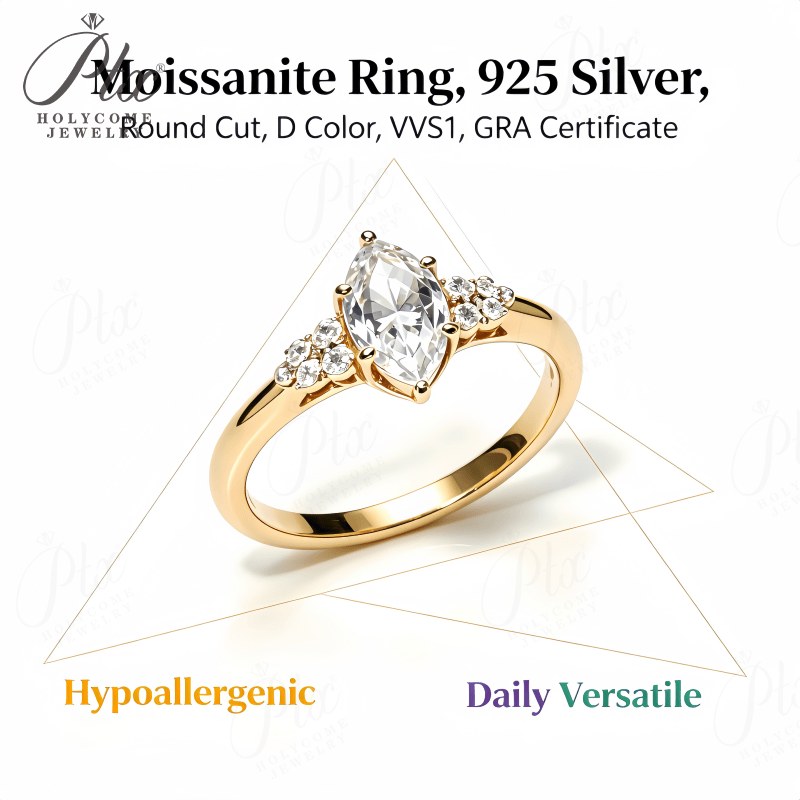
Building a custom engagement ring program that captures your brand's design language while hitting aggressive price points is one of the harder moves in fine jewelry. A custom engagement ring manufacturer that can move from sketch to CAD to casting to finished ring inside six weeks — while holding stones to ±0.02 mm tolerances on every prong — is not the same shop that does basic repair work. At HOLYCOME, we have been manufacturing custom rings for designers, independent brands, and private-label retailers since 2013, and this guide walks you through what actually happens during a custom ring production run, what tolerances you should demand, and how to evaluate a factory before you wire the deposit.
Why Work With a Custom Engagement Ring Manufacturer Directly
Many new jewelry brands assume they can design a ring locally and have it cast by a nearby shop, then hand-finish in-house. That works for one-off commissions. It falls apart the moment you have fifteen retail orders all with slightly different stone sizes and finger sizes, all due before a holiday weekend. A dedicated custom ring manufacturer removes five bottlenecks that kill delivery schedules.
Bottleneck 1: CAD Iteration Cycles
Every custom engagement ring starts as a CAD file. Junior designers using free tools produce files that look correct on screen but have wall thicknesses below 0.8 mm, prong heights that catch on fabric, or shank tapers that break during casting. Our in-house CAD team uses RhinoGold and MatrixGold, and every file passes a manufacturability review before it ever touches a printer. The result? First-cast success rates above 95%, compared to the 70-75% industry average reported in casting trade surveys.
Bottleneck 2: Stone Sourcing Match
If your factory is sourcing stones from a separate vendor and the casting from another, you lose control over stone-to-setting alignment. A 1.5 mm melee stone that is actually 1.46 mm will sit loose in a seat cut for 1.50 mm, and the setter has to burnish metal over it — which is a cosmetic repair, not a proper seat. As an integrated custom engagement ring manufacturer, we source diamonds, moissanite, and colored gemstones from our vetted supplier network in Guangzhou and Wuzhou, and every stone is measured with a digital micrometer before the seat is cut.
Bottleneck 3: Consistent Alloy Purity
White gold rhodium plating hides porosity for a few months, but customers return rings within a year when pits show through. We cast all 14K and 18K gold in-house using centrifugal casting machines, and every melt batch is sampled for alloy composition with an XRF gun. That means your 14K white gold stays 58.5% gold +/-0.3% batch to batch — not 56% on a busy Friday.
Bottleneck 4: Polishing Consistency Across Sizes
A size 4 ring and a size 10 ring of the same design need different polishing pressures and wheel durometers. Hand polishers in small shops treat every ring the same, and the smaller sizes come out over-polished (losing sharp edge detail) while the larger sizes show casting texture. Our production line assigns ring sizes to specific polishers with standardized wheel grit sequences, so your halo rings look identical across size 4 through size 11.
Bottleneck 5: Finished-Goods Inspection
Most factories inspect rings after setting and before shipping. We inspect three times: after casting (porosity and dimension check), after setting (stone security and seat depth), and after final polish (finish and plating). Each inspection has a documented pass/fail checklist, and rejected pieces do not move to the next station. This three-stage QC is the single biggest reason our return rate for custom rings stays below 0.8%.
Our Custom Engagement Ring Manufacturing Process Step by Step
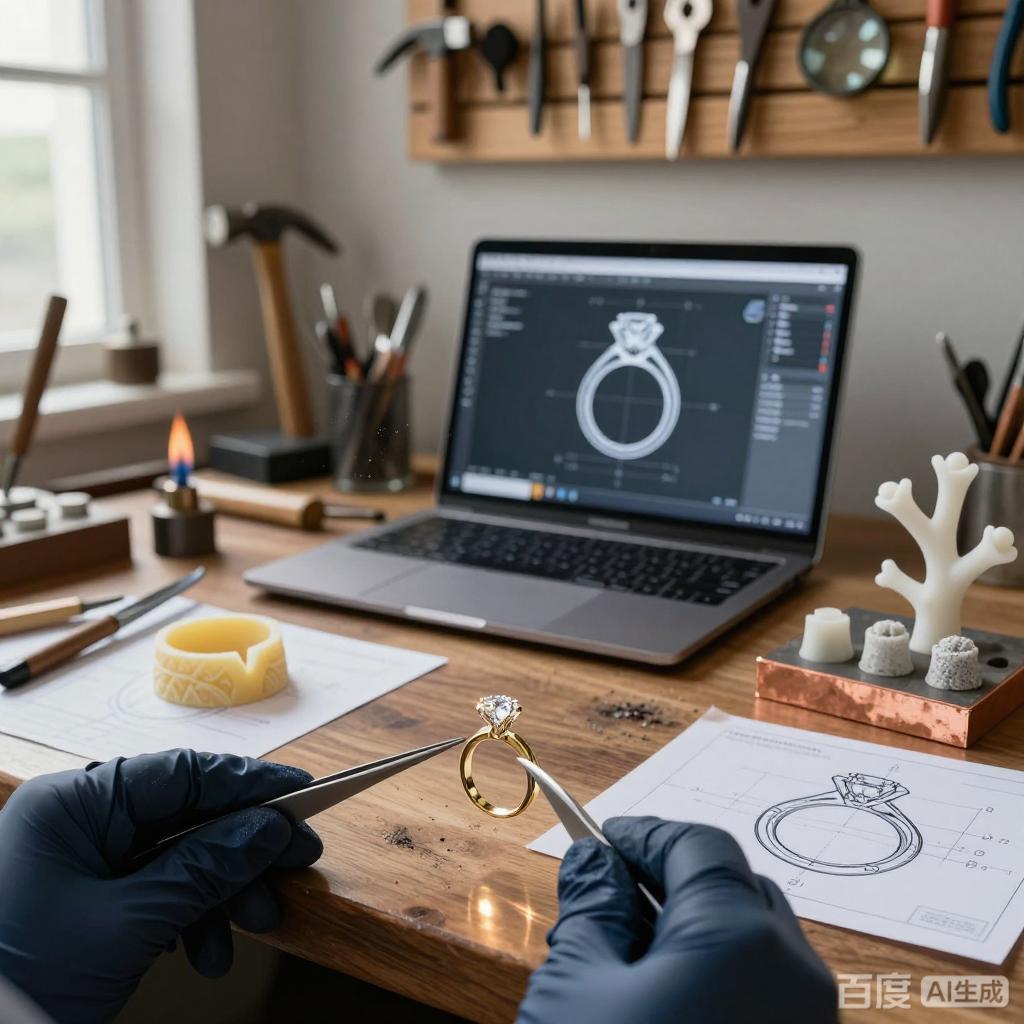
Brands that have only worked with casting houses often ask exactly what a full custom ring production run looks like end to end. Here is the process we follow for every custom engagement ring order at HOLYCOME.
Step 1: Design Brief and Reference Review
You send us sketches, inspiration photos, technical specs, stone dimensions, and target retail price point. We respond within 48 hours with a feasibility note: which design elements raise production cost, which require hand-forged work versus cast, and what MOQ applies. For solitaire and halo designs with standard shank profiles, MOQ starts at 30 pieces per SKU; for fully bespoke sculptural designs, MOQ is 50 pieces because of the custom tooling investment.
Step 2: CAD Modeling and Renderings
Our CAD team builds the model in RhinoGold and sends you 3D renderings from four angles (top, profile, three-quarter, and finger-on hand view) within 3-5 business days. You get up to two free rounds of revisions. Additional rounds are billed at $35 each, which covers the designer's time and re-rendering — but in practice, over 80% of clients approve on the second round because our first pass is built around manufacturability constraints from the start.
Step 3: Wax Printing or Resin Printing
Approved CAD files go to our Solidscape wax printers for high-detail designs (halos, pavé, filigree) or to our Formlabs resin printers for simpler solitaires. Wax produces cleaner burnout with zero ash residue, which is critical for pavé settings where even 0.01 mm of ash can cause a stone to sit proud. Resin is faster and cheaper for designs with large, smooth surfaces.
Step 4: Casting in Your Chosen Alloy
We cast in 10K, 14K, 18K gold (yellow, white, rose), platinum 950, palladium, and sterling silver. Gold casting uses centrifugal machines at 1050-1160°C depending on karat; platinum uses induction casting at 1900°C and argon atmosphere to prevent oxidation. Flask temperature, metal temperature, and spin time are logged for every casting tree for traceability.
Step 5: Sprue Removal, Pre-Polish, and Assembly
Sprues are cut with a jeweler's saw, never snapped (snapping creates microfractures that show up as cracks months later). Rings are pre-polished before assembly — meaning components like head, shank, and side accents are polished individually before they are soldered together. This is why our inside-finish quality is higher than shops that polish only after assembly: no dark, inaccessible soldered corners.
Step 6: Stone Setting
We offer prong, bezel, pavé, channel, tension, and gypsy setting. Every stone is seated to a depth of 12-15% of the girdle diameter — shallow enough that the girdle does not sit on metal, deep enough that the table sits at the correct height. Prong tips are shaped with a cup bur to exactly the radius of the stone's crown, so no sharp edges catch and no prong is shorter than the others. After setting, every stone is tested with an electronic stone tester and checked with 10x loupe by a separate QC inspector (not the setter).
Step 7: Final Polish, Plating, and Hallmarking
White gold rings receive 0.5-1.0 microns of rhodium plating over a nickel barrier (we also offer nickel-free palladium barrier plating for EU REACH compliance). Rings are tumbled for 4-6 hours in magnetic tumblers for the final high-luster finish, then hand-buffed. Karat stamps (10K/14K/18K/PT950) and your brand hallmark are laser-engraved on the inside shank before final QC.
Step 8: Three-Stage QC and Shipment
Every ring passes through: (1) gemologist verification of stone identity and weight, (2) dimensional check against the CAD file using digital calipers accurate to 0.01 mm, and (3) visual inspection under 10x magnification with ring-size verification on a mandrel. Rings are individually packaged in anti-tarnish pouches with a QC card listing stone specs, karatage, and inspector ID. Standard production lead time is 15-25 business days depending on design complexity; rush orders (7-10 days) are available for a 25% surcharge.
Custom Engagement Ring Options: Comparing Construction Methods
Different brands need different construction approaches based on price point, durability requirements, and aesthetic goals. The table below compares the four most common custom ring construction methods we produce.
| Construction Type | Best For | Durability | Price Tier | Lead Time |
|---|---|---|---|---|
| Solid cast (one-piece casting) | Solitaire, simple shank designs | Excellent — no solder joints | $ | 15-18 days |
| Cast with hand-fabricated head | Halo, three-stone rings requiring premium head security | Very good — hand-forged prongs are denser | $$ | 18-22 days |
| Full hand-fabrication | High-end bespoke, sculptural designs | Superior — grain structure is fully worked | $$$ | 25-35 days |
| CAD-designed, investment cast, hand-finished | Private-label production runs (30+ pieces of same design) | Very good — consistent across batch | $$ | 20-25 days |
Tolerances and Quality Standards You Should Demand
When evaluating a custom engagement ring manufacturer, ask for specific tolerance numbers in writing. Shops that give vague answers ("our settings are very secure") are usually not measuring. Here are the standards we contractually commit to on every order:
- Stone seat depth: 12-15% of girdle diameter, measured with a depth gauge
- Prong height above girdle: 0.25-0.35 mm for melee under 2.5 mm; 0.40-0.55 mm for center stones over 5 mm
- Prong spacing on 4-prong heads: Within 2 degrees of 90-degree spacing, measured with a protractor jig
- Shank wall thickness: Minimum 1.2 mm for ladies' bands; 1.5 mm for men's bands (thinner walls deform with normal wear within a year)
- Ring size accuracy: Within ±0.25 US sizes, measured on a steel mandrel at room temperature
- Pavé stone table height consistency: Adjacent stones within ±0.05 mm of each other (prevents "wavy" pavé lines)
- Solder joint gap: Zero visible gap at 10x magnification
- Plating thickness: Minimum 0.5 microns rhodium over nickel or palladium barrier
These tolerances are tighter than most US domestic custom jewelers work to, because domestic shops are often building one ring at a time with hand skills that vary by jeweler. Our production-line approach — where each step is a specialized station with calibrated tools — delivers consistency across batches of 50 or 500 rings.
Alloy and Stone Options for Custom Engagement Rings
We work with all standard and specialty bridal alloys. The choice affects both cost and how the ring wears over time.
Gold Alloys (10K, 14K, 18K — Yellow, White, Rose)
14K gold is the bridal industry sweet spot: hard enough to hold prongs securely, rich enough in color that customers can see the difference from 10K, and affordable enough for mid-market retail. 18K is softer and richer in color, preferred by high-end brands targeting $5,000+ retail. 10K is the most durable and lowest cost, popular in mass-market and men's bands.
Platinum 950
Platinum is denser and more expensive than gold but holds a high polish for years and does not require rhodium plating. It is the preferred metal for premium bridal brands. Our platinum casting uses 950Pt/50Ru (ruthenium alloyed) which machines cleaner than the older 950Pt/50Co formulation.
Center Stone Options
We set customer-supplied stones (you ship them to us and we insure upon receipt) or source from our network. Available stones include natural diamonds (GIA/IGI certified), lab-grown diamonds (IGI certified, HPHT and CVD), moissanite (Charles & Colvard Forever One and premium white Chinese moissanite), and colored gemstones (sapphire, ruby, emerald, morganite, aquamarine). All melee we source is D-F color, VS-SI clarity, and is sorted by both diameter and weight before setting.
Real-World Custom Ring Project: A 200-Piece Halo Collection Launch
A US-based direct-to-consumer bridal brand came to us in late 2024 with a tight deadline: they needed 200 pieces of a new halo engagement ring design (four variants: solitaire halo, three-stone halo, vintage-inspired halo with milgrain, and hidden halo) in time for a Valentine's Day launch. Their previous domestic vendor quoted 10 weeks and 3x our price. Here is how the project ran.
Week 1: Design review and CAD. The client sent hand sketches and Pinterest references. We found that the vintage halo's milgrain detail, as drawn, would wear off within six months because the edge height was only 0.2 mm. We recommended raising it to 0.35 mm and adding a small metal rail to protect the milgrain — the client approved. CAD files for all four variants delivered in 4 business days.
Week 2-3: Wax printing, casting tree assembly, and casting. All 200 rings (across 8 size runs per variant) were cast in 14K white gold from a single alloy batch to eliminate color variation. Casting yield was 96.5% — seven rings out of 200 had minor porosity at the sprue contact point and were re-cast immediately.
Week 4: Pre-polish, assembly, and stone setting. Center stones were customer-supplied (lab-grown diamonds in 1.0 ct and 1.5 ct sizes, IGI certified). We set each center stone first, then the halo melee (1.3 mm, 16 stones per halo), then the side stones on the shank. Each setter handles only one setting type to maintain consistency.
Week 5: Final polish, rhodium plating, QC, and packaging. All 200 rings passed three-stage QC; four were sent back for re-polish (light wheel marks visible at 10x), and two were re-plated because of uneven rhodium coverage on the inside shank. The full order shipped DHL on day 23 — two days ahead of our 25-day quoted lead time. The client reported zero returns in the first 90 days of sales and a 4.9/5 customer review average for the collection.
You can learn more about our materials and sourcing standards on our materials page.
Common Custom Ring Manufacturing Mistakes to Avoid
After over a decade in production, we see the same handful of mistakes from brands that previously worked with under-equipped factories.
Mistake: Designing Prongs That Are Too Thin
Designers love the look of delicate, needle-thin prongs. But a prong under 0.6 mm diameter at the tip will bend when the ring catches on a sweater or car door — and the stone falls out. We recommend minimum 0.7 mm prong tip diameter for center stones under 1 ct, and 0.8 mm for stones over 1.5 ct. The visual difference at that thickness is minimal in photos, but the stone security difference is substantial.
Mistake: Ignoring Finger Size vs. Ring Blank Weight
A size 4 halo ring and a size 10 halo ring of the same design should not weigh the same — the larger ring has more shank material. Some factories cast all sizes from the same wax pattern and stretch smaller sizes up or compress larger sizes down, which thins the shank on stretched rings and thickens it unevenly on compressed ones. We cut separate waxes for every quarter-size group above size 8 and below size 5.
Mistake: Using Hard Solders Near Prongs
Hard solder flows at higher temperatures and can re-melt nearby prong tips during assembly, weakening them. We use easy solder for all joints near stone seats, and medium solder for head-to-shank joins where higher strength is needed and prongs are far enough away that heat exposure is minimal.
Mistake: Skipping the Prototype
For new designs, always order a silver prototype first. A silver proto costs roughly $50-80 including CAD and shipping, and it lets you see the ring on a real finger, check proportions, measure shank thickness, and test the fit of the head to the center stone size before you commit to a 50-piece gold production run. The one time you skip the proto is the time the proportions look perfect on screen but feel clunky in person.
Pricing and MOQ Structure
Pricing for custom engagement ring manufacturing depends on alloy weight, stone count, setting complexity, and order volume. As a reference point, our volume pricing for common configurations is:
- 14K gold solitaire ring (no melee, customer-supplied center stone): $145-210 per piece at 50-piece MOQ
- 14K gold halo ring (16-piece halo melee, customer-supplied center): $220-310 per piece at 50-piece MOQ
- 14K gold pavé band (up to 30 melee stones): $95-160 per piece at 50-piece MOQ
- Platinum 950 solitaire ring: $280-380 per piece at 30-piece MOQ (platinum has lower MOQ due to higher per-piece value)
- Sterling silver CZ fashion ring: $12-28 per piece at 100-piece MOQ
Tooling fees for new designs range from $150-400 depending on whether we are creating a new rubber mold (for production replication) or only a single CAD file. Tooling is a one-time fee; reorders of the same design have no additional tooling cost. For detailed pricing on your specific design, request a factory quote with your CAD file or sketch.
Frequently Asked Questions
What is the minimum order quantity for custom engagement rings?
Our standard MOQ is 30 pieces per SKU for gold and platinum designs, and 100 pieces per SKU for sterling silver. For solitaire designs with standard heads, we can sometimes accommodate 20-piece runs. Fully one-off bespoke pieces (single rings) are accepted for established brands with ongoing production commitments.
Can you work with our CAD files, or do we have to use yours?
We accept client-provided CAD files in .3dm, .stl, and .igs formats. Our CAD team runs a manufacturability review on every incoming file and flags issues (thin walls, undercuts, impossible under-gallery geometry) before production begins. Revision fees apply if we need to rebuild geometry that will not cast reliably.
Do you provide stone sourcing, or do clients supply their own?
Both. We can source natural diamonds (GIA/IGI), lab-grown diamonds (IGI), moissanite, and colored gemstones from our vetted supplier network with full certification. We also accept customer-supplied stones, which are inspected, weighed, and documented on receipt; we carry insurance coverage for stones in our possession up to $50,000 per parcel.
How do you handle quality control and inspection?
Every ring goes through three inspection stages: post-casting (porosity and dimension check), post-setting (stone security and seat depth), and post-polish (finish, plating, hallmark). Each stage is performed by a different inspector who signs off on the QC card. Failure at any stage routes the piece back to the relevant department for rework; pieces that cannot be reworked to spec are scrapped and recast at our cost.
What is your lead time for custom engagement ring production?
Standard lead time is 15-25 business days from CAD approval and stone receipt, depending on design complexity and order volume. Rush production (7-10 business days) is available for a 25% surcharge, subject to production capacity. Reorders of existing designs typically ship in 10-15 business days.
Do you offer branding and custom packaging?
Yes. We laser-engrave your brand hallmark inside the shank at no additional cost. Custom packaging (ring boxes, pouches, care cards with your logo) is available; packaging setup fees range from $200-500 depending on complexity, with per-piece packaging costs of $2-8. We also offer drop-shipping directly to your customers under your brand name, with no HOLYCOME branding on any external packaging.
Ready to Start Your Custom Engagement Ring Production?
Whether you are launching your first bridal collection or scaling an existing line to meet holiday demand, our transparent pricing, documented quality standards, and 12+ years of custom ring manufacturing experience let you order with confidence. Reach out through our contact page with your sketches, CAD files, or reference images, and we will send a detailed quotation and production timeline within two business days. For general information about our facility and capabilities, visit our about page.
The Wikipedia article on rhodium explains why rhodium plating is applied to white gold and silver jewellery.
Related reading: Custom Ring Manufacturer OEM Engagement China, Custom Earring Manufacturer Studs Hoops OEM, Custom Necklace Manufacturer Pendant Chain OEM.


