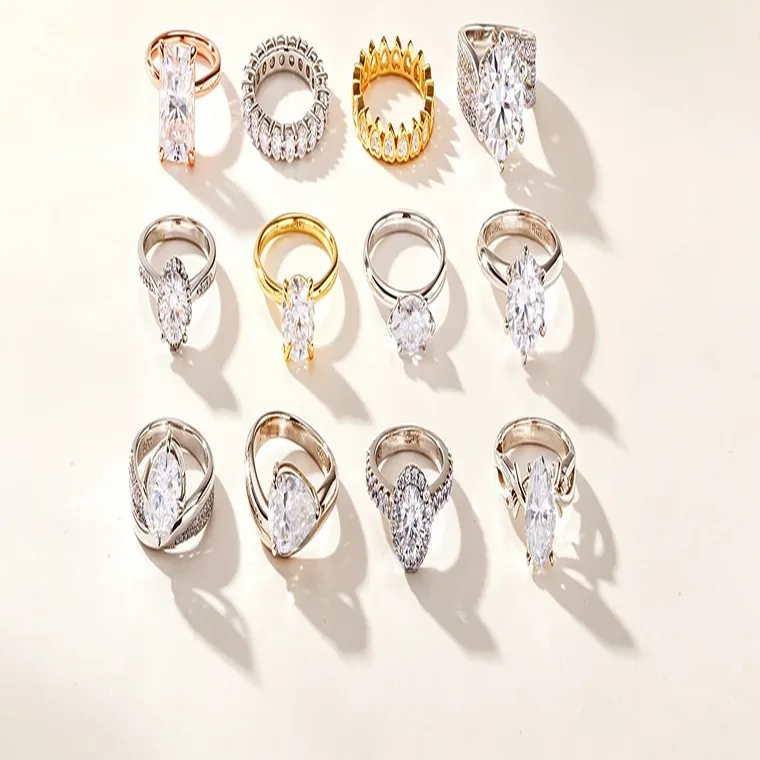
The traditional anniversary gift list dates back to the Victorian era, when certain marriage years became associated with specific materials — paper for the first, cotton for the second, silver for the twenty-fifth, gold for the fiftieth. The point was never the object itself. It was a prompt: give something that matches the weight of the year. At our bench, we see clients who take that prompt and turn it into jewelry, and the results are almost always more personal than another bouquet.

The first decade
Year 1 (Paper) sounds like a strange year to buy jewelry, but it is the year we most often see clients come in for a thin gold stacking band or a pair of small studs engraved on the inside. The "paper" theme is honored by the handwritten note that goes in the box, not by the gift itself.
Year 5 (Wood) is a natural moment for a wooden-textured gold band, or a piece set with a brown-toned stone like smoky quartz or citrine. Year 10 (Tin/Aluminum) is the first big jewelry anniversary. Modern lists suggest diamond jewelry, and we often build a small diamond pendant or a three-stone ring that references the decade.
The second decade
Year 15 (Crystal) pairs naturally with a clear stone — a small diamond, a white sapphire, or a morganite. Year 20 (China) is the year we most often build a colored-stone piece that matches the wife's birthstone, set into a pendant or earrings. The "china" theme is honored by the elegance of the piece rather than by the material.
Year 25 (Silver) is the first metal anniversary that is actually jewelry. Sterling silver is traditional, but we usually suggest upgrading to something with a little more permanence — a 925 silver piece designed to be worn daily, or a small diamond set in silver-topped gold. By year 25, clients usually already have a gold wedding set, so silver adds something different.
The big milestones
Year 30 (Pearl) is the pearl anniversary, and it is one of the easiest to get right: a strand, a pair of studs, or a pearl pendant. See our pearl care guide for what to expect over the decades.
Year 40 (Ruby) is the ruby anniversary, and it is the year we most often see clients come in for a meaningful red stone — not necessarily a big ruby, but a small one set into a ring, a pendant, or a pair of earrings that can be worn every day. Year 50 (Gold) is gold, and by this point clients usually want something that references the original wedding band — a matching stacking ring, a pendant, or a rebuild of the original piece in heavier gold.
Year 60 (Diamond) is rare, and the gifts we build for it are almost always heirloom pieces — something that will be worn by the next generation, not just the current one.
Budgeting for the anniversary piece
The most common mistake we see is over-buying at year five and under-buying at year twenty-five. A better rhythm is to spend modestly on the early years — a small engraving, a thin band, a pair of studs — and let the piece accumulate meaning. By the time you hit year 25 or 30, you have a little collection, not a single big object that came out of nowhere.
We also suggest buying something the recipient will actually wear. A pendant on a daily chain gets worn far more than a brooch that lives in a drawer. A pair of small diamond studs outlasts a statement necklace that comes out twice a year. For the broader principles, our gift jewelry guide walks through how to choose for any occasion, and the birthstone guide gives you a color reference if you want the stone to match the month.
What we build most often
Across all the anniversary years, the pieces clients actually wear narrow down to a short list: a thin stacking band that sits beside the original wedding ring, a small diamond pendant on an everyday chain, a pair of small studs, or a charm added to an existing bracelet. We have built all four dozens of times. The pieces that sit in a drawer are the statement necklaces and the brooches — beautiful, but worn twice a year. If your goal is a gift that gets used, build it around the chain they already wear or the stack they already start each morning with.
Engraving is the secret weapon
The single highest-return add-on on any anniversary piece is a small engraving — a date, a set of initials, a line from a letter. It costs minutes at the bench and turns a generic gift into a specific one. We engrave on the inside of bands, on the back of pendants, and on the clasp of bracelets. If you are ordering an anniversary piece, ask for the engraving before we finish the piece. It is a five-minute addition that the recipient will notice for fifty years.
The 92.5% silver composition and properties of sterling silver are described in the Wikipedia entry on sterling silver.
Related reading: Birthstone Jewelry Gifts, The Bespoke Jewelry Process: From Concept to Delivery, 3D Printing in Jewelry Design: Prototyping Your Custom Piece.
Frequently Asked Questions
How do I verify a factory before placing a bulk order?
Request a production video, business license, export records and a paid sample run. A factory that accepts a 50-piece test order is usually a real manufacturer.
What payment terms do you offer?
30% T/T deposit with the balance against the bill of lading. This protects both sides on first orders and can move to net terms after a track record.
What is your normal reject rate?
3–5% under 10x loupe inspection for cast and set pieces. Defective units are replaced free in the next shipment.
Where is the factory located?
Wuzhou, Guangxi, China—the core lab-grown and moissanite manufacturing cluster. Shipments go via Guangzhou or Shenzhen ports.


