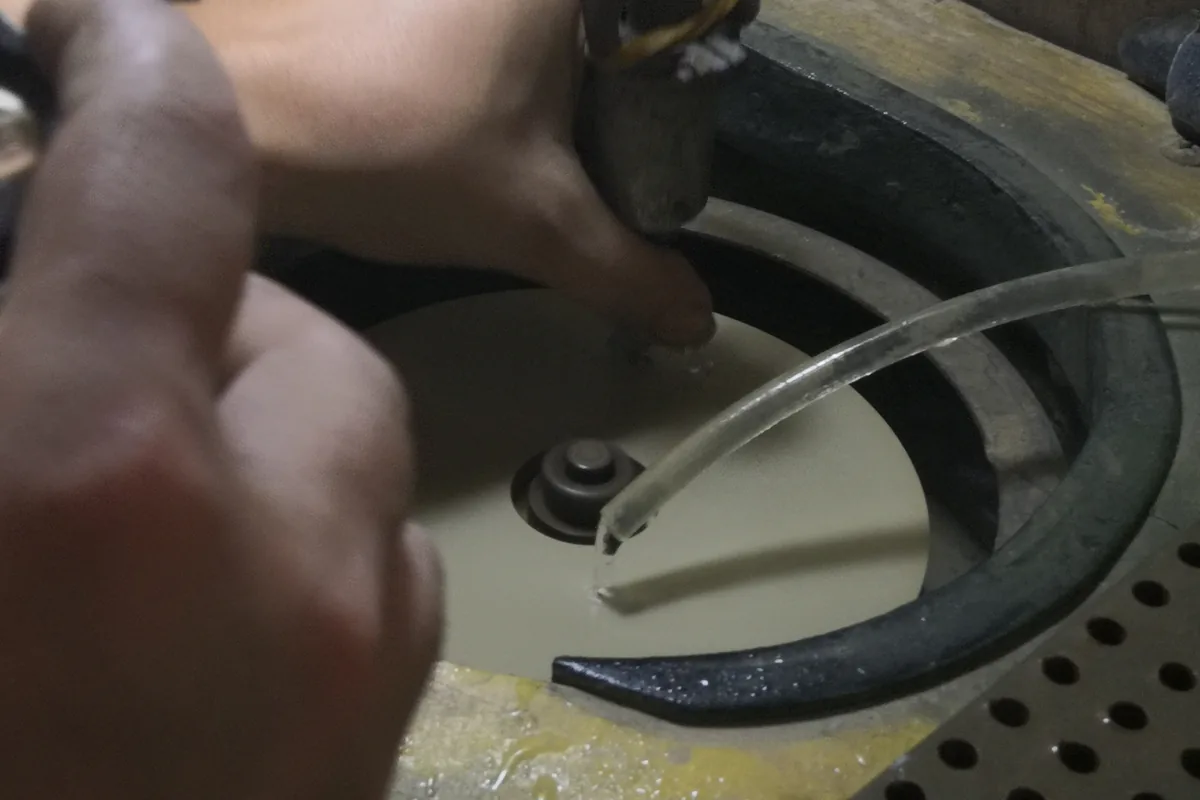
Moissanite is often marketed as "diamond alternative, same hardness." That is half the story. On the Mohs scale, moissanite sits at 9.25 — harder than sapphire (9) and only a touch below diamond (10). But moissanite is also brittle and sensitive to point pressure, and it has a different thermal and expansion behavior. Settings that work fine for diamond can chip moissanite within months of wear. The protection is built into the CAD, not fixed at the bench, and buyers who skip this step pay for it in warranty returns.
Why moissanite chips differently
As Wikipedia's entry on moissanite notes, silicon carbide is highly anisotropic — its hardness varies by crystal direction. The girdle edge of a round-brilliant moissanite is the weakest plane. A prong clamped too hard against the girdle, or a seat that bottoms out on the culet, creates a stress concentration that propagates into a chip when the ring is bumped. Diamond absorbs that same point load; moissanite cracks. This is why moissanite set in a diamond-style tight-prong seat shows a chip at the girdle within a year of daily wear, while the same seat on a diamond survives for decades.
The seat clearance we design in
For a 6.50 mm round moissanite, our CAD seat diameter is 6.55–6.60 mm — roughly 0.05–0.10 mm of clearance over the measured stone, not the nominal size. This is deliberate: the stone must drop in without force, and the prongs, not the seat walls, hold it. A seat that grips the stone by friction around the girdle is the #1 cause of moissanite breakage. The culet must also sit 0.2–0.3 mm above the seat floor so it never bottoms out on the metal when the ring is pressed against a surface. We re-measure every moissanite on a digital caliper before setting, because "6.5 mm" stones commonly run 6.42 to 6.55 mm.
Girdle relief and prong shape
Prong tips must be rounded — never knife-edge. A 0.4 mm radius on the inside of each prong spreads the contact over a wider area. We also leave a small girdle relief channel: the prong meets the girdle edge, not the crown facets, so no sharp metal edge presses against the pavilion. For bezel settings, the inner rim is burnished to a soft radius; a sharp bezel lip is a moissanite cutter. For channel and pavé settings, we widen the channel by 0.05 mm over diamond specs, because moissanite melee is slightly more brittle under side pressure.
Thermal and laser limits
Moissanite conducts heat roughly 3–4 times slower than diamond, so it heats up faster under a laser welder. Our rule: never laser within 3 mm of a mounted moissanite, and shield the stone with a wet cotton swab during any nearby weld. Many bench stories of "the stone shattered" during setting are thermal shock from an unshielded laser, not mechanical stress. We also avoid soldering on the same shank as a mounted moissanite — the torch heat, even at a distance, can crack the girdle.
Color and clarity: why setting tolerance is not just about chips
Moissanite also has a lower refractive-index window than diamond, which means a too-deep seat can make the stone look darker through the table. Our CAD places the stone so the table sits level with the top of the prongs, not below it — a seated-deep moissanite looks smaller and darker even if it is secure. This is a cosmetic tolerance rather than a structural one, but buyers who compare moissanite rings side by side will see the difference immediately.
What buyers should specify in the BOM
When you send us moissanite to set, include the measured girdle diameter (not just the carat weight) and the girdle thickness. We re-dimension the CAD seat to that measurement. A "6.5 mm" moissanite that actually measures 6.42 mm needs a 6.47 mm seat, not a 6.60 mm one. This tolerance work is part of our QC checklist. For buyers sourcing moissanite melee in volume, we recommend specifying the stone diameter to ±0.03 mm rather than accepting nominal sizes — the cost difference is small, and the reject rate drops sharply.
Can you set moissanite in a prong setting?
Yes, with rounded prong tips and a 0.05–0.10 mm clearance seat. Tight-friction seats are the failure mode. We set moissanite in prong, bezel, channel, and pavé, all with the girdle-relief CAD built in.
Does moissanite chip easier than diamond?
On Mohs it is almost as hard, but its brittleness makes it more sensitive to point pressure and thermal shock. A moissanite that survives daily wear in a properly designed seat will still chip if slammed against a hard surface — the same is true of diamond, but the threshold is lower.
Can laser welding be done near a mounted moissanite?
Not without shielding. Keep the beam at least 3 mm away and cool the stone during welds. We wet-cotton and test-pulse on scrap before approaching the setting.
Sourcing moissanite jewelry in volume? HOLYCOME designs seats to your stone's measured dimensions and shields stones during setting. Request an OEM quote for a moissanite line.
Frequently Asked Questions
Is moissanite a good diamond alternative for retail buyers?
Yes for price-sensitive customers who want brilliance and hardness. Moissanite ranks 9.25 on the Mohs scale, holds up to daily wear and costs a fraction of a natural diamond of the same size, so it resells fast in bridal and fashion lines.
What is the minimum order for wholesale moissanite?
MOQ starts at 50 pieces per design for stock items. Custom cuts and private-label settings usually start at 100–300 pieces depending on the mold.
Do you provide certificates with moissanite stones?
Yes. Every parcel ships with GRA or IGI documentation listing carat weight, color grade and cut. We recommend passing the certificate to your end customer for trust.
How long does sample and bulk production take?
Samples ship in 3–5 days. Bulk runs take 15–20 days under 500 pieces, and 25–30 days for custom work.


