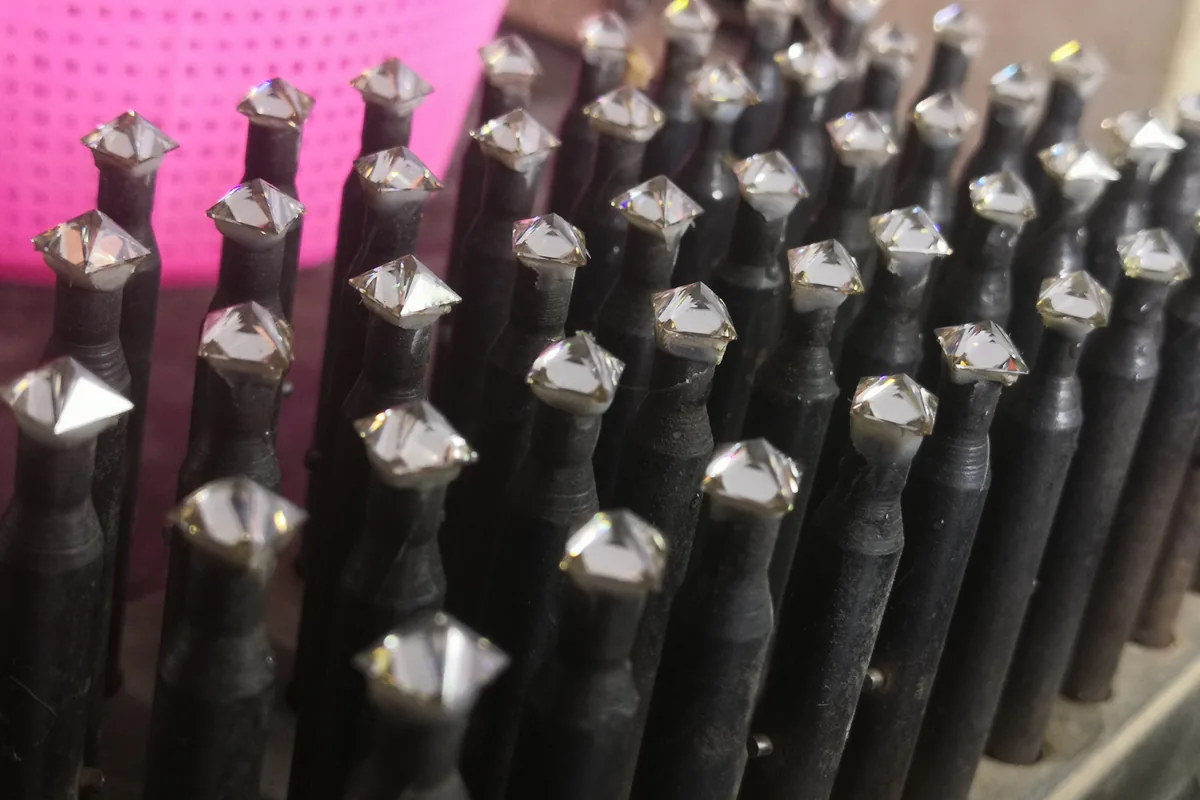
A setter receives a new bag of 6.5 mm round moissanites, cuts a seat to 6.5 mm as the CAD instructed, and on the third stone hears a faint tick — the girdle has cracked. The supplier caliper check reveals the lot actually runs 6.48 to 6.58 mm across, a 0.10 mm spread inside a single labeled size. Moissanite is harder than silver (9.25 on Mohs vs 2.5–3 for sterling) but its girdle is often thin and faceted, which makes it crack exactly where a diamond would compress. Fitting moissanite is a measurement problem, not a CAD problem. Here is the bench workflow we use.
Measure the girdle, not the label
We open every stone lot under a 10× loupe or microscope and measure the girdle at four points (top, bottom, left, right) with a digital caliper readable to 0.01 mm. Round brilliant moissanite commonly runs 6.45–6.58 mm for a 6.5 mm label; ovals can vary 0.3 mm on the long axis. We record the mean and the maximum and cut the seat to (mean minus 0.05 mm). A seat 0.05 mm smaller than the girdle means the stone sits in with a light press; 0.1 mm smaller will not go in by hand and will crack when prongs are closed. The general tolerance logic is described in moissanite setting tolerances and girdle fit,.
Seat depth and culet clearance
The seat must sit below the girdle by roughly 0.15–0.25 mm for a prong setting. Too shallow and the stone sits high, catching on things; too deep and the culet (bottom point) presses against the metal and can chip. We cut a pilot bur to the measured girdle radius, then a smaller cup bur at the center to leave a 0.2 mm culet clearance pocket. On moissanite, which has a sharper, more pointed culet than most diamonds, we leave the pocket 0.3 mm deep. The geometry of setting types is compared in prong, bezel, pavé, and channel setting.
Girdle thickness: faceted vs polished
Moissanite girdles are often thin (knife-edge) or heavily faceted, which is different from a typical diamond slightly thick polished girdle. A thin girdle cannot rest on a flat seat — it needs a 30-degree bearing ledge cut with a Hart bur, or the stone will rock. We check girdle thickness under the microscope and adjust the seat angle: thin girdles get a 30–35 degree seat, thick girdles a flat 0.2 mm ledge. This is also why a moissanite cannot be swapped into a seat cut for a CZ from the same size label — the girdle profile is different. Buyers should send the stone supplier girdle report, as we explain in what a factory needs from your CAD file.
After setting: check and photo
Once the stone is seated and prongs closed, we wiggle it with a prong pusher — it should not move. We check the seat shadow under 10× for daylight gaps around the girdle. Every ring then gets a macro photo of the seat and the girdle, logged to the buyer QC folder (see QC photos before shipment). If a stone ever rattles in service, that photo tells us whether the seat was cut to the wrong size or the prong was under-closed. We also log the lot number so a replacement stone can be cut to the same bearing angle.
Can I send the CAD without measuring stones?
You can, but we will measure on receipt and re-cut seats. Sending the girdle report up front saves one revision round and 2–3 days.
Does moissanite scratch during setting?
Moissanite is 9.25 Mohs, so steel tools will not scratch the crown, but fine dust and investment residue will. We clean seats thoroughly and use brass or bamboo pushers on the pavilion. Material properties of moissanite, including its thermal conductivity and hardness relative to diamond, are summarized in the moissanite entry on Wikipedia. Material properties of moissanite are summarized in the moissanite entry on Wikipedia. Material properties of moissanite, including thermal conductivity and hardness relative to diamond, are summarized in the moissanite entry on Wikipedia.
What if the girdle is out of round?
We cut the seat to the smaller axis and accept a slight table tilt that is invisible from the top. Seating to the larger axis would leave the stone rocking on the smaller axis.
Sending moissanite for custom setting? HOLYCOME measures every girdle before cutting seats and returns a macro photo of each seated stone. Send us your stone lot number and CAD — we will quote per-stone fitting and include seat measurements in the QC pack.
Frequently Asked Questions
Is moissanite a good diamond alternative for retail buyers?
Yes for price-sensitive customers who want brilliance and hardness. Moissanite ranks 9.25 on the Mohs scale, holds up to daily wear and costs a fraction of a natural diamond of the same size, so it resells fast in bridal and fashion lines.
What is the minimum order for wholesale moissanite?
MOQ starts at 50 pieces per design for stock items. Custom cuts and private-label settings usually start at 100–300 pieces depending on the mold.
Do you provide certificates with moissanite stones?
Yes. Every parcel ships with GRA or IGI documentation listing carat weight, color grade and cut. We recommend passing the certificate to your end customer for trust.
How long does sample and bulk production take?
Samples ship in 3–5 days. Bulk runs take 15–20 days under 500 pieces, and 25–30 days for custom work.


