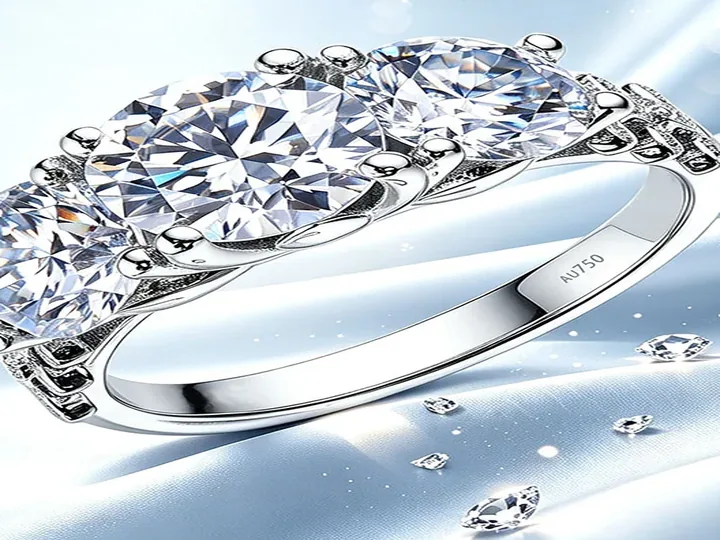
Natural moissanite is rarer than diamond, found in meteorite impact sites and a handful of deep-source rock deposits. Almost every moissanite sold in jewelry today is manufactured, and the process bears almost no resemblance to mining. Understanding that process helps buyers talk honestly about what they are stocking and why two stones with the same carat weight can price very differently.
Starting material: silicon carbide powder
The feedstock is a high-purity silicon carbide powder, often derived from silica sand and carbon heated together. The powder is loaded into a growth crucible with a small seed crystal of oriented silicon carbide at one end. The crucible sits inside a vacuum or inert-atmosphere furnace that ramps to roughly 2,200–2,500°C.
Rather than melting the material (silicon carbide sublimes before it melts), manufacturers use physical vapor transport: the powder sublimes, travels as vapor through the crucible, and recrystallizes onto the cooler seed. Over days to a couple of weeks, the seed grows into a cylindrical single crystal called a boule. Boules are typically only a few millimeters to a centimeter thick and several centimeters long, which is why larger moissanite stones carry a price premium.
Why color varies by growth run
The boule’s color depends heavily on growth conditions: trace nitrogen, stacking faults, and the temperature gradient all shift the crystal from near-colorless to greenish, greyish, or straw-tinted. Premium near-colorless grades come from the cleaner cores of carefully tuned runs; greener sections are often routed to lower color tiers or to darker jewelry designs where the tint is hidden.
Because moissanite has a higher refractive index and stronger dispersion than diamond, even a slight yellow or green body color reads differently in light than it would in a diamond of the same tint. Buyers should grade the stone under actual daylight-equivalent light, not just under white showroom bulbs, which can flatten the tint.
Cutting and faceting
Once a boule is sliced into rough slabs, the cutter treats it like any other colored gem: planing orientation to hide inclusions, then cutting on diamond-impregnated blades and polishing on laps charged with diamond grit. Moissanite’s Mohs hardness of 9.25 sits between corundum (9) and diamond (10), so it cuts cleanly but wears cutting tools faster than quartz or beryl.
The cut itself is where the stone’s famous fire is controlled. A well-proportioned round brilliant spreads the strong spectral flashes evenly across the face-up view; a shallow or deep cut leaks light and makes the stone look dead in the center. Wholesale buyers should ask for actual measured proportions, not just a photo, when sampling a new supplier’s cut quality.
Grading, matching, and certification
Finished stones are sorted by carat, color tier, clarity, cut, and hand-matched in pairs for earrings or in sets for eternity bands. Most wholesale moissanite ships with a grading report from labs such as GRA, IGIA, or similar in-house labs; buyers should note that these labs describe moissanite’s own color and clarity scales, not diamond’s, and that certification does not replace an in-house check under magnification.
How it wears in real jewelry
At 9.25 on the Mohs scale, moissanite survives daily wear better than almost any colored gem — sapphire is 9, ruby is 9, emerald is 7.5–8. The one material difference buyers should know is thermal conductivity: moissanite reads differently on a diamond tester than diamond, so staff who use testers at the counter need the right tool. It also has roughly 2.4 times the fire of diamond, which some customers love and others find flashy. That is a styling conversation, not a quality issue. For bridal marketing, the honest framing is that moissanite is a durable, consistent, ethically straightforward alternative — not a diamond substitute that needs to be hidden.
Because moissanite is manufactured, supply is consistent: a 2-carat oval in a near-colorless grade is available today and in six months, unlike a natural stone where each parcel is unique. That predictability is why brands build bridal lines around it and why reorder lead times are shorter than on natural-stone collections. It also means wholesale pricing is comparatively transparent — the main cost drivers are color tier, cut grade, and size, not a single find of rough. For buyers, that predictability makes forecasting easier: a best-selling SKU can be restocked on a known schedule rather than hunted down parcel by parcel.
What to ask a supplier
- What color tier and cut grade are in the price I am quoted?
- Are stones hand-matched in pairs or sets?
- What is the replacement policy on a stone that facets out during setting?
- Can I see a measured-proportion sheet for the cut?
For finished pieces, browse our moissanite rings to see how manufactured stones read in a production setting. The takeaway for buyers: moissanite is a precision-grown engineered material, and the price spread between growth runs is real — sampling a single stone before placing a bulk order always pays off.
Gemstone grading terminology used here follows the Gemological Institute of America’s gem encyclopedia.
Related reading: Moissanite vs. Lab-Grown Diamond: Which Should You Choose?, Moissanite vs Lab-Grown vs Natural Diamond: A 2025 Buyer's Guide, Moissanite vs Lab-Grown Diamond: A 2025 Bespoke Buyer's Guide.
Frequently Asked Questions
Is moissanite a good diamond alternative for retail buyers?
Yes for price-sensitive customers who want brilliance and hardness. Moissanite ranks 9.25 on the Mohs scale, holds up to daily wear and costs a fraction of a natural diamond of the same size, so it resells fast in bridal and fashion lines.
What is the minimum order for wholesale moissanite?
MOQ starts at 50 pieces per design for stock items. Custom cuts and private-label settings usually start at 100–300 pieces depending on the mold.
Do you provide certificates with moissanite stones?
Yes. Every parcel ships with GRA or IGI documentation listing carat weight, color grade and cut. We recommend passing the certificate to your end customer for trust.
How long does sample and bulk production take?
Samples ship in 3–5 days. Bulk runs take 15–20 days under 500 pieces, and 25–30 days for custom work.


