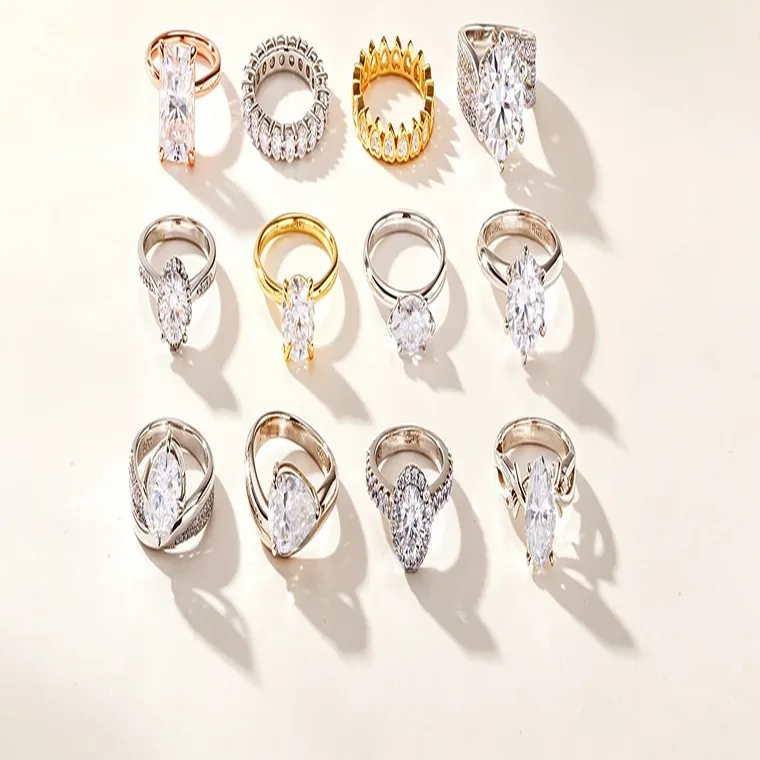
A design studio sends a ZBrush sculpt exported as an STL, the resin printer pulls a wax, the casting room pours it, and the buyer gets a piece with a thin web that breaks off at the sprue. The design was correct. The export was not. STL settings, wall thickness, and support geometry are the difference between a CAD file that casts on the first pull and one that needs three revision rounds.
STL tolerance and mesh quality
STL is a triangle mesh, not a solid. When you export from Rhino, Matrix, ZBrush, or Fusion, you set a chord height (the distance between the true surface and the approximating triangle). A chord height of 0.05 mm is loose; 0.01 mm is the line we want for jewelry. Loose chord height produces faceted curves on the wax and visible ridges after casting. Tight chord height produces a larger file but a smooth wax. We also ask for a unit check: millimeters, not inches, and not doc units. We have had files arrive where the model exported 25.4 times too large because the unit was wrong. The IGI lab notes on CAD-to-cast jewelry also flag unit mismatch as the top reason first wax samples fail dimensional checks.
Wall thickness minimums
A wax that is too thin (under 0.4 mm) distorts during burnout and casting. A wax that is too thick (over 2.5 mm) sinks into a heavy piece and risks internal porosity because the center cools slowly. Our working minimums are: 0.6 mm for rings, 0.8 mm for pendants, 0.4 mm for earring posts, and 1.0 mm for any piece that will be stone-set. We document (FTC jewelry industry guides) the same numbers in jewelry CAD tolerances factory default and jewelry CAD file factory requirements.
Supports and sprue points
Resin-printed wax needs supports where the model overhangs. If the designer places supports under a visible surface, the support leaves a nub that the casting bench has to file out, and on a polished piece that file mark shows. We ask designers to leave sprue and support placement to our wax room. The designer exports a clean STL, and we add sprue pins at non-visible points (usually the back of a pendant or the inside of a shank). This is the same workflow we describe in sprue design jewelry casting tree.
Why a perfect CAD still produces a twisted wax
Resin printing is layer-by-layer. If the model is oriented flat on the build platform, tall features (prongs, earring posts) print perpendicular to the layer lines and flex. We orient the model at 30 to 45 degrees on the build platform so layer lines run diagonally through the thin features. That single orientation choice reduces wax distortion by roughly 70 percent. We cross-check orientation against 3D printed wax resolution fit before the first pull.
Revision rounds and approval
We expect one to two revision rounds on a new CAD: the designer exports, we print a wax, we measure against the spec, and we send a photo back. The designer adjusts and re-exports. We do not cast until the wax sample is approved. This is the loop we describe in ring CAD model revision rounds approval, and it saves more metal than any casting optimization.
FAQ: CAD STL export for casting
What STL chord height do you recommend for jewelry?
0.01 mm maximum. Tighter if the design has curved surfaces that will be polished. Looser chord height shows as faceting on the wax and survives through to the cast piece.
Should the designer hollow the model before export?
No. Hollowing and shell thickness are our wax room job, because we need to add drainage holes for burnout. A designer who hollows without drainage will produce a wax that traps resin and blows the flask.
What file format is better than STL for casting?
3MF or OBJ with units preserved. STL is universal but lossy on unit and tolerance metadata. If the design studio can export 3MF, we prefer it.
How long does a CAD to first wax take?
Typically 3 to 5 business days: export check, print, wash, cure, sprue, and a photo back. We cover the timeline in custom ring CAD to production timeline.
If you are sending a CAD file for a custom run, export at 0.01 mm chord height in millimeters, leave walls at our minimums, and let our wax room handle supports and sprues. We will return a wax photo for approval before any metal is poured.
What to send us on the first export
To cut the revision loop short, send us four things with the first STL: a rendered JPG of the design from three angles, a dimensions note (ring size, band width, stone seat diameter), the target alloy, and the unit the file was built in. We return a wax sample within five days. If the wax measures off, we send the measurement back and the designer adjusts one number rather than guessing. That loop is what keeps a custom run on schedule and avoids the three-round revision cycle that most brands assume is normal.
Gemstone grading terminology used here follows the Gemological Institute of America’s gem encyclopedia.
Frequently Asked Questions
What care instructions should I give end customers?
Remove jewelry before swimming, cleaning or applying perfume. Store dry in a sealed bag. Clean with mild soap and a soft brush, then dry fully.
How often does rhodium plating need renewal?
Every 12–18 months under daily wear. Offer a re-plating service to your customers to build repeat visits.
Does chlorine damage sterling silver?
Yes. Chlorine and saltwater accelerate tarnish and can pit the surface. Rinse and dry immediately after any contact.
What causes green skin marks?
Copper or nickel in the base alloy reacting with sweat. Switch to 316L, titanium or sterling, and specify nickel-free plating.


