A jewelry buyer in Texas ordered 500 sterling silver band rings from a new supplier. At the 90-day mark, 12% came back: band walls thinned at the sizing shoulder, a few stones rattled loose, and three rings were out of round. Re-work freight and replacement cost them more than the original margin. The problem was not a bad supplier on paper. It was that nobody walked the line and checked where the factory was cutting corners. If you buy rings at wholesale, the manufacturing process is the product. Here is what actually happens on the floor, and where the industry normally slips.
Where most ring orders lose money
Ring production is a chain of small deviations that stack up. A sprue placed too close to the stone seat leaves porosity; a casting cooled too fast leaves internal stress that shows up as a cracked band six months later; a polishing step that skips one grit stage leaves a finish that tarnishes fast. Industry return rates for mass-produced silver rings commonly run 8–15% once wear returns are included. Best-practice factories hold that under 3%.
| Stage | Industry typical | Best-practice standard |
|---|---|---|
| Casting porosity | Visual only; ~5% of pieces reworked | X-ray / magnifier check; porosity under 1.5% |
| Ring roundness | ±0.15 mm | ±0.05 mm on the mandrel |
| Prong seating | Visual, finger-tight | 1.5 kg pull test per stone |
| Wall thickness (bands) | 0.8 mm nominal | 1.2 mm minimum at shoulder |
The line, from wax to finished ring
- CAD and 3D print. The approved design is modelled in CAD and printed as a high-resolution resin pattern. This is where sizing, shoulder taper and stone seat depth are locked.
- Wax injection. Rubber moulds are cut from the master and production waxes are injected. Each wax is trimmed under 10x magnification before it goes on the tree.
- Investment and burnout. The wax tree is encased in plaster investment and slowly burned out in a kiln. Residual carbon here is the silent cause of cloudy castings.
- Casting. Molten alloy (925 silver, 10k/14k gold) is centrifugally or vacuum-cast into the hot mould. Vacuum-assist casting cuts porosity sharply compared to gravity pour.
- Quench, divest, pickle. The castings are broken out, cleaned in acid pickle, and inspected for sprue shrinkage.
- Mounting and stone setting. Stones are set under magnification; prongs are shaped, burnished and tipped.
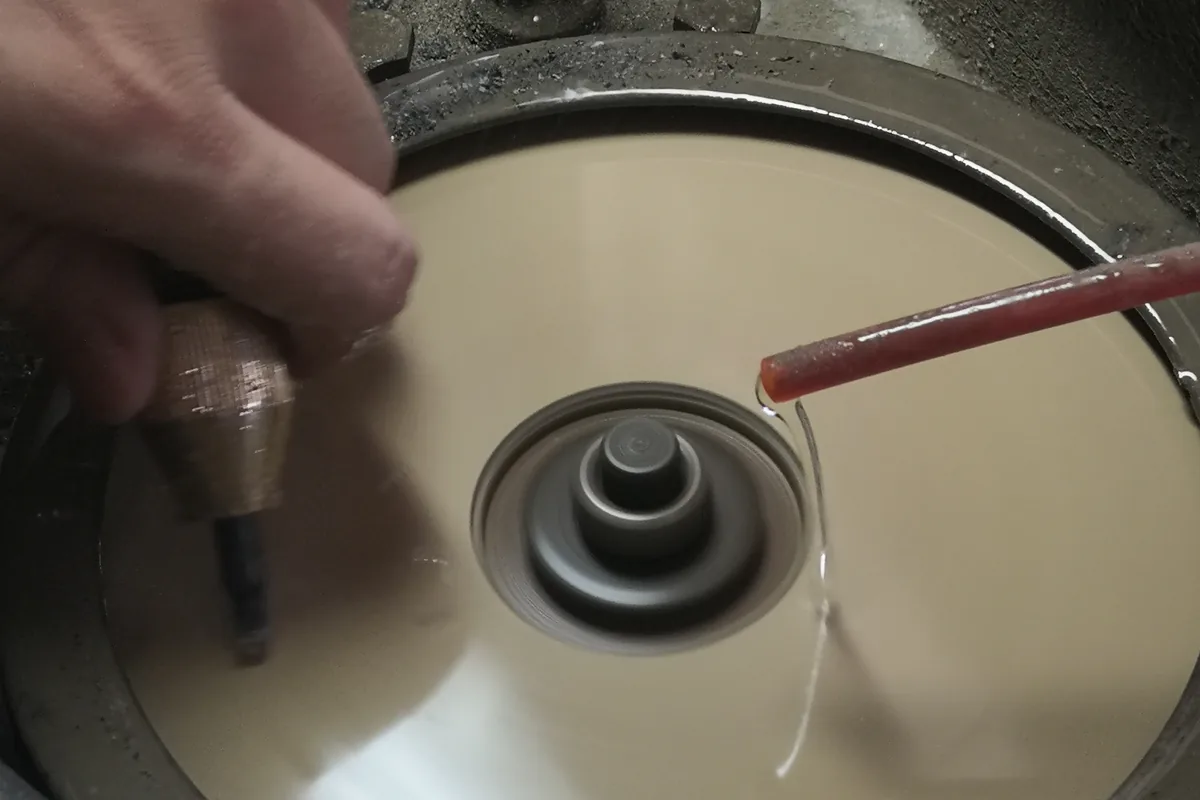
- Polishing and plating. Progressive grit polishing (from 240 up to rouge), then plating if specified. Rhodium plate on silver and white gold protects against tarnish.
- Final QC and sizing. Rings are sized on a steel mandrel, ultrasonic cleaned, and inspected under 10x loupe before bagging.
Where our standard runs above the floor
We vacuum-cast every ring rather than gravity pour, which brings porosity below 1.5% against a 5% industry norm. Every loose stone is pull-tested at 1.5 kg, not just looked at, and our band walls hold 1.2 mm at the shoulder even on slim designs. Rhodium plating is held to 0.5 µm where 0.3 µm is the common spec. These are small numbers, but they are the numbers that decide whether your customer comes back or asks for a refund.
Which buyer are you?
Opening small-batch buyer (50–200 pcs): ask for one pilot lot before committing to a seasonal order. Audit the sample under loupe: look at the inside of the band for porosity, check prong tips for rough edges, and run a sizing check. High-end boutique (200–1,000 pcs): request X-ray casting reports and a tolerance sheet. You are paying for consistency across runs, so ask how the factory locks CAD files between production batches. Private-label program: insist on branded stamping control (karat mark, maker’s mark, your own mark) and a sealed sample set held between reorders so a re-run matches the original.
Frequently Asked Questions
How long does wholesale ring manufacturing take?
A repeat design in 925 silver typically takes 25–35 days from approved CAD to shipped goods, including casting, setting, polishing, plating and a 100% final QC pass.
What MOQ should a new ring buyer expect?
Most factories set a wholesale MOQ of 50 pieces per design for silver, and 20 pieces for established private-label reorders. Casting tooling is amortised across that first run.
Can a factory match an existing ring I supply?
Yes. A sample ring can be 3D-scanned, reverse-modelled, and reproduced in your chosen alloy and size range. Matching usually adds 7–10 days for the scanning and approval step.
How is ring sizing handled in bulk production?
Rings are cast oversize where possible, then sized on a steel mandrel to ±0.05 mm. Common wholesale runs split sizes across US 5–9; half sizes add a small tooling surcharge.
What causes high return rates on cheap wholesale rings?
Most returns trace to thin band walls, poorly seated stones, and skipped polishing grit stages that show up as fast tarnish. Pull-testing and wall-thickness checks prevent the majority of these.
Key takeaways
- Audit the line, not just the sample: porosity, roundness, prong pull and wall thickness are the four numbers that predict returns.
- Vacuum casting and progressive polishing are the two upgrades that move defect rate from double digits to under 3%.
- Start with a pilot lot, then lock CAD files and sealed samples before scaling to seasonal volume.
Request a sample lot: MOQ 50 pcs per design, shipped within 35 business days of CAD approval. Ask for our ring QC checklist and compare it against your current supplier’s process.
Related reading: our ring collection · more manufacturing guides · OEM casting services.
The Wikipedia article on rhodium explains why rhodium plating is applied to white gold and silver jewellery.


