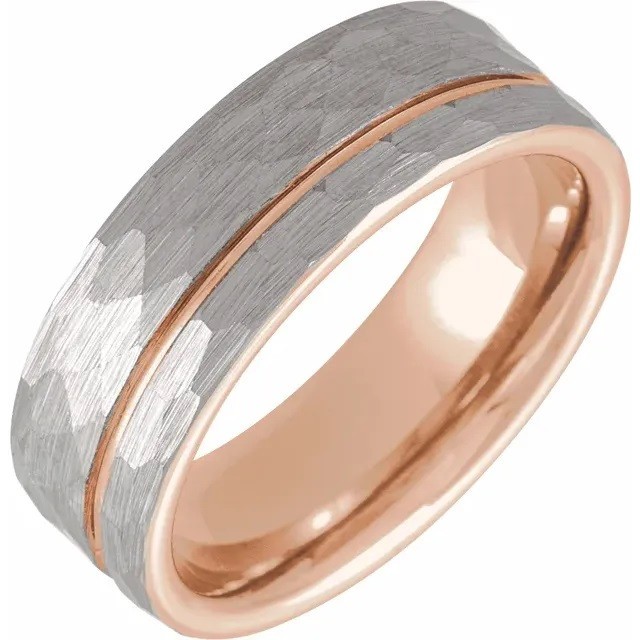
Titanium wedding bands have quietly become one of the fastest-selling men's ring categories in the last decade. They are light, gray, and almost indestructible on paper. They are also impossible to resize in most cases and cannot be repaired the way gold or platinum can. We finish titanium pieces in our shop, and we want you to know both sides before you order one.
What titanium actually is, in jewelry terms
Titanium is an element (Ti, atomic number 22) with a very high strength-to-weight ratio. Jewelry-grade titanium is usually commercially pure (CP) titanium, grade 1 to 4, or an alloy called Ti-6Al-4V used in aerospace. It is about 40% lighter than steel and roughly half the weight of a 14k gold ring of the same size. It is naturally a dark gray, and it takes a matte, brushed, or polished finish well.
Titanium is not the same as tungsten carbide, cobalt chrome, or stainless steel, though all four get lumped together as "alternative metals." They behave very differently in a jeweler's hands.
The real advantages
The biggest one is weight. A titanium band that looks like a substantial 8mm comfort-fit ring feels almost nothing on your finger, which people who are not used to wearing jewelry love. The second is hypoallergenic: titanium does not leach nickel, so it is one of the safest choices for people with sensitive skin. Our guide to sensitive skin covers who benefits most. The third is durability: titanium is extremely scratch-resistant compared to gold, and it does not tarnish or oxidize.
The real trade-offs
Here is the honest list. Titanium cannot be soldered with standard jewelry torches. It melts at a much higher temperature, and welding it requires specialized equipment. That means most titanium bands cannot be resized. If your finger size changes — and it does, with weight, age, and seasons — a titanium ring may not adjust with you. You would replace it rather than re-size it.
Titanium is also brittle in a way that gold is not. It will not bend under impact, which sounds great until you realize that "will not bend" means "will crack or shatter" if struck hard enough. A titanium ring caught in machinery will not deform to save your finger; it will break. We have seen cracked titanium bands come in that cannot be repaired because the fracture runs through the whole shank.
And polishing titanium is different. You cannot use standard gold polishing compounds the same way; you risk embedding grit. We finish titanium in-house with dedicated wheels, and we tell customers not to take it to a general jeweler for a buff.
Anodized color: real, but fading
Titanium can be anodized — electrically oxidized to produce thin oxide layers that interfere with light and produce blues, purples, and golds. This is the source of most "colored titanium" jewelry. It looks great when new, but the color is a surface layer that wears off with time. On a ring band, anodized color fades to gray in 6 to 18 months depending on wear. We tell customers this up front. If you want a colored interior, expect it to age. If you want permanent color, choose inlaid gold or platinum instead.
How titanium compares to alternatives
Against tungsten carbide: tungsten is heavier, denser, and more scratch-resistant, but it is also more brittle and cannot be resized. Titanium is the lighter, slightly less scratch-resistant option. Against stainless steel: steel is cheaper and more available, but it contains nickel that can irritate sensitive skin. Against gold or platinum: the precious metals weigh more, scratch more, but can be resized, repaired, and engraved freely. We cover the broader choice in our metal selection guide.
Care and maintenance
Titanium is low-maintenance. Warm soapy water and a soft cloth will keep it clean. It does not tarnish, it does not need plating, and it does not need polishing to look new. The one thing it does need is protection against extreme impact: take it off before heavy lifting, gym work, or any activity where your hand might be crushed. Store it in its own slot in a jewelry box; at its hardness it will scratch softer pieces stored against it.
Who should buy titanium
Titanium bands suit people who work with their hands, who react to other metals, or who want a ring they can forget about. They are a poor fit for anyone whose finger size fluctuates, anyone who may want to resize or engrave later, or anyone who expects a band that bends instead of breaking under impact. We are happy to show you titanium next to gold and platinum so you can feel the difference in weight. Most customers walk away understanding exactly which metal they actually want — and sometimes that is titanium, and sometimes it is not.
For the legal text behind our material compliance, see the REACH Regulation (EC) No 1907/2006 on EUR-Lex.
Frequently Asked Questions
How do I verify a factory before placing a bulk order?
Request a production video, business license, export records and a paid sample run. A factory that accepts a 50-piece test order is usually a real manufacturer.
What payment terms do you offer?
30% T/T deposit with the balance against the bill of lading. This protects both sides on first orders and can move to net terms after a track record.
What is your normal reject rate?
3–5% under 10x loupe inspection for cast and set pieces. Defective units are replaced free in the next shipment.
Where is the factory located?
Wuzhou, Guangxi, China—the core lab-grown and moissanite manufacturing cluster. Shipments go via Guangzhou or Shenzhen ports.


