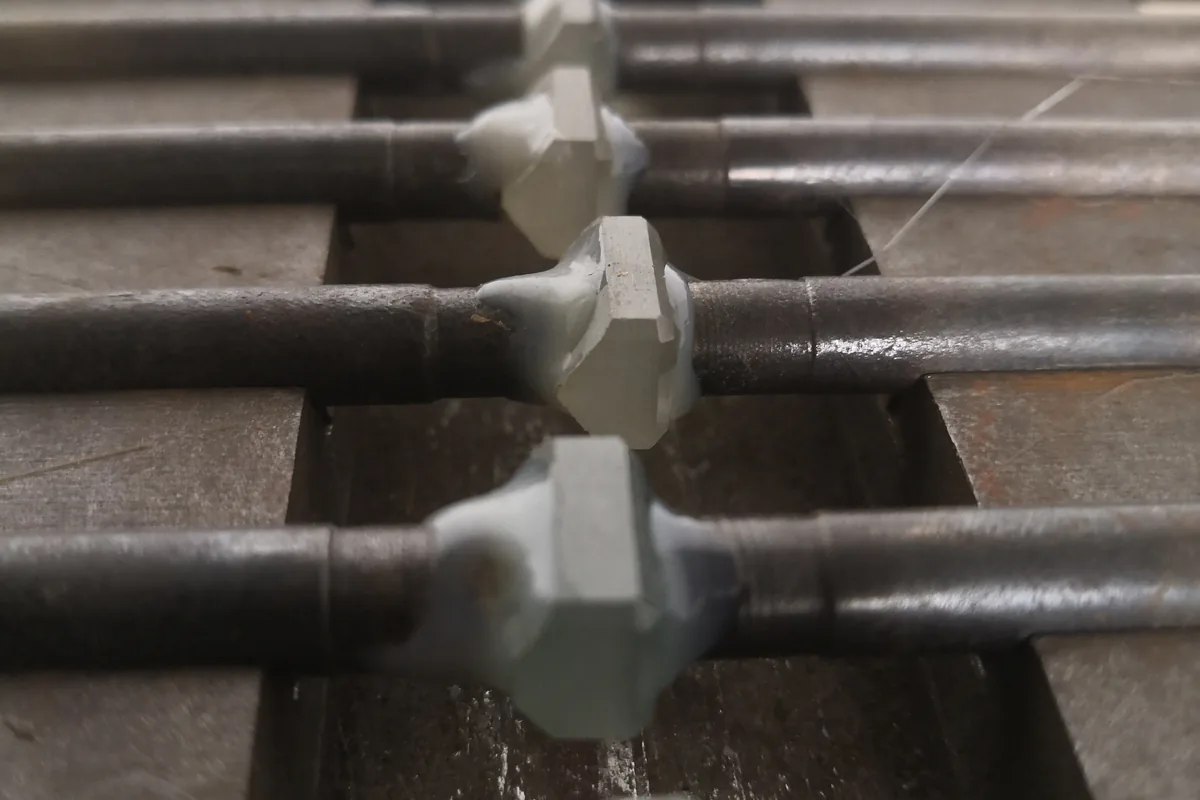
Gemstones do not just sit in jewelry. They are clamped. The metal around a stone is deliberately deformed after the seat is cut, pressing inward against the girdle or crown until friction and compressive pressure hold the stone in place. Glue is a repair-room hack, not a manufacturing step. Once you understand that a setting is a small engineered fastener, the design rules that experienced setters follow stop looking arbitrary and start making sense.
Prong settings: gauge and tip geometry
A prong is a cantilever. It starts thick where it joins the basket and tapers to a small claw that bends over the crown. On a solitaire in 14k gold, prong wire runs roughly 10 to 14 gauge at the base, with the tip rounded and polished before it is pushed over the stone. Too thin and the prong flexes with daily wear, eventually opening; too thick and it dominates the stone visually and is hard to seat cleanly against the crown angle.
Four prongs are structurally sufficient for a round stone with a sound seat. Six prongs spread the load more evenly and are standard for stones that sit high on the hand or for more brittle material. Eight prongs on a small stone usually means the designer was compensating for shallow seats: more fingers where fewer, properly fitted, would hold just as well.
Bezel settings: wall thickness and how closure works
A bezel is a continuous band of metal around the girdle. The wall starts between 0.3 mm and 0.5 mm thick in silver or gold, taller than the girdle by a fraction of a millimeter. The setter presses the wall inward with a bezel pusher, working around the stone in small alternating steps, then burnishes the edge smooth. A wall that is too thin cracks as it folds; a wall that is too thick cannot close against the stone without marring the crown.
Full bezels protect a stone well because they shield the girdle - the most chip-prone part. Half bezels leave two sides open, look lighter, and are popular on modern solitaire settings, but they rely entirely on the two closed sections holding. They are a poor choice for heavily included or brittle rough.
Pavé: the web is the whole story
Pavé diamonds sit in drilled holes, held by tiny beads of metal raised from the surface around each hole. The web - the strip of metal between adjacent drill holes - is the engineering. On a well-made pavé band, webs are at least 0.25 mm wide. Below that, the beads shear off during the setting process, and the resulting setting either has loose stones or visible repair spots.
Webs that are too thin also flex with wear. A pavé band on a ring shank experiences constant bending; after a year, the stones on the sides of the shank loosen first, which is exactly where customers report lost stones. Factories that take pavé seriously widen the webs on high-bend zones even when the CAD file was tighter.
Channel settings: rails and girdle clearance
Channel stones sit in a groove between two rails. The rails are then pressed inward to trap the row. The clearance above and below the girdle has to be precise: too tight and the stones chip as the rails close; too loose and the stones rattle, which is itself a wear mechanism that rounds the girdle over time. A well-made channel row does not move when you run a fingernail along it.
Why stones actually loosen in wear
Loose stones are rarely the result of a bad single setting day. They are the result of slow mechanical wear: prong tips abrade against desks and clothing, losing the 0.2 mm of inward bend that does the actual holding. Ultrasonic cleaning accelerates this by vibrating the stone against its seat. Thermal cycling - taking a ring on and off in hot water - expands and contracts the metal around the girdle. Over two years, a prong tip can lose enough height that the stone rocks slightly. That rocking is the warning sign; the stone falling out is the conclusion.
How a factory checks a setting before it ships
Setters run a dental instrument or wooden pusher against each prong and try to wiggle the stone. A held stone does not move. They inspect the seat under a 10x loupe to confirm no metal is covering the table and no chip sits at the girdle. Pavé rows are checked with a dental floss thread - if it catches on a bead, that bead needs re-tipping. Wholesale buyers specifying work for retail shelves should ask for this checklist in writing; the difference between a setting that lasts and one that returns under warranty is these ten seconds per stone. Browse our range of ready settings and mountings to compare wall and prong gauges in person.
The International Gem Society moissanite guide explains how moissanite performs in daily wear compared with diamond.
Authoritative References
For buyers who need to verify the technical and regulatory basis of this guide, the following independent institutions publish authoritative reference data:
- GIA Gem Encyclopedia - independent grading and identification reference for natural and lab-grown gems.
- Wikipedia: Moissanite - peer-reviewed background on moissanite chemistry, optics and history.
Frequently Asked Questions
How do I verify a factory before placing a bulk order?
Request a production video, business license, export records and a paid sample run. A factory that accepts a 50-piece test order is usually a real manufacturer.
What payment terms do you offer?
30% T/T deposit with the balance against the bill of lading. This protects both sides on first orders and can move to net terms after a track record.
What is your normal reject rate?
3–5% under 10x loupe inspection for cast and set pieces. Defective units are replaced free in the next shipment.
Where is the factory located?
Wuzhou, Guangxi, China—the core lab-grown and moissanite manufacturing cluster. Shipments go via Guangzhou or Shenzhen ports.


