A mokume gane ring does not look like other rings. Run your eye across the band and the metal seems to flow in ribbons — rose gold bleeding into yellow, then into a darker shadow of palladium or shakudo, as if someone had grown wood grain inside the metal. That effect is not an inlay, not an enamel, and certainly not a print. It is the result of stacking sheets of contrasting metal, fusing them into one solid billet, and then forging and twisting that billet until the layers stretch into patterns.

Where the technique comes from
Mokume gane translates roughly to "wood grain metal." It was developed in 17th-century Japan for sword fittings, where craftsmen needed decorative tsuba that still held up to use. Modern jewelers borrowed the process and adapted it for rings, cufflinks, and pendants. The word sounds exotic, but the engineering is straightforward: diffusion bonding of stacked metals under heat and pressure.
Building the billet
We start with thin, precisely cleaned sheets of two or more metals. Common pairings are 14k rose gold with 14k yellow gold, yellow gold with palladium, or gold with a copper-rich shakudo alloy. The sheets are stacked — often ten to thirty layers — into a sandwich, then sealed at the edges. The billet goes into a kiln under controlled atmosphere until the layers diffusion-bond into a single solid block. There is no solder between layers; the metals themselves fuse. That is what makes the finished band structurally one piece, not a veneer that can peel.
Forcing the pattern
A flat, stacked billet is just a slab of stripes. The pattern emerges when the smith forges, twists, and punches the billet. Hammering stretches the layers; drilling and pushing creates the "wood grain" undulations; twisting rotates the layers into vortexes. Each ring is sliced across the cross-section of the forged billet, the way you would cut a slice of marble-patterned polymer clay. Because every forged billet is unique, no two mokume rings share the same flow lines. That is part of the appeal — and part of the price, since a single billet yields a limited number of bands.
Finishing the band
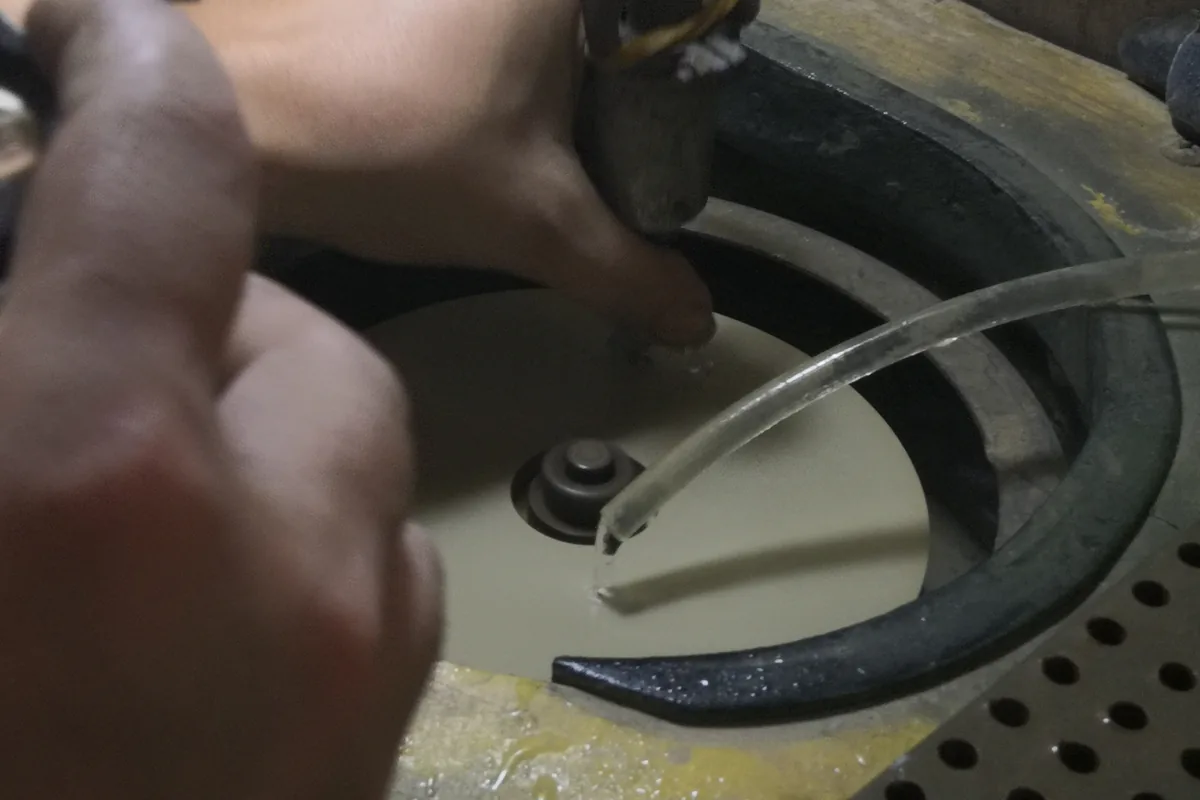
Once the ring blank is cut, sized, and soldered shut, the face is polished to a flat plane. Some makers then apply a light etch to deepen the contrast between layers, so the rose and gold lines read more clearly. We prefer a softer satin on the sides with a high polish on the top face, which makes the grain appear to sit under a clear window. The inside of the band is rounded and comfort-fit for daily wear.
Why it costs what it costs
Mokume gane bands sit above plain gold wedding bands in price because of the labor. A single billet takes days to stack, fire, forge, and slice, and there is real scrap loss in forging. The payoff is a band that reads as art on the hand and wears as a single piece of metal. Because the layers are integral, the pattern will never wear off — if the band is resized later, we cut from the same billet stock to keep the grain continuous.
Matching mokume to an engagement ring
One question we get often is whether a mokume band will clash with a specific engagement ring. In practice it complements almost anything: against a platinum solitaire, the warm gold ribbons add depth; against a rose gold engagement ring, a yellow-and-palladium mokume picks up both tones; against a plain white gold band, a mokume band becomes the visual focus. Because the pattern is tonal rather than multicolor, it does not compete with a colored center stone. We usually recommend seeing a small section of the actual billet before we cut your size, since the pattern shifts along the length and you can choose the slice that matches what you pictured.
Who chooses mokume
Mokume gane bands attract clients who want a wedding ring that does not look like everyone else's. It pairs beautifully with a plain platinum engagement ring, because the band adds movement without competing with the stone. It also works well in men's rings, where the layered metal reads as texture rather than ornament. For everyday durability, we stick to karat gold pairs rather than mixing in soft silver, which would tarnish between the layers.
If you are designing a band to sit beside an engagement ring, read our notes on matching a wedding band to your engagement ring, and see how mokume compares in our broader metal finishing overview.
The history and conventions of engagement rings are outlined in the Wikipedia entry on engagement rings.
Frequently Asked Questions
What ring sizes can you supply in bulk?
US sizes 5–12 including half sizes. Send a size breakdown with your order and we cast to that curve; comfort-fit inner bands reduce resize requests.
Can I order a mixed size run instead of one size?
Yes. Mixed runs are standard for wholesale: specify quantity per size and we pack and label by size at no extra labor cost.
What is the MOQ for custom ring designs?
50 pieces per design for existing molds; 100–300 pieces when a new mold or CAD model is required.
How should I price rings for retail margin?
Most partners use a 3–4x markup on FOB cost for sterling and 2.5–3x for moissanite solos, which keeps landed cost under 30% of retail.


