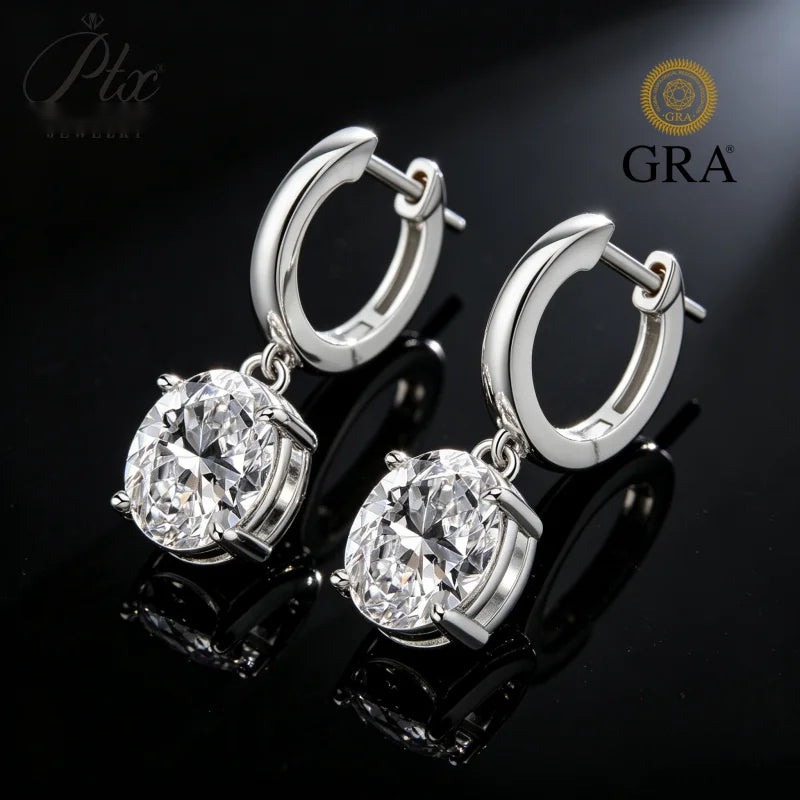
On a spec sheet, a 6.5 mm round brilliant reads the same whether it is diamond, moissanite (per Wikipedia), or a lab-grown diamond. On the bench, it does not. The setter, the polisher, and the QC inspector all treat these stones differently, because their physical properties are different and a mounting built for one will not necessarily hold the other the same way.
Hardness and chip risk
Diamond sits at 10 on the Mohs scale; moissanite at 9.25. Both are hard enough for daily wear, but moissanite is slightly more brittle along its cleavage planes and is more likely to chip if a prong is closed hard on a sharp girdle. Setters who are used to diamonds sometimes over-tighten on moissanite because they expect the stone to flex under pressure the way a diamond does. It does not. The result is a chipped pavilion that returns in warranty. Setting technique on moissanite is gentler: smaller increments of pressure, more frequent checks, and a slightly shallower seat so the stone is not stressed against a hard bottom.
Girdle and culet geometry
Moissanite is often cut with a thicker girdle than a comparable diamond, because the rough does not cleave the way diamond does and cutters leave more meat. A 6.5 mm moissanite in a mounting cut for a 6.5 mm diamond may sit high because the girdle is thicker. The seat has to be measured to the actual stone, not the nominal diameter. This is why we always ask whether the mount is being built around a stone we will receive, or around a spec the buyer will fill later—if the latter, we leave the seat undersize and final-cut it when the stone lands.
Brilliance and cut grading
Moissanite has a higher refractive index than diamond, which means it returns more white light and more fire. On a render, this reads as "more sparkle." In production, it means the cut grade expectations are different. A diamond graded "Very Good" cut is a different product from a moissanite cut to the same proportions; the optics do not translate. Buyers comparing specs across the two stones should not read the cut grade as equivalent, and should ask for actual light performance photos rather than trusting the label.
Certification and paperwork
Natural diamonds ship with GIA or equivalent certificates. Lab-grown diamonds ship with IGI or similar. Moissanite ships with a GRA certificate and often a laser inscription on the girdle. For wholesale programs, the certificate has to travel with the stone, because the end buyer expects it. A ring that ships without the cert in the package is a return even if the stone itself is correct. Production flow therefore has a step that ties each stone to its paperwork before the stone is set.
Plating and polishing around the stone
Moissanite is more heat-sensitive than diamond under a polishing wheel. High polish compounds run warm, and a moissanite that spends too long against a hot buff can develop a frosted edge. The polisher works faster around moissanite, uses lighter pressure, and keeps the stone cool. Rhodium plating, which is electroplated at low temperature, does not affect either stone, but the cleaner and rinse steps around a moissanite are gentler because surface damage shows more on a high-refraction stone.
Repair and resizing around the stone
When a moissanite ring comes in for a resize or a prong retipping, the bench has to heat-sink the stone carefully. Moissanite is more sensitive to localized torch heat than diamond, and a stone left in place during a hot solder joint can develop thermal stress. The standard practice is to remove the moissanite before any torch work on the shank, then re-set it after the piece is re-finished. On a diamond ring, the same operation often proceeds with the stone in place, heat-sunk. That difference changes the repair ticket: a moissanite resize takes longer and costs more, and the customer should be told why.
What this means for a product line
Buyers who sell both diamond and moissanite versions of the same ring should not assume the same mount works for both without a seat adjustment. The prong count, the seat depth, and the polishing sequence all shift slightly. For a moissanite rings program built from scratch, we engineer the mount around moissanite properties from the first CAD, and the result sets faster, chips less, and polishes cleaner than a mount borrowed from a diamond program.
The other production difference is in the cert step. Each moissanite ships with a GRA certificate that has to travel with the stone into the finished piece; the QC line that pairs stone to cert before setting does not exist in the same way for a buyer sourcing loose diamonds on a separate account. Building that pairing step into the workflow prevents a finished ring from shipping without its paperwork, which is the most common moissanite return in wholesale distribution.
Frequently Asked Questions
Is moissanite a good diamond alternative for retail buyers?
Yes for price-sensitive customers who want brilliance and hardness. Moissanite ranks 9.25 on the Mohs scale, holds up to daily wear and costs a fraction of a natural diamond of the same size, so it resells fast in bridal and fashion lines.
What is the minimum order for wholesale moissanite?
MOQ starts at 50 pieces per design for stock items. Custom cuts and private-label settings usually start at 100–300 pieces depending on the mold.
Do you provide certificates with moissanite stones?
Yes. Every parcel ships with GRA or IGI documentation listing carat weight, color grade and cut. We recommend passing the certificate to your end customer for trust.
How long does sample and bulk production take?
Samples ship in 3–5 days. Bulk runs take 15–20 days under 500 pieces, and 25–30 days for custom work.


