A US online jeweler bought 300 moissanite solitaires from a cheap supplier and within four months was fielding two complaint types: stones that rattled, and buyers who sent back GRA certificates they had looked up and found mismatched to the stone. Both problems are factory-line failures, not stone failures. Moissanite (Mohs 9.25) is a brilliant, durable diamond alternative, but the value only holds if the stone, the setting and the paperwork are consistent across a bulk run. This is how a moissanite ring production line is built, and what QC actually means at volume.
Where bulk moissanite orders go wrong
Two failure modes dominate. The first is mechanical: a prong not fully closed on a stone cut slightly off-spec, which loosens over wear. The second is documentary: stones and GRA certificates that do not match in carat, cut or clarity, which triggers trust-killing returns. A controlled line keeps both under 2%.
| Check | Common practice | Controlled line |
|---|---|---|
| Stone intake | Bag accepted as-is | Carat/cut/colour verified vs cert |
| GRA cert match | Paperwork loose in parcel | Serial matched to stone before setting |
| Prong seating | Visual | 1.5 kg pull test per stone |
| Clarity grading | "Eye-clean" assumed | 10x loupe, inclusions flagged |
| Fire/colour check | — | Under calibrated light vs master stone |
How a moissanite ring is built at scale
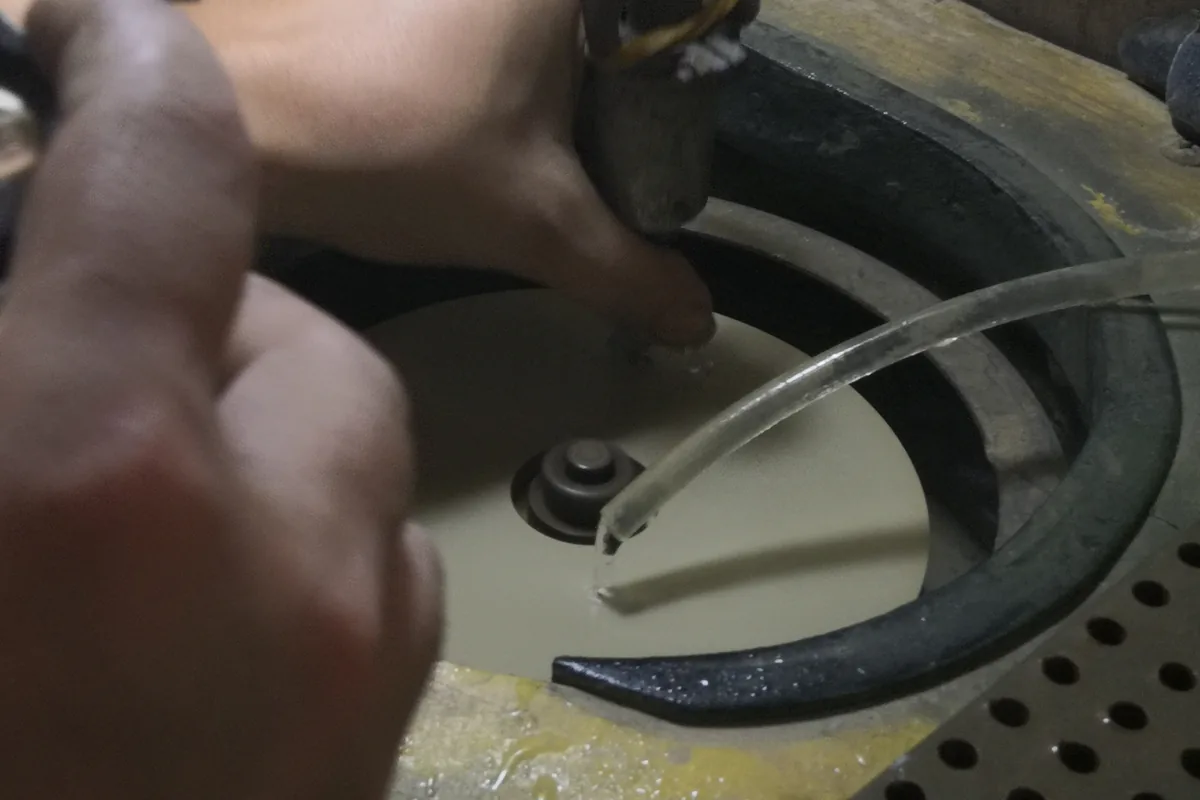
The mounting is cast like any ring — CAD, wax, vacuum casting — but the stone stage is where moissanite differs. Each loose moissanite arrives with a GRA report covering cut, carat, colour and clarity. Before setting, the factory verifies the stone against the certificate and logs the serial number. The stone is then set in a prong or bezel mount under magnification, pull-tested, and the ring moves through polishing and rhodium plating. The matched certificate travels with the finished piece so the end customer can cross-reference the stone they receive.
Moissanite’s advantage in production is that it is tougher than diamond for some setting operations (no cleavage to worry about), but its fire means the stone seat must be cut accurately — a tilted stone kills the brilliance that justifies the price.
Size availability also shapes the wholesale plan. Round brilliant is the most stocked cut and the fastest to reorder, while oval, cushion and emerald cuts carry a small lead-time premium because they are sourced to demand. Most boutiques open with the round 6.5–8 mm solitaires that match everyday bridal sizes, then extend into fancy cuts once the round line proves out.
Certification, in plain terms
GRA is the certificate most commonly paired with wholesale moissanite; it documents cut, carat, colour and clarity for each stone. GIA and IGI are diamond labs; GIA especially is the benchmark for natural and lab-grown diamonds, not typically issued for moissanite. The buyer’s job is to make sure the certificate in the parcel matches the stone in the ring — not to assume any certificate means the same thing.
Buying by program
Opening buyer (100–300 pcs): start with one hero solitare SKU in a popular round cut. Verify cert-stone matching on the pilot before scaling. Bridal boutique (500–1,000 pcs): ask for a clarity-graded pick — eye-clean stones for the main line, and a small premium grade for higher-ticket rings. Private-label program: lock a master stone for colour comparison, hold sealed samples, and require cert serial numbers logged against each finished ring so reorders stay consistent.
Frequently Asked Questions
Is moissanite a good wholesale product for boutiques?
Yes. Moissanite (Mohs 9.25) is durable, brilliant and priced well below diamond, which makes it a strong margin product for bridal and everyday-wear boutiques that handle returns well.
What does a GRA certificate actually cover?
A GRA report documents a moissanite stone’s cut, carat weight, colour grade and clarity. It should be checked against the physical stone by serial number before setting.
Why do some moissanite rings arrive with mismatched certificates?
Mismatches usually come from loose paperwork handling at the factory. Matching the cert serial to the stone before setting eliminates this entirely.
What MOQ applies to bulk moissanite rings?
Most factories start wholesale moissanite ring MOQs at 50 pieces per design, with in-stock round cuts in 6.5–8 mm sizes covering the US market best.
How do you prevent moissanite stones from loosening?
Every prong-set stone is pull-tested at 1.5 kg and the prong tips are burnished. This keeps loose-stone returns under 1% on controlled production.
Key takeaways
- Cert-stone matching and pull-testing are the two checks that stop the most common moissanite returns.
- Moissanite’s brilliance depends on an accurately cut stone seat — sloppy setting wastes a good stone.
- Lock a master comparison stone and sealed samples before scaling a private-label line.
Request a moissanite sample parcel: MOQ 20 pcs, GRA certificates matched per stone, ships in 5 business days. Browse the moissanite range.
Related: moissanite buying guide · OEM programs · request a quote.
Gemstone grading terminology used here follows the Gemological Institute of America’s gem encyclopedia.


