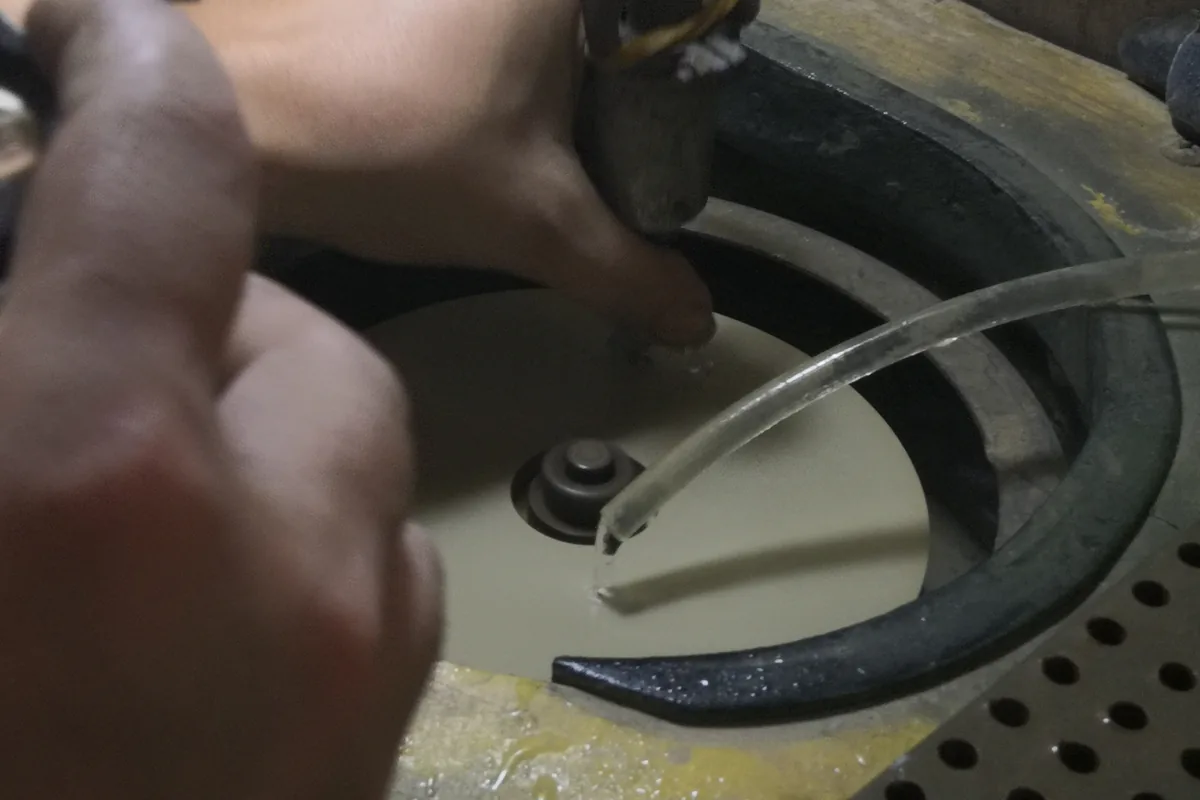
Moissanite scores 9.25 on the Mohs scale, just below diamond, so buyers often assume production is identical to diamond jewelry. It is not. The stone is harder to scratch but more brittle under direct impact, its double refraction changes how it reads under the loupe, and its inventory pipeline is nothing like diamond's. Factories that have run diamond for years make predictable mistakes when they switch to moissanite unless the line is adjusted. Those mistakes rarely show up at final QC; they show up as chipped pavilions and loose stones months after the pieces reach retail shelves.
Hardness vs. toughness on the bench
Hardness measures resistance to scratching; toughness measures resistance to chipping. Moissanite is highly scratch-resistant but has lower toughness than diamond. A setter who forces a prong shut with the same pressure used on a diamond can chip the moissanite's pavilion edge, especially on oval, pear, or marquise cuts with thin tips. Production setters handling moissanite work with lighter hammer taps, more careful prong pre-bending, and a final check under 10x magnification for edge cracks. The chip rate on an untrained bench is visibly higher than on a moissanite-dedicated bench, and that difference shows up as returns six months after delivery.
Why culet and girdle matter more
Moissanite is often cut slightly thicker at the girdle to protect the pavilion, and the culet can be a stress point in flush and bezel settings where the bottom corner contacts metal. Good factory designs for moissanite either leave a small seat clearance or use a knife-edge bezel that does not pinch the culet. CAD files inherited from diamond settings sometimes need a small redraw before production; a factory that skips this step will see a higher field-failure rate on thin bands. When you adapt an existing diamond design to moissanite, budget for a short CAD review rather than assuming the seat will drop in.
Double refraction and the setter's loupe
Moissanite shows doubling of facets under the loupe because of its high refractive index and birefringence. Setters used to reading diamond facets for alignment sometimes misjudge table positioning on moissanite. Experienced moissanite setters orient the stone so the doubling reads evenly across the table, and they verify centering by eye rather than by the facet-by-facet alignment they use on diamond. This is a learned habit, not an instruction on the spec sheet, which is why a setter's moissanite hours matter more than their diamond hours when you are placing a moissanite order.
Certification pairing and inventory
Diamond wholesale runs on loose stones routed from a sightholder pipeline; moissanite production usually means buying graded stones (commonly GRA certificates) in volume by size and cut, and pairing each finished piece with the matching cert card. Factories that do this at scale keep a cert-logging step at setting time: the stone's laser-inscribed number is recorded against the order PO before the prong is closed. Skipping this step leads to mismatched certs at packing, which is the most common complaint in wholesale moissanite returns. A buyer receiving a ring with a cert that does not match the stone's inscribed number will reject the whole shipment, and re-pairing after the fact is impossible without re-setting the stone.
Price ladder and stone size breaks
Moissanite pricing jumps sharply at certain size tiers (1ct, 2ct, 3ct equivalents). A production planner who is optimizing a line of solitaire rings will choose the tier that lands closest to the target weight without paying for the next break. Buyers who want a "2ct look" should confirm whether the factory is sourcing a true 2ct stone or a 1.7ct stone cut to read larger; the visual difference is real, and the cost difference is larger. Ask for the actual stone weight on the spec sheet, not just the target look.
Color grades and inventory sorting
Moissanite is sold in color grades, commonly a near-colorless DEF grade and a slightly warmer GH grade. Factories buying in bulk sort stones by grade before setting, because mixing grades in a single batch of rings produces a visible mismatch when a customer compares two pieces side by side. A production planner working a mixed order needs the grade locked on the PO; if the buyer has not specified, the factory will default to whatever grade is in stock, which may not match the sample the buyer approved. Ask which grade your sample was cut from, and confirm the bulk order is drawn from the same parcel.
What to ask a moissanite-focused factory
Ask whether the setter's bench is dedicated to moissanite or shared with diamond, how they log cert numbers, and what their replacement rate is on chipped pavilions. A line that has run moissanite for years will have answers ready, and those answers will be specific rather than generic. You can see examples of finished pieces on our moissanite rings.
Independent background on moissanite — how its hardness and refractive index compare with diamond — is documented in the Wikipedia article on moissanite.
Frequently Asked Questions
Is moissanite a good diamond alternative for retail buyers?
Yes for price-sensitive customers who want brilliance and hardness. Moissanite ranks 9.25 on the Mohs scale, holds up to daily wear and costs a fraction of a natural diamond of the same size, so it resells fast in bridal and fashion lines.
What is the minimum order for wholesale moissanite?
MOQ starts at 50 pieces per design for stock items. Custom cuts and private-label settings usually start at 100–300 pieces depending on the mold.
Do you provide certificates with moissanite stones?
Yes. Every parcel ships with GRA or IGI documentation listing carat weight, color grade and cut. We recommend passing the certificate to your end customer for trust.
How long does sample and bulk production take?
Samples ship in 3–5 days. Bulk runs take 15–20 days under 500 pieces, and 25–30 days for custom work.


