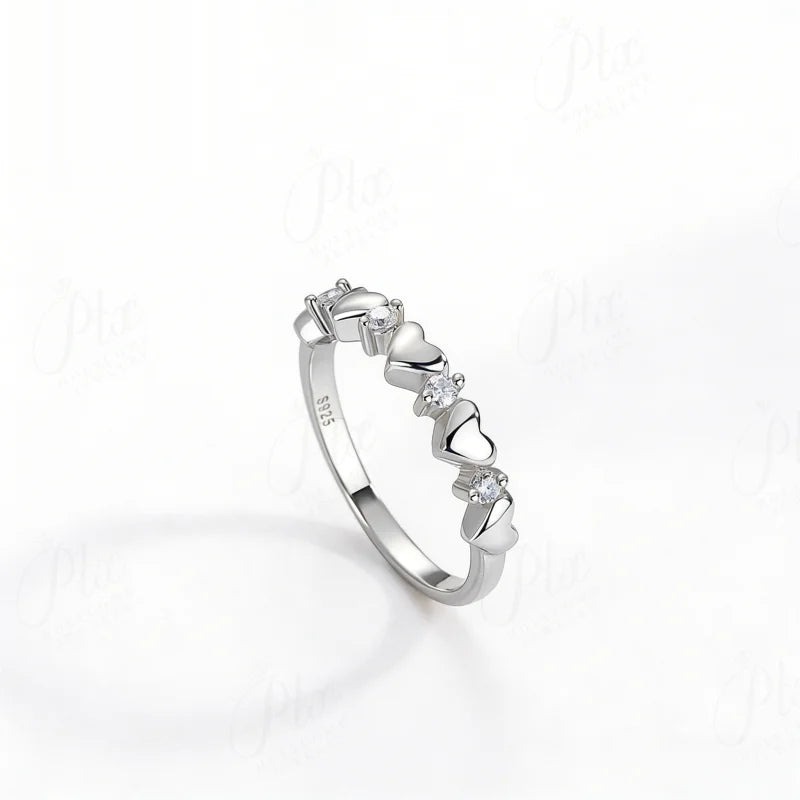
A first-time wholesale buyer once toured our floor and asked, "Why does a silver ring take 25 days to make when I can cast one in a college workshop in a weekend?" The answer is that a weekend workshop makes one piece. We make 400 of them on the same tree, and every department has to hold the same tolerance across all 400. The jewelry manufacturing process is not a single craft. It is a seven-stage production line, and each stage has its own failure mode. This is the floor walk, from the CAD screen to the carton.
Stage 1: CAD and 3D wax printing
The process starts as a digital model. A CAD designer builds the ring to the approved spec: band width, prong geometry, stone seat, comfort-fit interior. The model is exported to a resin 3D printer, which builds a wax-equivalent model layer by layer, about 25 microns thick.
Failure mode here is dimensional drift. A model that looks right on screen but is 0.2mm thin at the stone seat will produce 400 rings with loose stones. We approve every wax against the signed sample before it goes to the investment room.
Stage 2: Tree building and investment
Wax models are attached to a central wax sprue like branches on a tree. A 400-piece ring order is not 400 separate castings; it is 8-10 trees of 40-50 pieces each. The tree is then encased in a plaster-like investment slurry, which hardens overnight.
Failure mode here is air bubbles trapped against a wax surface. A bubble next to a stone seat becomes a porosity hole in the metal. The investment room vibrates the slurry under vacuum specifically to prevent this.
Stage 3: Burnout and casting
The investment flask goes into a kiln at about 700°C. The wax melts and burns out, leaving a hollow mold shaped exactly like the tree. Molten metal (sterling silver at 900°C, 14k gold at 940°C) is poured into the hollow under centrifugal force. The flask cools for several hours, then is broken open.
Failure mode here is incomplete fill. If the metal chills before it reaches the tip of a branch, that piece comes back as a stump. The casting department holds about a 2-3% scrap rate at this stage on a normal run.
Stage 4: Tree removal and prep
The tree is cut apart. Each piece is separated from the sprue with a thin saw, and the attachment point is filed smooth. This is the first bench where a human hand really works the piece. Failure mode is over-filing: a bench tech who takes off too much at the sprue attachment changes the ring's weight and can thin a band.
Stage 5: Stone setting
The stone is seated and the prongs are pressed over it. On a 4-prong solitaire, a trained setter takes about 4-6 minutes per piece. Pavé settings take 15-25 minutes because each tiny stone is set individually.
Failure mode is the loose prong. This is the single most common cause of wholesale returns, which is why we pull-test every prong at 1.5kg before the piece moves on. Visual check alone catches about half of them.
Stage 6: Polishing and plating
Polishing is three steps: pre-polish with a coarse compound, high-polish with a rouge, and a final tumble. Then the piece goes to the plating bath. Sterling silver gets a 0.5µm rhodium flash (industry norm is 0.3µm) to prevent tarnish and give a white finish. Gold pieces get a 18k gold flash if the buyer specifies it.
Failure mode is buff-through: a polishing wheel that cuts through the plating on a high-wear edge, showing silver under a gold flash. This is why high-wear edges are hand-finished, not machine-buffed.
Stage 7: QC and packing
Every piece is inspected under a 10x loupe, ring size is measured, weight is checked, certificate is matched, barcode is applied, and the piece goes into its box. The carton count is reconciled against the packing list before the carton is sealed.
Failure mode at this stage is mismatched certificates. A GRA certificate has to travel with the correct stone. We photograph each SKU's certificate set before sealing, so a mismatch on arrival is provable.
Frequently Asked Questions
How long does each stage take on a 200-piece order?
CAD and wax printing: 2-3 days. Investment and casting: 2 days. Setting: 2-3 days. Polishing and plating: 2-3 days. QC and packing: 1-2 days. Queue time between stages adds another 7-10 days. Total: 18-28 working days after sample approval.
What is lost-wax casting, and why is it used?
Lost-wax casting is the 5,000-year-old process where a wax model is encased in plaster, burned out, and replaced by molten metal. It is used because it reproduces fine detail across dozens of pieces on a single tree, which is how wholesale jewelry stays affordable.
Why does my piece have a small seam inside the band?
The seam is the sprue attachment point, filed smooth after casting. A faint mark is normal. A rough or deep mark means the filing bench skipped a step, and that is a QC reject on our floor.
Can I visit a factory floor before ordering?
Yes. We host buyers by appointment, usually for a half-day walk. If you cannot travel, we send a video of your specific production run, from wax tree to packed carton.
What is the most common defect that reaches customers?
A loose prong on a prong-set stone. It is caught by the 1.5kg pull test on our floor, which is why we recommend buyers specify that test in the PO instead of relying on a visual inspection.
Key takeaways
- Seven stages, each with its own failure mode. Wholesale quality is about holding tolerances across all 400 pieces on the tree.
- The pull test at setting stage is the single highest-value QC gate. Specify it in the PO.
- Plating thickness is a choice. 0.5µm rhodium costs pennies more and doubles the time before tarnish shows.
- Queue time between stages usually dwarfs bench time. That is why lead time is 25 days, not 5.
Want to see your production run on video? We record every wholesale order from wax tree to carton and share the clip before shipping. See the production steps in detail, browse the moissanite catalog, read the buying guides, or review our QC stage-gates.
Sterling silver terminology used in this guide follows the Wikipedia entry on sterling silver.


