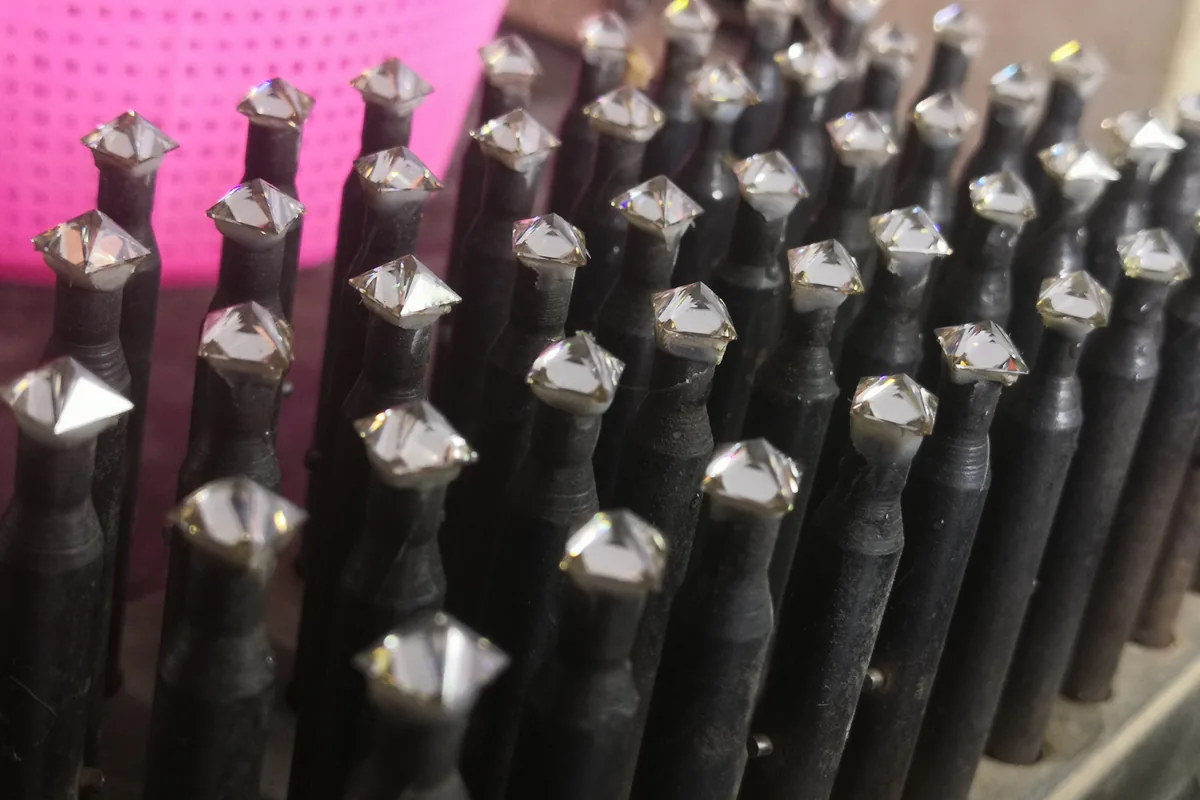
Casting is the step where a wax pattern becomes a metal part. Buyers sometimes picture a single ring being poured; in practice the factory builds a tree of dozens of waxes, invests it in a ceramic flask, burns the wax out, and pours metal once for the whole batch. Understanding the cycle explains why casting lead times are batch-driven and why mixing metals on one shop day rarely works.
Building the wax tree
Each wax is injected from a rubber mold or printed on a 3D wax printer, then inspected for flash, incomplete fill, and distortion. Approved waxes are sprued onto a central wax stalk with a wax knife and a small heated tip. Spruing is not decoration: it controls how metal flows into each piece and where the flask's air escapes. A poorly sprued tree means cold shuts, trapped air, or thin sections that fail before they reach the caster. The spruing layout also decides where the sprue button ends up on the finished piece, which in turn decides how much grinding the finisher has to do. Good casters place sprues on surfaces that are easy to repair, never on a visible high point.
Investing the flask
The sprued tree sits inside a steel flask, and a fine gypsum- or phosphate-bonded investment slurry is poured around it under vacuum. The investment captures the finest surface detail from the wax while leaving room for the metal to flow. The flask sits overnight to set, which is why casting schedules are planned a day ahead. A rushed de-mold or a slurry mixed too thin translates directly into rough cast surfaces the finisher has to sand away. Investment temperature and water ratio are logged per batch; a flask mixed on a humid morning behaves differently from one mixed on a dry afternoon, and experienced shops adjust.
Burnout: removing the wax
The loaded flask goes into a burnout kiln on a controlled ramp. Wax melts, drains, and vaporizes, leaving a hollow ceramic mold in the exact shape of the tree. The ramp is important: heat too fast and the wax expands faster than it can escape, cracking the investment. The kiln ends at a temperature matched to the metal being poured; a flask that is too cold when metal hits it will not fill, and a flask that has soaked too long loses its ceramic strength. Burnout cycles are run on a timer, not by eye, because the difference between a good flask and a cracked one is a matter of ramp rate.
The pour
Metal is melted in a crucible, either by torch or induction furnace, at the temperature the alloy demands. The hot flask is withdrawn from the kiln and placed under a casting machine. Vacuum, centrifugal force, or pressure drives the molten metal into every crevice of the ceramic shell. The whole pour takes seconds; the preparation takes hours. The caster reads the metal temperature with a pyrometer or by color, and pours when the alloy is at its fluid window. Pour too early and the metal freezes mid-flow; pour too late and it burns or picks up gas.
Quench and shakeout
Once the metal has solidified, the flask is quenched in water. The hot ceramic cracks on contact with the water and the tree of cast pieces is revealed. Workers knock off investment with a steam cleaner or sandblast, then cut the pieces from the sprues with a separating disc. The sprue metal is saved, re-melted, and re-alloyed to spec; recycled metal is a normal part of a well-run shop and not a quality compromise when re-alloyed and tested. Each re-melt is XRF-checked before it goes back into a new pour, so the karat stays honest across batches. Investment that is not fully removed hides under later polishing and shows up as gritty patches on the finished surface, which is why shakeout time is not skimped on.
Why scheduling drives lead time
A casting day is organized by metal and color. A flask of 14k yellow gold shares the kiln and the furnace with other 14k yellow orders. A lone piece that does not match the day's alloy waits for the next compatible batch. This is why factories ask buyers to commit to a metal early and not swap gold colors mid-production. It is also why a 20-piece run in a common karat moves faster than a 2-piece run in a rare alloy: the rare alloy has to wait for a flask of its own, which may only run once a week.
What buyers should ask
Ask how often the factory runs your karat and color, whether they cast in-house or outsource, and how they handle recycled alloy testing. A transparent shop will show you the casting schedule and the alloy check log. You can read more about how we schedule flasks on our process guides.
For the legal text behind our material compliance, see the REACH Regulation (EC) No 1907/2006 on EUR-Lex.
Frequently Asked Questions
How do I verify a factory before placing a bulk order?
Request a production video, business license, export records and a paid sample run. A factory that accepts a 50-piece test order is usually a real manufacturer.
What payment terms do you offer?
30% T/T deposit with the balance against the bill of lading. This protects both sides on first orders and can move to net terms after a track record.
What is your normal reject rate?
3–5% under 10x loupe inspection for cast and set pieces. Defective units are replaced free in the next shipment.
Where is the factory located?
Wuzhou, Guangxi, China—the core lab-grown and moissanite manufacturing cluster. Shipments go via Guangzhou or Shenzhen ports.


