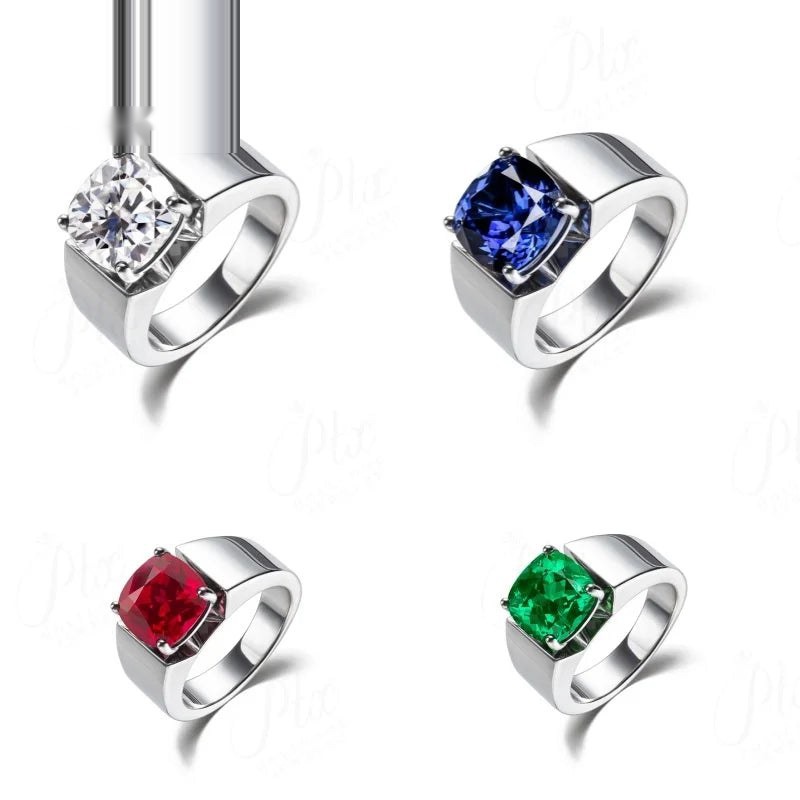
Garnet is the January birthstone most people picture as a deep red bead in a decades-old necklace. That picture is incomplete. Garnet is not a single mineral but a family of silicate minerals that share a crystal structure, and the family ranges from common deep red to rare vivid green priced like fine emerald. Knowing which variety you are looking at is the first step toward buying it well.
The red garnets most people know
Almandine is the most common garnet, a deep brownish red found across the world and used in inexpensive jewelry and even industrial abrasives. Pyrope is the brighter, more crimson red, the stone in many Victorian and Edwardian pieces. The recognizable rhodolite garnet, a purplish rose-red between the two, sits in this family and is the variety most often cut into clean commercial gemstones. These red garnets run Mohs 7 to 7.5, wear well, and cost modestly at commercial sizes.
The red garnets are affordable precisely because they are abundant. A five-carat clean pyrope is a pleasant buy rather than an event. Value moves when color veers away from red entirely, which is where the collector side of the family begins.
The orange and green garnets worth knowing
Spessartine, colored by manganese, runs from golden orange to a vivid mandarin. Fine orange spessartine from Namibia and Nigeria sells well above ordinary red garnet because that saturation is rare. Grossular garnet includes hessonite, the cinnamon orange-brown stone of older jewelry, and tsavorite, the intense emerald-green variety discovered in Kenya and Tanzania in the 1960s. Tsavorite is rarely large, almost always heavily included, and priced per carat like a premium colored stone rather than a birthstone.
Andradite garnet tops the family. Demantoid, a vivid green with characteristic horsetail inclusions, is the rarest and most expensive garnet of all. Fine demantoid from the Ural Mountains trades at prices that rival fine emerald, and its dispersion actually exceeds diamond, meaning it throws more fire than a colorless stone of the same size. Uvarovite, a bright emerald green that almost always forms as tiny druzy crystals rather than cut stones, rounds out the group for collectors.
Hardness, setting, and everyday wear
Garnets run Mohs 6.5 to 7.5 depending on variety. Red garnets handle ring wear well; tsavorite and demantoid deserve a little more respect because their value makes a chip expensive. Our bench sets valuable green garnets in protective bezels or low-profile prongs, and advises against channel-set eternity bands in thin varieties where a tight cut risks splitting the girdle over years of wear.
Garnets are rarely treated in the ways other colored stones are. They are not oiled like emeralds, not routinely heat-treated like sapphires, not irradiated like some tourmalines. What you see is essentially what came out of the ground, which is a useful transparency when comparing stones of similar color in the market. For the treatment landscape more broadly, emerald origins and treatments make the contrast clear and explain why untreated garnet feels refreshingly straightforward.
How to shop garnet by variety
If you want an affordable everyday January stone, a clean pyrope or rhodolite in red or rose-red is sensible and durable. If you want color that reads as expensive, tsavorite's green or spessartine's orange give you a look that a buyer cannot immediately place, at a fraction of emerald's cost. Demantoid is a collector's stone: buy it from someone who will show you the horsetail inclusion under magnification and explain the origin in writing.
When comparing prices, ask the variety name, not just the family name. A jeweler who answers tsavorite instead of garnet is doing their job. For stacking and everyday ring choices, our stackable rings guide shows how garnet tones pair with gold, and the hardness scale explains which varieties earn a place on the daily finger rather than in a drawer.
Caring for garnet jewelry
Garnet is low maintenance compared with most colored stones. Warm soapy water and a soft brush handle nearly every situation. Ultrasonic cleaners are generally safe on red garnets, but we avoid them on included tsavorite and demantoid, where internal fractures can travel under vibration. Steam cleaning is off the table for all garnet varieties, just as it is for most included colored stones.
Store garnet pieces separately from diamonds, since at 7 to 7.5 on the scale, a diamond will scratch the surface over long shared storage. Red garnets do not fade, which is another advantage: the color you buy is the color your grandchildren inherit. A garnet ring worn daily for thirty years usually needs nothing more than a fresh polish and a prong check to look current again, which is part of why the stone has stayed in continuous fashion for so long.
Garnet rewards curiosity. The stone your grandmother wore in red is the same family as one of the rarest green gems on the market, and the difference between those two pieces is a single word on the label.
The definition of carat weight and how it is measured are set out in the Wikipedia entry on carat weight.
Related reading: Garnet Gemstone Guide: Varieties, Colors & Hardness, Tsavorite Garnet: The Durable Green Alternative to Emerald, Tsavorite Garnet: A Gemstone Deep-Dive for Jewelry Manufacturers.
Frequently Asked Questions
How do I verify a factory before placing a bulk order?
Request a production video, business license, export records and a paid sample run. A factory that accepts a 50-piece test order is usually a real manufacturer.
What payment terms do you offer?
30% T/T deposit with the balance against the bill of lading. This protects both sides on first orders and can move to net terms after a track record.
What is your normal reject rate?
3–5% under 10x loupe inspection for cast and set pieces. Defective units are replaced free in the next shipment.
Where is the factory located?
Wuzhou, Guangxi, China—the core lab-grown and moissanite manufacturing cluster. Shipments go via Guangzhou or Shenzhen ports.


