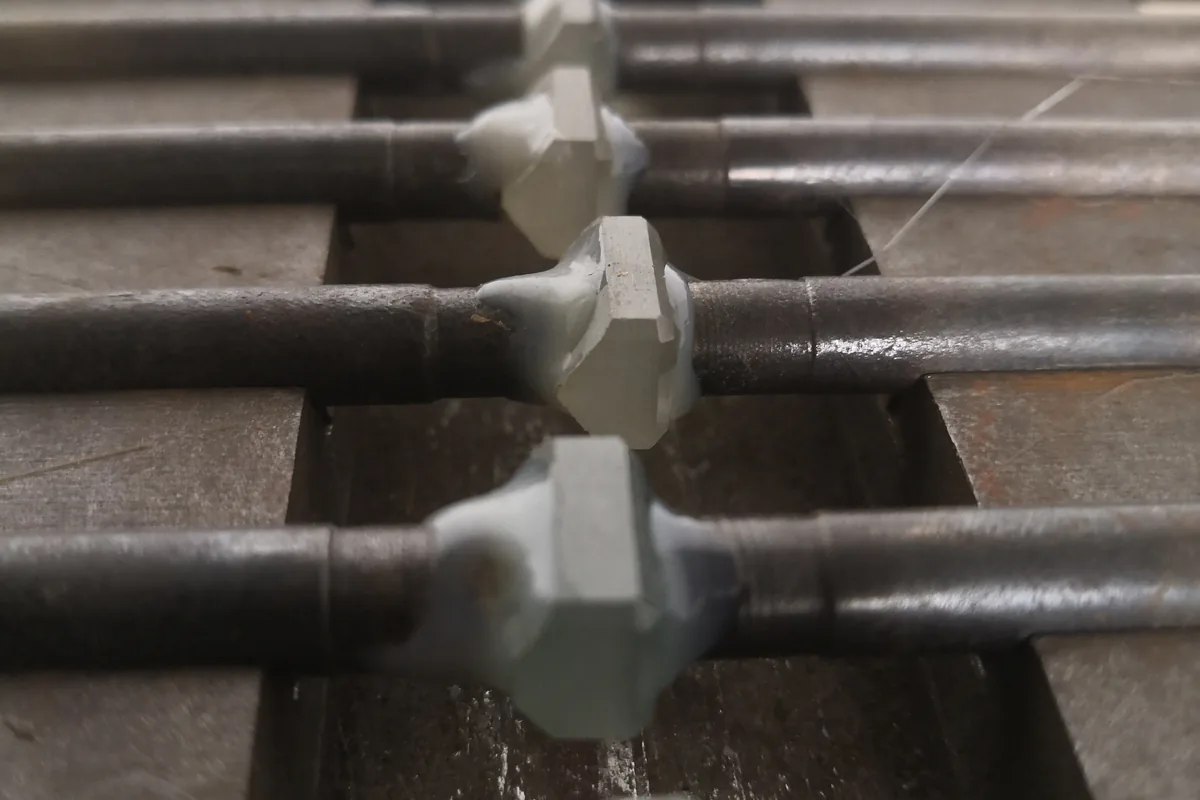
A 300-piece run in Bangkok came back with a split defect pattern: the rings on the top tier of every tree were fine, the rings on the bottom tier showed cold shuts, and the rings in the middle had investment inclusions. The metal alloy was the same. The burnout was the same. The flask was packed wrong. Tree and flask placement is the most under-discussed lever in casting quality, because it decides how evenly metal reaches every ring. Here is how our foundry spaces them.
Why tier position changes the casting
Centrifugal and vacuum casting throw metal outward along the sprue. Rings too close to the crucible see the first, hottest metal and often get a turbulence flash; rings at the far tip see the last, coolest metal and risk cold shuts. Rings touching the flask wall chill against the investment and show a rough surface. Rings stacked vertically with no gap between them trap steam and gas pockets. The goal is a tree where every ring sees the same metal temperature and the same wall distance.
We follow our own tree layout and piece-count rules, pair it with the burnout schedule that matches the flask size, and confirm the divest step in cooling and divesting. For the investment mix itself, see powder-to-water ratio and vacuum mixing. Buyers can check fineness labeling against the sterling silver reference on Wikipedia when quoting alloys.
Our placement rules
Wall clearance
Every ring sits at least 15 mm from the flask wall and 20 mm from the top and bottom disks. That gap keeps the ring from chilling against the investment and leaves room for the slurry to flow around it during investing. Rings touching the wall always come back with a rough, pitted face that polishing cannot fully recover.
Vertical spacing
Rings on adjacent tiers sit 25 mm apart vertically and offset by half a step, like bricks. Direct stacking traps gas between the upper and lower ring and shows up as a pit on the shared face. We cap ring diameter at one third of the flask inner diameter so the tree never crowds the wall.
Gate orientation
All gates point the same way around the sprue, angled 30 degrees upward. We never put a ring upside down on the tree because the sprue angle reverses and the ring sees metal entering from the wrong side. Symmetric trees cast more uniformly than mixed-orientation trees.
| Flask size | Max rings/tree | Wall clearance | Tier spacing |
|---|---|---|---|
| 3 inch | 20-25 | 15 mm | 25 mm offset |
| 4 inch | 35-40 | 18 mm | 25 mm offset |
| 5 inch | 50-55 | 20 mm | 30 mm offset |
We also track which tier a defective ring comes from. If a defect rate is flat across tiers, the problem is metal or burnout; if it clusters on one tier, the tree layout is wrong. That diagnostic is faster than re-melting a batch and guessing.
How this changes production economics
A novice tree packs 60 rings into a 4-inch flask and saves per-tree labor. We pack 40. The extra 20% of tree cost is returned by a defect rate under 1% instead of 5-8%, and by rings that do not need re-polishing. For a brand running 1,000 rings a month, that math favors space over density. We will show the buyer our tree photo for their SKU before casting, so they see the spacing themselves.
Frequently Asked Questions
Does more rings per tree always save money?
No. Packed trees raise the defect rate on the top and bottom tiers. The labor saved per tree is spent twice over in rework and rejects.
Why do bottom-tier rings get cold shuts?
They see the last metal to leave the crucible, which has cooled by 100-150 degrees by the time it arrives. Keeping the lower tier empty of critical rings avoids the issue.
Can I watch how my tree is laid out?
Yes. We photograph every assembled tree before investing and send it with the batch update. You can see wall clearance and tier spacing yourself.
Does flask size change the burnout time?
Yes. A 5-inch flask needs 30 minutes more in the burnout oven than a 3-inch flask to reach a uniform core temperature. We size the schedule to the flask, not the alloy.
What happens if a ring touches the wall?
It comes out rough and often needs 60 seconds extra polishing. If the roughness goes through to the gallery, the ring is rejected. We inspect tree photos before investing to catch it.
Key takeaways
- 15 mm wall clearance and 25 mm tier spacing, offset like brickwork.
- Same gate angle on every ring; never mix orientation on a tree.
- Track defects by tier; clustering means layout, not alloy.
Next step: send us your ring spec and we will return a tree layout photo with the quote, showing exactly where each ring sits. Custom manufacturing opens at 20 pieces per SKU, and we invest the flask only after your approval of the tree layout.


