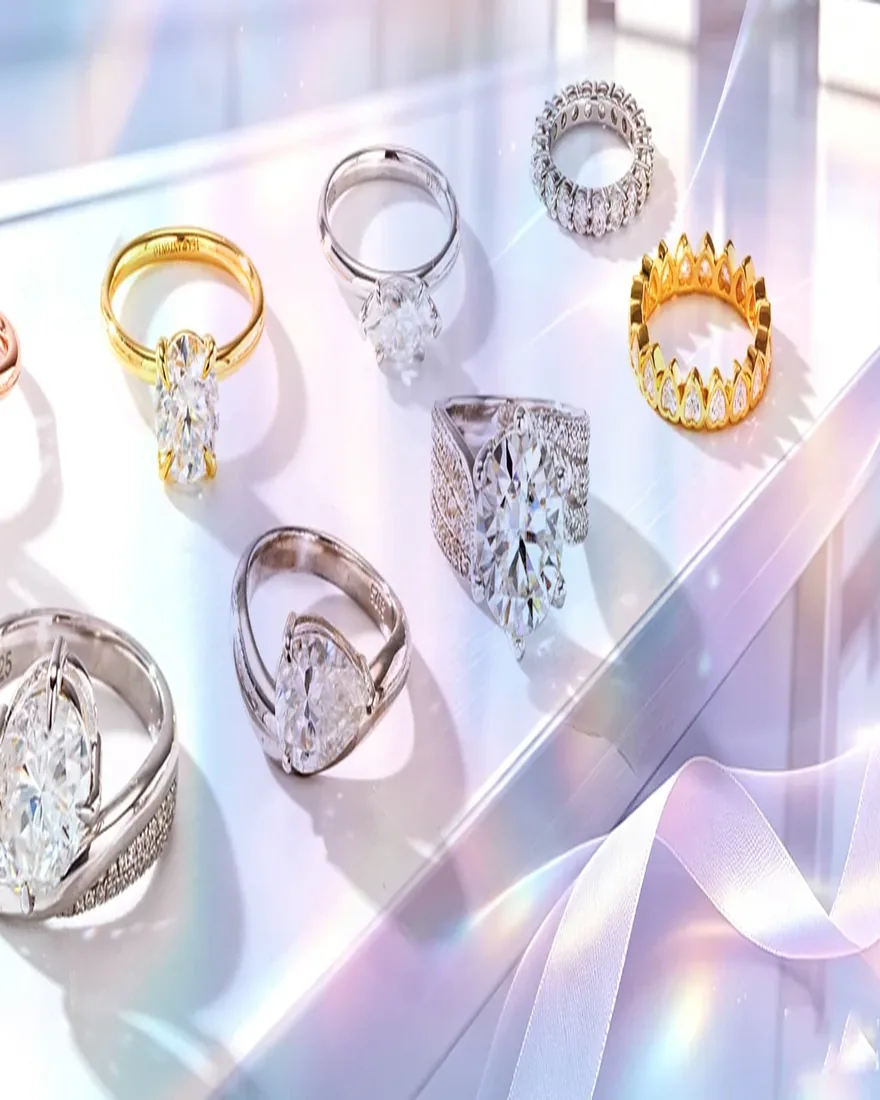
An eternity band is the ring equivalent of a sentence without a period: the stones go all the way around the shank, symbolizing a love or a commitment with no beginning and no end. It is one of the most popular anniversary gifts we make, and also one of the most commonly misunderstood. The choice between a full eternity band and a half eternity band is not a stylistic afterthought — it changes whether the ring can ever be resized, how comfortable it is to wear, and what it costs.

Full eternity: the all-around look
A full eternity band has matching stones set continuously around the entire circumference. From any angle, the ring reads as a line of sparkle. It is the most romantic version, and it looks spectacular stacked against a plain band. The catch is structural. Once stones are set all the way around, the shank cannot be cut, heated, or stretched for resizing without damaging the settings. If your finger changes size in the future — weight shifts, seasons, pregnancy — the only fix is removing and resetting the stones into a new band. We always flag this before we build a full eternity ring.
Half eternity: the practical default
A half eternity band carries stones across the top half of the shank — the part you see when you look down at your hand — and leaves the bottom half solid metal. From the front, it looks almost identical to a full eternity ring. From the back, it is a plain band, which means it can be resized normally, worn in comfort against the knuckle, and built thinner without risking the stones. For most clients, a half eternity band is the smarter buy, and the visual difference is invisible in daily wear.
Channel vs pavé vs shared-prong
Three setting styles dominate. Channel set stones sit between two rails of metal, which protects the girdle and reads cleanly. Pavé stones are held by tiny beads, which maximizes sparkle but needs regular prong checks. Shared-prong stones are held by prongs between adjacent stones, which uses less metal and keeps the band thin. For a band worn daily, we usually recommend channel or shared-prong; pavé looks gorgeous but collects lotion and needs more maintenance.
Cost differences
A full eternity band uses roughly twice the diamond weight of a half eternity version in the same width. That doubles the stone cost, and the setting labor is higher because stones must be set from awkward angles around the shank. If budget matters, the half eternity buys you nearly the same look for a meaningful reduction. We also steer clients toward slightly smaller, better-cut stones across a half band rather than larger, lower-clarity stones around a full band, because the visual result is brighter.
Stacking and pairing
Eternity bands are designed to stack. They pair with solitaire engagement rings, with plain wedding bands, or with other eternity bands in different colors. If you plan to stack, let us know the ring you are stacking against so we match the exact inner radius and comfort fit. A band that is proud of its neighbor will catch on gloves and sleeves. We often recommend a slightly domed profile on the inner edge so stacked rings slide past each other smoothly.
Metal choices for eternity bands
Because the band is covered in stones, the metal framework is doing real work. Platinum is the most durable choice for a daily eternity band, especially in pavé, because it holds tiny beads tighter than gold. 18k yellow gold is softer but more forgiving and patinas beautifully. 14k white gold will eventually need rhodium touch-ups, which means taking the band off rotation for a day. We rarely recommend 10k for an eternity band because the higher alloy content makes it stiffer and less comfortable to resize. Match the metal to your engagement ring, but if you have the choice, platinum is the long-play answer for a band you intend to wear every day for decades.
Who should skip full eternity
If you are between sizes, if you are planning a pregnancy, or if you work with your hands, choose half eternity. The full eternity is best for clients who know their size, want the all-around look for special wear, and are comfortable resetting later if needed. We will build either one well — we just want you to go in with eyes open.
For related buying decisions, see our wedding band buying guide, our notes on matching bands to engagement rings, and how to keep the stones tight in prong check warning signs.
Carat weight conventions cited here follow the Wikipedia entry on carat weight.
Frequently Asked Questions
How do I verify a factory before placing a bulk order?
Request a production video, business license, export records and a paid sample run. A factory that accepts a 50-piece test order is usually a real manufacturer.
What payment terms do you offer?
30% T/T deposit with the balance against the bill of lading. This protects both sides on first orders and can move to net terms after a track record.
What is your normal reject rate?
3–5% under 10x loupe inspection for cast and set pieces. Defective units are replaced free in the next shipment.
Where is the factory located?
Wuzhou, Guangxi, China—the core lab-grown and moissanite manufacturing cluster. Shipments go via Guangzhou or Shenzhen ports.


