The number on the mandrel is not the whole fit
A ring that measures the correct size on a mandrel can still spin around the finger, dig into the knuckle, or slip off at the worst moment. Ring sizing is not a single dimension - it is a compromise between the knuckle (which the ring must pass over) and the base of the finger (where the ring actually rests). Most fit complaints trace back to that mismatch, not to a wrong number on the card.
The knuckle problem
On many hands, especially as people age, the knuckle is wider than the finger base. A ring sized to slide comfortably over the knuckle then rides loose at the base and turns. A ring sized to the base is impossible to get on. The standard workaround is sizing beads or a spring insert - small metal bumps inside the shank near the bottom that grip the finger and let the ring pass the knuckle without a full resize. A customer returning a "too loose" ring often does not need a smaller size; they need beads. A shop that simply resizes down is about to hear that the ring now will not come off.
Temperature and time of day
Fingers shrink in cold and expand in heat, and they run larger at the end of the day and after salty meals. A ring fitted in an air-conditioned morning shop may feel tight in a hot evening, and a ring that fits perfectly in summer can spin loose in winter. Good practice measures the finger at room temperature, midday, and on a hand that is not swollen or cold. Fitting a ring on a swelled finger after a flight, or on a hand pulled out of a hot coffee, is a known error. For rings meant to be worn year-round, a half-size room to move is safer than a snug fit.
Wide bands fit differently than thin bands
A 2mm band and a 6mm wedding band are not the same size at the same number. Wider bands grip more finger surface and feel tighter, which is why wide comfort-fit bands are often sized slightly looser than thin solitaire shanks. Buying a wide band off the same measured size as a thin one usually produces a tight fit. This is the single most common cause of a bridal set that feels right on the thin engagement ring but wrong on the wide wedding band - they should have been sized together, on the same finger, at the same sitting.
Sizing set stones and eternity bands
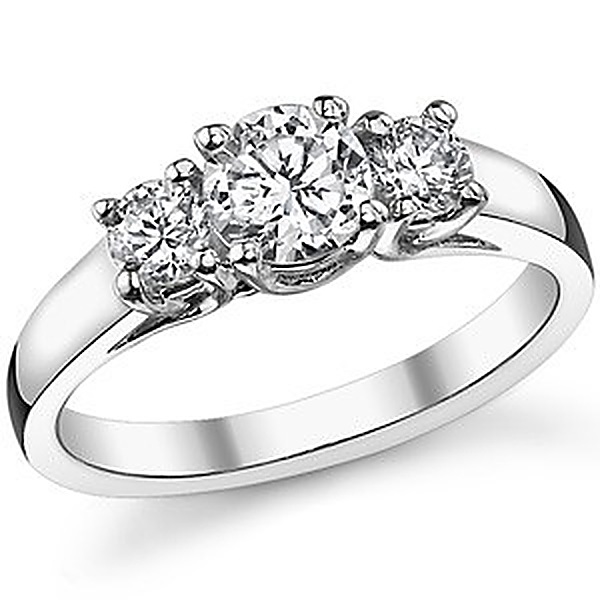
A plain shank resizes easily: stretch or compress on a mandrel, or cut and add or remove a section. A band set all the way around with stones (an eternity band) cannot be stretched - the operation cracks stones, pulls prongs, and snaps the setting. Resizing an eternity band means re-setting stones on a new shank, which is a major repair, not a quick service. This is why eternity bands are sold as "choose carefully, they rarely resize." Half-eternity bands, with stones only on top, can sometimes be sized through the plain bottom section, but only if the bottom has enough plain metal to work with. A ring with stones flush up to both edges of the shank has no safe sizing zone.
How far a ring can actually be resized
Not every ring resizes by more than a half-size or two. A plain gold shank can be stretched up roughly one size or compressed down, and a cut-and-add section handles larger changes - but each resize work-hardens the metal, and a ring resized twice in the same spot is approaching fatigue. Platinum resizes cleanly because it is dense and forgiving; silver work-hardens faster and is more prone to cracking at the joint. A ring with a hidden hollow band, a solder seam near the sizing zone, or engraved pattern across the bottom often cannot be resized at all, and the honest shop will say so rather than attempt it and create a crack. Buying a ring with a known small sizing tolerance is a reason to measure carefully up front, not a reason to trust a future resize.
Hidden causes: weight, swelling, and life changes
Beyond geometry, fingers change. Weight shifts, pregnancy, arthritis, and water retention all move ring size over years. A ring that fit perfectly at purchase can become tight or loose later - that is a re-size or a re-fit, not a manufacturing fault. Customers should expect to re-fit a ring that has not been off in a decade, and shops should avoid resizing on a hand that is temporarily swollen (pregnancy, illness) because the swelling may reverse.
What to tell your customer
Sell fit, not size. Ask whether the knuckle is the bottleneck; suggest beads before a down-size; measure wide and narrow bands separately; and warn eternity-band buyers that sizing is a rare, costly service. A ring that sits still, level, and comfortable beats a ring that matches a number on a card. For measuring guidance, see our ring sizing and fit guides, or bring a band in for a professional re-fit.
The Wikipedia entry on engagement rings gives an independent overview of engagement ring traditions and settings.
Frequently Asked Questions
What ring sizes can you supply in bulk?
US sizes 5–12 including half sizes. Send a size breakdown with your order and we cast to that curve; comfort-fit inner bands reduce resize requests.
Can I order a mixed size run instead of one size?
Yes. Mixed runs are standard for wholesale: specify quantity per size and we pack and label by size at no extra labor cost.
What is the MOQ for custom ring designs?
50 pieces per design for existing molds; 100–300 pieces when a new mold or CAD model is required.
How should I price rings for retail margin?
Most partners use a 3–4x markup on FOB cost for sterling and 2.5–3x for moissanite solos, which keeps landed cost under 30% of retail.