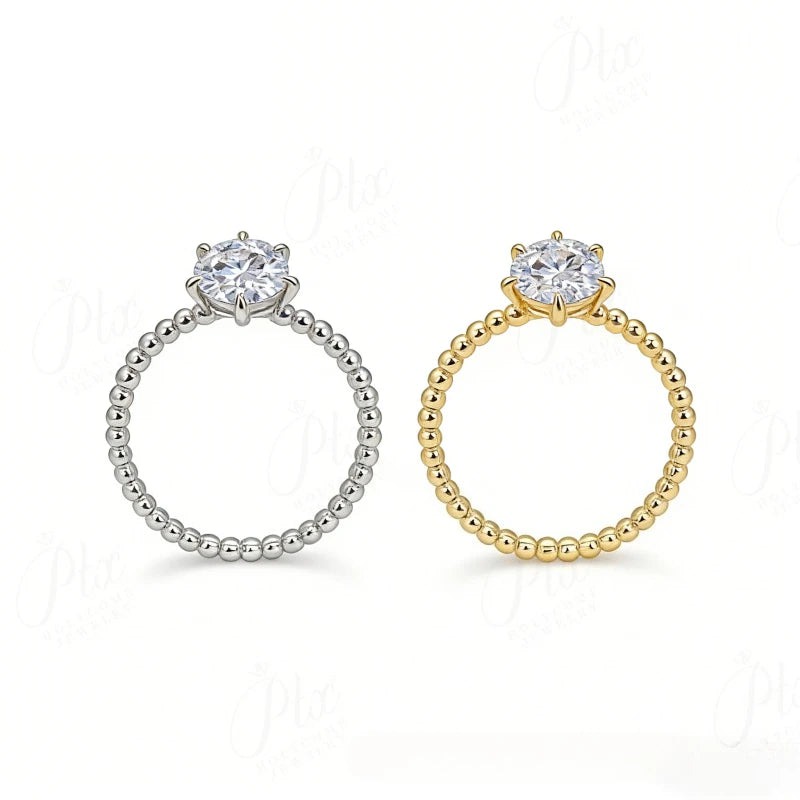
A CAD render that looks perfect on a monitor is not the same as a ring that casts, sets, and survives on a finger. The gap between those two is where production schedules die. Factories see the same design errors week after week, and almost all of them are fixable in the design review stage, before any wax is poured.
Shanks that are too thin at the bottom
The most common design error is a shank that looks slim and elegant in a render but measures under 1.2 mm at the narrowest point. A shank that thin will cast, and it will set a stone, but it will bend the first time the ring is knocked against a desk. Resizing a thin shank also cracks it, because the metal has no mass to stretch. The fix is conservative: a comfort-fit shank on a solitaire should not go below 1.5 mm at the bottom, and a halo or pavé ring, which already has structural load elsewhere, should stay closer to 1.8 mm.
Prongs that are decorative rather than structural
Designers who have never set a stone draw prongs that look like claws but are too narrow at the tip to actually close over a girdle. A prong that reads as a fine needle in the render cannot be burnished without snapping. The setter needs roughly 0.6 mm of prong tip to work with, and the prong shoulder needs to be thick enough to take that pressure without bending. Prong count is the other mistake: a 2-carat stone on four fine prongs looks elegant and returns for re-tipping every year. Six prongs, or four heavier prongs, add cost and stop the warranty claims.
Stones that touch each other
Pavé and channel designs often draw stones edge-to-edge with no metal between them. In a render this reads as continuous sparkle. In production, two stones touching rub against each other and chip both girdles within months. The design needs a minimum of 0.15 mm of metal between adjacent stones, and the seats have to be cut so the culets do not collide underneath. A render that shows stones touching is a design that has not been engineering-checked.
Undercuts and impossible-to-polish cavities
Organic shapes and openwork designs often have cavities that a polishing wheel cannot reach. The render shows a perfect piece; the casting comes back with a dull interior that no compound can touch. If a feature cannot be reached by a 3 mm abrasive wheel and a bent burnisher, it should either be widened or redesigned. This is also where plating fails: rhodium will not build up evenly in a deep cavity, and the result is a dark spot inside the setting that the customer sees from the side.
Engraving placed where a resize will erase it
Engraving on the inside of a shank looks great in the render. But ring sizing stretches or compresses the shank, and an engraving placed where the resize wheel will run disappears. Engraving either goes on a flat panel that will not be stretched, or it is applied after sizing is finalized. For custom work, that means the engraving step waits until the size is locked.
A head sized for the wrong stone weight
A setting that looks right on a rendered stone often fails when the actual stone arrives. The render shows a 6.5 mm round; the buyer ships a 6.5 mm moissanite that happens to have a thicker girdle, or a diamond cut deeper than the render assumed. The seat is cut for the render, not the stone, and the stone either sits high or rattles. The fix is to either final-cut the seat when the stone arrives, or to specify the stone's full dimensions—not just the diameter—at design time. A 6.5 mm stone with a 4.2 mm depth needs a different seat than a 6.5 mm stone with a 3.8 mm depth.
Wedding-band profile ignored
An engagement ring designed in isolation often has a cathedral that flares outward, which looks elegant on screen. The wedding band, designed later, will not sit flush against that flare. The result is a gap that the customer notices on their wedding day. The engagement ring CAD has to be profiled with the companion band in mind from the first revision, or the band is designed around the ring after the fact. Either way, the two pieces are not independent.
The fix: a design review before casting
Every one of these errors is caught in a single review: send the CAD to the factory bench, ask the setter and the polisher what they think, and revise before wax. The review takes an afternoon and saves weeks. Buyers who skip it pay for it in re-casts, re-sets, and warranty claims. Our design-review checklist, part of the CAD design intake, is built specifically to flag these five before the mold is cut.
Carat weight conventions cited here follow the Wikipedia entry on carat weight.
Frequently Asked Questions
What ring sizes can you supply in bulk?
US sizes 5–12 including half sizes. Send a size breakdown with your order and we cast to that curve; comfort-fit inner bands reduce resize requests.
Can I order a mixed size run instead of one size?
Yes. Mixed runs are standard for wholesale: specify quantity per size and we pack and label by size at no extra labor cost.
What is the MOQ for custom ring designs?
50 pieces per design for existing molds; 100–300 pieces when a new mold or CAD model is required.
How should I price rings for retail margin?
Most partners use a 3–4x markup on FOB cost for sterling and 2.5–3x for moissanite solos, which keeps landed cost under 30% of retail.


