A chain is the part of a necklace people notice least and depend on most. You do not admire the links; you notice the pendant, the length, the drape. But the chain is doing all the work, and in a manufacturing shop it is one of the most technically specific components we source and assemble. A great chain feels alive: it moves, catches light, and never twists. A cheap chain feels stiff, kinks, and breaks at the worst moment.

It starts with wire
Every chain begins as drawn wire. Gold (or silver, or platinum) is pulled through a series of progressively smaller dies until it reaches the exact diameter the design needs. A fine box chain might use wire so thin it looks like thread, while a heavy curb chain uses wire thick enough to feel like cord. The wire's temper, how soft or springy it is, matters, because the links have to hold their shape after they are closed. Drawing wire to a consistent diameter is the foundation; if the wire varies, the links will vary.
Forming the links
Most chains start by winding the wire around a spindle, which creates a long spring of tightly spaced coils. A precision saw or cutting wheel slices that coil into individual rings, each one a tiny open O. Those rings are then tumbled or brushed to remove sharp burrs. From there, the chainmaker's choice of pattern takes over:
- Cable chain: the classic uniform oval link, open and breathable, the workhorse of necklace chains.
- Curb chain: links are flattened and rotated so the chain lies flat against the skin, a popular unisex look.
- Box chain: square, boxy links soldered shut, sleek but prone to kinking if too thin.
- Rope chain: many tiny links woven diagonally so the whole piece twists like a rope; highly sparkly but harder to repair if a link fails.
- Snake chain: tightly folded metal tubes that look smooth and continuous; beautiful, but once kinked it rarely recovers.
Closing and welding the links
On finer chains, each link is closed and then either soldered shut under a microscope or welded closed with a controlled electric arc. Closed links are stronger: an open jump ring can slowly pry itself apart over years of catching on fabrics. For a chain that will hold a pendant or a charm, we strongly prefer closed links. The difference is invisible in photos and obvious at the bench.
Finishing and the clasp
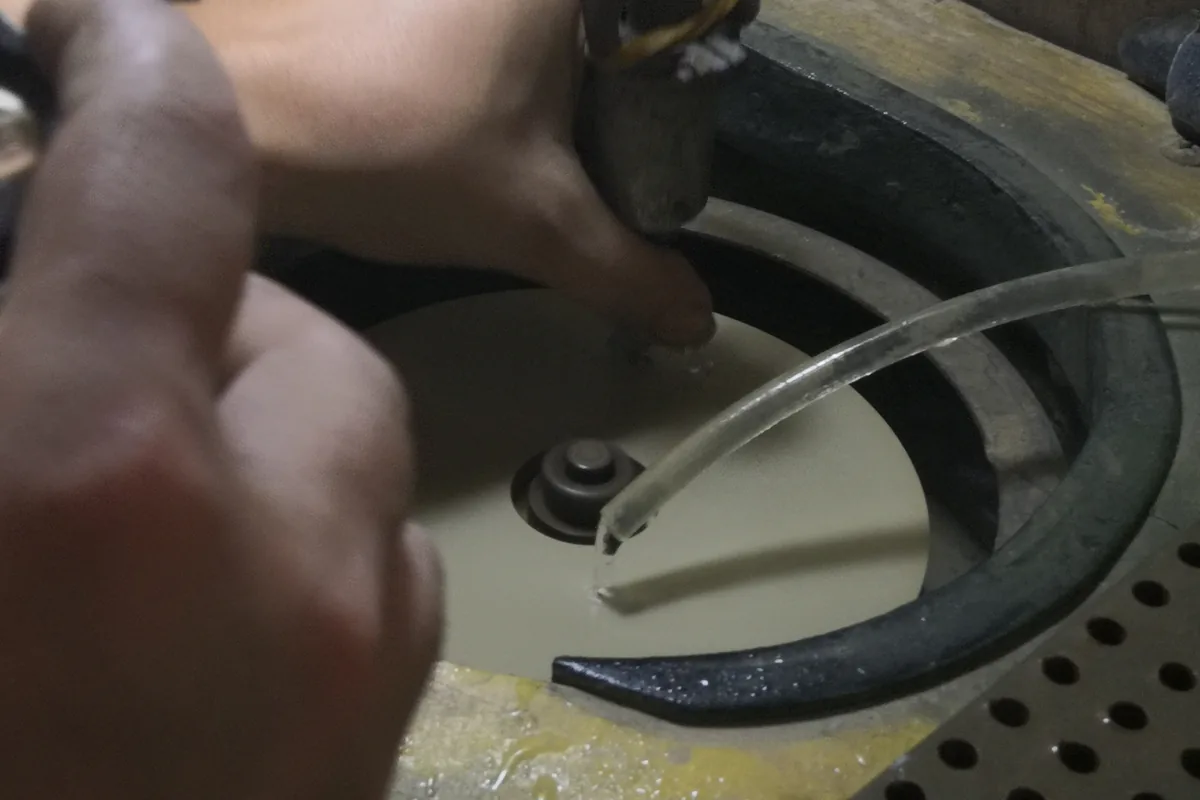
A chain comes off the bench looking dull and gray. It then goes through successive grinding and polishing stages, often in a revolving drum with mild abrasives, until every link is bright. The final operation is attaching the clasp. A spring ring is the common small clasp; a lobster claw is larger, more secure, and easier to operate with one hand. For heavier chains or for clients with limited finger dexterity, we often upgrade to a lobster clasp or add an extender. The clasp is the part that fails first on most "broken" chains, which is why our guide to clasp inspection and replacement exists.
Why thin chains break
People come in with a "snapped" chain and expect it to be a defect. More often it is the math: a 0.5mm box chain is not designed to hold a heavy pendant or to catch on a door handle. Chains fail at the point of highest stress, which is usually the link next to the clasp or a link that was previously kinked and partially fractured. If you want to hang a 10-gram pendant on a chain, size the chain accordingly: we generally match chain weight to pendant weight rather than picking a chain purely for looks. For a complete sizing walkthrough, see our necklace and chain buying guide.
What to look for when you buy
Hold a chain up and run it between two fingers. It should flow smoothly without catching on itself. The links should look uniform: no obviously flattened or squeezed ones. The clasp should snap firmly and stay closed when you tug gently. Hallmarks should be present and legible. And if the price seems too good for a long, fine gold chain, ask whether it is hollow. Hollow chains are light and affordable, but they dent and crush; solid chains cost more and last decades. For a piece you plan to wear every day, the solid chain is the one that earns its keep.
Common questions buyers ask
Why does my chain kink so easily? Thin box and snake chains kink because the links are rigid; once bent, they stay bent. Rope and cable chains are more forgiving. Can a broken chain be repaired? Most can, but a snapped rope chain is often a poor repair because many tiny links have to be re-woven. If the break is at the clasp or at a single link, it is a quick fix. How thick should a chain be for a pendant? For a small pendant under five grams, a 1mm chain is fine. For a heavier pendant, move to 1.5 to 2mm or a rope chain. When in doubt, size up rather than down; a chain that holds the pendant you love is worth a few extra grams. Is gold-filled or gold-plated chain okay? For occasional wear, yes. For daily wear, solid gold wins because plating wears off and reveals the base metal underneath.
Independent background on moissanite — how its hardness and refractive index compare with diamond — is documented in the Wikipedia article on moissanite.
Related reading: Filigree at the Bench: How Fine Wire Jewelry Is Made, Filigree Jewelry Making: How Fine Wire Work Comes to Life, Filigree Jewelry: How Hand-Drawn Wire Lace Is Made.
Frequently Asked Questions
Which chain lengths should I stock first?
16 to 18 inch covers most necklines and gift purchases. Add 20 inch for layering sets and 24 inch for pendant lines.
Are your chains nickel-free and hypoallergenic?
Yes. Sterling silver is 92.5% silver; stainless lines use 316L. Both are nickel-safe for reactive customers when plated correctly.
Can necklaces be personalized?
Laser engraving on pendants and clasps is available from 50 pieces, with 3–5 day turnaround on the engraving step.
What is the bulk lead time?
15–20 days under 500 pieces; 25–30 days for custom pendants or new molds.


