Bridal work moves through a shop in stages that other categories do not. A pair of earrings can be built start to finish by one bench. A bridal set has to clear design approval, casting, fitting between the engagement ring and band, setting, finishing, and a final QC that checks the two pieces against each other. The staged flow is why lead times are measured in weeks, not days.
Stage 0: The approval gate that saves rework
Before the six stages, there is a gate that buyers sometimes skip: the first article. After the first casting is cleaned and before stones are set, the factory sends a finished (unset) sample to the buyer for approval. This is the moment to check proportions, ring size on a mandrel, and the profile of the band against the engagement ring. Approving the first article means the rest of the run is built to the same spec. Skipping it means fifty rings come back with the same proportional error, and the error is now expensive to fix because every ring has to be resized or re-profiled.
Stage 1: Design lock and stone brief
Production does not start until the design is locked. That means a CAD render signed off, a stone spec sheet with dimensions, and a matching note for the wedding band. The band has to be profiled to sit flush against the engagement ring's cathedral or halo; a band designed in isolation will not sit flush, and that is the most common bridal return we see.
At this stage the factory also confirms the metal alloy and karat, the finish (polished, satin, combination), and any engraving. Engraving is done after final polish, so it does not get burnished over.
Stage 2: Casting and preliminary clean-up
The approved CAD (or carved wax) is cast, sprued, and tumbled. At this point the ring is a rough casting with a sprue nub, casting skin, and porosity visible under magnification. The caster trues the shank, checks the ring on a mandrel, and sends it forward only if the dimensions hold. A ring that will not size correctly on the mandrel here goes back before any time is spent on setting.
Stage 3: Fitting the bridal pair together
For a bridal set, the engagement ring and wedding band are fitted to each other at this stage. The band is profiled to the ring's shank so the two sit flush with no gap larger than a sheet of paper. If they are soldered as a unit, that soldering happens now, before setting, so heat does not shock the stones.
Stage 4: Stone setting
Stones are set after the pair fits. Center stones are set first, melee and halo stones second. The setter works from the CAD spec, which calls out prong count, seat depth, and stone size. For pavé work, setting happens before final polish so the setter can clean up any metal that has rolled over a stone edge.
Stage 5: Multi-stage finishing
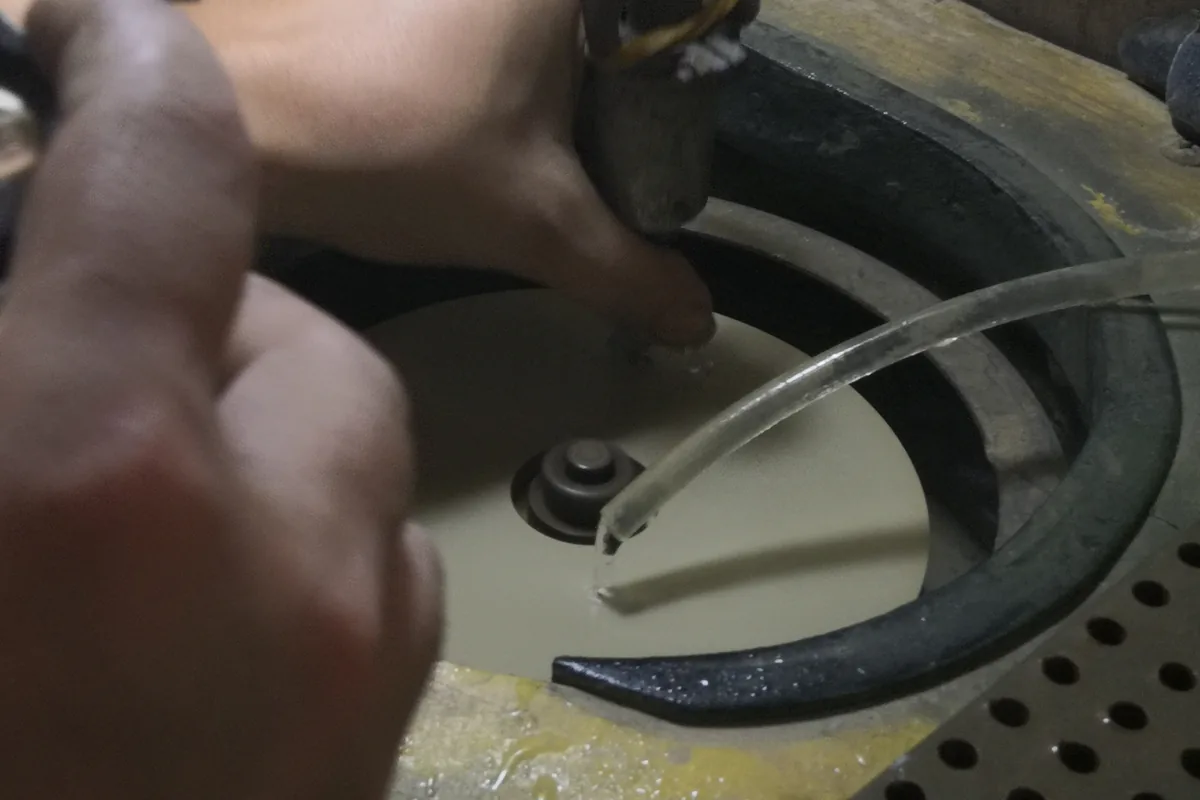
Finishing is where the piece goes from cast-metal to jewelry. It runs through a sequence: pre-polish with a coarse compound, attention to detail under magnification, medium polish, high polish or satin as specified, and a final steam and ultrasonic clean. White gold gets its rhodium plate as the very last step, after every mechanical operation is done, so the plate is not scratched by the next one.
Stage 6: QC, pairing check, and packaging
The final QC checks size on the mandrel, prong tightness under magnification, stone security, finish consistency, engraving depth, and—the step that distinguishes bridal—a side-by-side check of the engagement ring and band. They are then boxed as a set, often with separate boxes if the retailer will sell them separately.
What this means for lead times
A standard bridal set in this flow runs three to five weeks from design lock, with rush possible at a premium. The bottleneck is never casting—it is the fitting and setting stages, where each piece has to wait for the pair. Buyers who order engagement ring and band together avoid a second fitting pass; buyers who order the band later pay a re-fit fee. For ongoing wedding bands programs, placing the engagement ring and the companion band on the same PO is the single most effective way to protect the schedule.
Rush production compresses stages 2 through 5 but cannot compress the approval gates. A rushed bridal order that skips the first-article check saves a week and creates a recall. The honest rush is one that keeps stage 0 and stage 6 intact and speeds the bench between them; the dishonest rush cuts corners on fitting or QC and shows up later as a warranty claim. When a buyer asks for a rush, the first question is which gates are allowed to stay, not how fast the foundry can pour.
The history and conventions of engagement rings are outlined in the Wikipedia entry on engagement rings.
Frequently Asked Questions
What ring sizes can you supply in bulk?
US sizes 5–12 including half sizes. Send a size breakdown with your order and we cast to that curve; comfort-fit inner bands reduce resize requests.
Can I order a mixed size run instead of one size?
Yes. Mixed runs are standard for wholesale: specify quantity per size and we pack and label by size at no extra labor cost.
What is the MOQ for custom ring designs?
50 pieces per design for existing molds; 100–300 pieces when a new mold or CAD model is required.
How should I price rings for retail margin?
Most partners use a 3–4x markup on FOB cost for sterling and 2.5–3x for moissanite solos, which keeps landed cost under 30% of retail.


