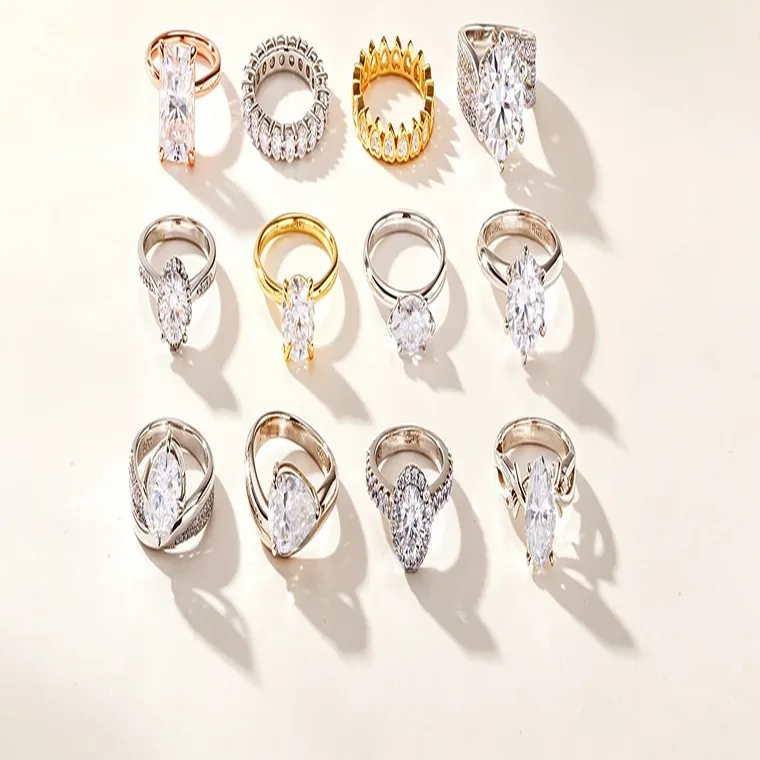
An anniversary band is the ring that appears after a decade, or two, of marriage. It looks like a wedding ring, but it solves a different problem: it has to sit next to an existing engagement ring on the same finger, comfortably, forever. Buying one badly means a band that pinches, spins, or crowds the engagement ring, and buying one well means a piece that becomes part of the daily uniform.

The three main styles
The full eternity band wraps a continuous row of stones all the way around the finger. It is the most romantic option, traditionally given at ten or twenty-five years, and the least practical: it cannot be resized once stones wrap the whole shank, and a chipped stone means rebuilding the band from scratch. Buy a full eternity in the exact finger size, with the buffer of a professional measurement on a day when hands feel normal rather than swollen.
The half eternity band carries stones across the top half only, leaving the bottom plain. This is the most popular choice for good reason: it resizes, it wears flat against the engagement ring, and a damaged stone is a quick bench job. Three-stone anniversary bands, with a center stone flanked by two smaller ones, sit closer to the engagement ring in silhouette and read as a matched set rather than a stacked addition on a separate story.
Matching the metal and the setting
Match the anniversary band to the engagement ring's metal. A yellow gold band next to a white gold engagement ring reads as a separate story; the same metal makes the two rings look designed together. Metal purity matters too: a 14k engagement ring pairs comfortably with 14k or 18k bands, and mixing the two wears fine but costs slightly more in bench labor if a repair ever needs both soldered together.
Setting height is the hidden detail. An engagement ring with a high basket needs an anniversary band with a low profile so the two sit flat together. A band with stones sitting at the same height as the engagement ring's prongs will chip the side stones over years of rubbing. Our guide on matching bands to engagement rings walks through that profile matching in detail, and the wedding band guide covers width and metal choices that apply here as well, since the two decisions share the same language.
Sizing and finger changes
Fingers change over decades. A half eternity band resizes comfortably up or down half a size without drama. A full eternity band does not. Buyers with naturally fluctuating hands, summer swelling, or changes in weight are better served by the half style or a plain milestone band with a single center stone, rather than committing to a size that may not hold.
Stackable anniversary bands, two or three thin rings worn together, are the modern alternative. They mark each milestone with a new thin ring rather than replacing a band, and they are easy to add to as the years go by. Our stackable rings guide shows how thin bands layer without catching, and many couples now build a stack that reads as a visual timeline of years together rather than a single statement piece.
Stones that last
Anniversary bands take the same wear as wedding bands. Diamonds and sapphires are the natural choices; softer stones like emerald or opal belong in pendants and earrings rather than on a finger that already carries a second ring rubbing against them all day. Keep total carat weight modest: a band that is too tall on the knuckle catches on pockets, sweaters, and desks, and ends up in a jewelry box rather than on a hand where it was meant to be seen.
Milestone years and what they usually mean
Tradition ties certain anniversaries to certain materials: the tenth is tin or aluminum, the twenty-fifth silver, the fiftieth gold. In jewelry terms, couples most often choose an anniversary band at the tenth, twentieth, and twenty-fifth years, which is also when a half or full eternity band reads as a deliberate milestone rather than an impulse purchase.
There is no rule that says the band must match the engagement ring's stone. Many couples now choose a colored anniversary band in sapphire, ruby, or emerald that reflects the birth month of a child or the year the couple met, turning the ring into a second story on the same finger. The piece still needs to match in metal and sit flush in profile, but the center stone choice is where the personal meaning usually lives, and that is the detail worth deciding together before the bench begins.
Mark the milestone with a ring that earns its place on the finger. Size it honestly, match it to the engagement ring, and choose a style that survives the next decade the way the first one did. That is the entire point of the piece, and the reason couples keep coming back to the bench for another band every ten years.
The Wikipedia entry on engagement rings gives an independent overview of engagement ring traditions and settings.
Related reading: Men's Jewelry Buying Guide: Styles, Metals, and Fit, The Signet Ring Buying Guide: Styles, Metals, and Engraving That Lasts, Promise Ring Buying Guide: Meaning, Styles, and Budget.
Frequently Asked Questions
How do I verify a factory before placing a bulk order?
Request a production video, business license, export records and a paid sample run. A factory that accepts a 50-piece test order is usually a real manufacturer.
What payment terms do you offer?
30% T/T deposit with the balance against the bill of lading. This protects both sides on first orders and can move to net terms after a track record.
What is your normal reject rate?
3–5% under 10x loupe inspection for cast and set pieces. Defective units are replaced free in the next shipment.
Where is the factory located?
Wuzhou, Guangxi, China—the core lab-grown and moissanite manufacturing cluster. Shipments go via Guangzhou or Shenzhen ports.


